1. INTRODUCTION
Generally, fuzzy controllers are particularly useful in dealing with complex or ill-defined systems that conventional control methods are hard to handle.[1][2][3] The design of the fuzzy controller is based on the characteristics of the system to be controlled and quite frequently the resulting performance of the control system cannot be tuned efficiently.
However, fuzzy control rules, which are the most important factor in FLC, are generally obtained from intuition and experience of the experts, and such rules represented by linguistic rule sets or fuzzy relation. But there is always something difficult to obtain from such control rules and this makes the design of the controller difficult and the response trajectory of the controlled system is unpredictable. Also,
The sliding mode control approach is one of the robust control methods to handle systems with model uncertainties. Systematic design procedures for sliding mode controller are well known and available in the many literature.[4]-[7] Also the sliding mode control is robust the perturbations of parameters and the external disturbances. Besides, the stability analysis can be made by Lyapunov stability theorem.
Recently, many researchers have managed to two techniques together for better performance of the control systems.[8]-[11] Based on this property, fuzzy sliding mode control is actively researched. The key advantages of using fuzzy sliding mode control are no need of exact plant dynamics and no need of linear in the parameter condition on the unknown nonlinearities.
However, Most of the studies are generally restricted in class of affine nonlinear systems.
In this paper, we proposed the indirect adaptive fuzzy model based sliding mode controller to control a nonaffine nonlinear systems. Takagi-Sugano fuzzy system is used to represent the nonaffine nonlinear system and then inverted to design the controller at each sampling time. Also sliding mode component is employed to eliminate the effects of disturbances, while a fuzzy model component equipped with an adaptation mechanism reduces modeling uncertainties by approximating model uncertainties. The proposed controller and adaptive laws guarantee that the closed-loop system is stable in the sense of Lyapunov and the output tracks a desired trajectory asymptotically.
This paper is organized as follows. Section 2 gives problem statements. Section 3 presents Takagi-Sugeno fuzzy model for
nonlinear systems. Then, the proposed fuzzy model based sliding mode control is detailed in section 4. In section 5, The effectiveness for the proposed controller is illustrated with computer simulations. Finally, section 6 presents some conclusions
2. PROBLEM STATEMENT
Consider a single-input single-output(SISO) nonlinear system ( )n ( , (1), , (n1), ) y = f y y y - u
(1)
where
yÎR:
measured output uÎR:
control input ( )i ( 1,2, , )y i= n
:
i-th time derivative of output
y1 ( ) : n
f × R+ ®R
:
unknown nonlinear functionNote that, the nonlinearity f( )× is an implicit function with respective to u . The control objective is to find a control input u such that the output of the system tracks given a desired output trajectory y td( ), with an acceptable accuracy, under the constraint that all signal involved must be bounded.
Let
[
]
(1) ( 1) 1, , ,2 , , , T T n n n x x x éy y y - ù = =ë û Î x R be statevector. Then, we represent system (1) in state model
1 2 2 3 1 ( , ) n x x x x x f u y x = = = = x (2)
Let us consider a desired smooth and bounded trajectory vector given by:
(1) ( 1)
, , , n n
d d d d
Y =éy y y - ùÎ
ë û R (3)
In this case, the controller synthesis can be investigated using the input-output linearization technique [12] when the system under consideration is so that f can be written in an affine nonlinear system:
( , ) ( ) ( )
f xu =a x +b xu (4) where b( ) 0x ¹ for xÎR . n
Indeed, under this assumption the input-output linearization controller can be implemented using the analytical inversion
Design of a Fuzzy Model Based Sliding Mode Control for Nonlinear Systems
Sam-Jun Seo*, and Dong-Sik Kim**
*Department of Electrical & Electronic Engineering, Anyang University, Korea (Tel : +82-31-467-0874; E-mail:[email protected])
**Division of Information and Technology Engineering, Soonchunhyang University, Korea (Tel : +81-41-530-1370; E-mail:[email protected])
Abstract: We proposed the indirect adaptive fuzzy model based sliding mode controller to control a nonaffine nonlinear systems.
Takagi-Sugano fuzzy system is used to represent the nonaffine nonlinear system and then inverted to design the controller at each sampling time. Also sliding mode component is employed to eliminate the effects of disturbances, while a fuzzy model component equipped with an adaptation mechanism reduces modeling uncertainties by approximating model uncertainties. The proposed controller and adaptive laws guarantee that the closed-loop system is stable in the sense of Lyapunov and the output tracks a desired trajectory asymptotically.
of (4), that is: ( ) ( ) ( ) v u a b b = x + x x (5)
where v is a new input.
However, this method cannot be directly applied to non-affine nonlinear system in the form (1), even when the dynamics of f are exactly known. When the analytic inversion of (1) cannot be determined, one must have recourse to numerical inversion techniques which necessary introduce difficulties inherent in iterative algorithms such as
initialization values, convergence conditions and
approximation errors.[13]
Moreover, when the dynamics of (1) are unknown, it is even more difficult to design the linearizing controller. As a alternative, when the plant dynamics are represented by a fuzzy system, the linearizing controller can be designed based on a local inversion of the fuzzy model.
3. TAKAGI-SUGENO FUZZY MODEL FOR
NONLINEAR SYSTEMS
Consider an optimal Takaki-Sugeno fuzzy model of the plant (1), whose rule-base consists of fuzzy rule with singleton consequence in the following form:
1
1 2
1 1
, , , , ( )
If is and and is and is Then n n i i j n n i i i j n f x A x A u B y =q (6) where ik k
A ,k=1, 2, , , is a linguistic term associated with n
variablexk,Bjis a linguistic term associated with variable u
andqi i1 2, , , ,i jn ÎR . When considering k
N linguistic terms for describing xk,i.e. ikÎ =Ik
{
1,2, ,Nk}
,k=1, , and M nis linguistic terms for describing u ,i.e. j JÎ =
{
1, 2, ,M}
, the complete rule-base is composed of1 n k k L N M = =
Õ
rules.Using the singleton fuzzifier, center average defuzzification and product inference engine, the output of the Takagi-Sugano fuzzy model (6) is given by
1 1 2 1 1 1 , , , , 1 1 1 1 ( ) 1 1 1 1 ( ) ( ) ( ) ( ) ˆ ( , , ) ( , ) n n ik j k n n ik j k n N N M n i i i j k B A i i j k n f N N M n k B A i i j k T x u y x u f u u q m m m m h = = = = = = = = éæ öù êç ÷ú è ø ë û = éæ öù êç ÷ú è ø ë û = Q = Q
å åå
Õ
å åå Õ
x x (7)where ( , )h xu is L dimensional vector with its i i1 2, , , ,i jn
element given by 1 2 1 1 1 , , , , 1 1 1 1 ( ) ( ) ( , ) ( ) ( ) ik j k n n ik j k n n k B A k i i i j N N M n k B A i i j k x u u x u m m h m m = = = = = æ ö ç ÷ è ø = éæ öù êç ÷ú è ø ë û
Õ
å åå Õ
x (8) andQ =éq1,1, ,1,1, ,qN N1, 2, ,N Mn, ùÎ L ë û R .The assumption of a strict triangular partitioning of the universe of discourse allows to guarantee that each input variable is described with two linguistic terms at the most[13]. Thus, in the case of a system with n+1 inputs, at the most,
1
2n+ rules are activated for any vector of inputs. The output
generated by the fuzzy system is then reduced to that produced by fuzzy subsystem composed of the 2n+1 fired rules, i.e. the active subsystem.
Let us consider above the explanation. The membership functions of linguistic variables of u have the form of a triangle and are placed evenly throughout the whole defined spaceUuas shown in fig. 1.
min u umax u U 1 B B2 B3 BM-1 BM 1 a a2 a3 a4 aM-2 aM-1 aM ( )u m 2 u U 3 u U M2 u U - M1 u U -1 u U u
Fig. 1 Membership function of the input linguistic variables. The spaceUucan be decomposed into several subspaces
( 1, 2, , 1)
u
Ua a= M- . If u exists in subspace
u
Ua , all
membership function of linguistic variable of u given by 1 1 1 1 ( ) 1 0 m m m m m B m m u a m a a a u u m a a otherwise a m a + + -ì = ï -ï ï -=í = + -ï ï ï î (9)
whereamis a constant satisfying mBm( ) 1am = .
Substituting (9) into (7) and considering that u exists inUua, we have
(
)
(
)
1 1 2 1 2 1 2 1 1 1 2 1 2 1 2 1 , , , , , , , 1 , , , , 1 1 1 1 , , , , , , , , , , , 1 1 1 1 ˆ ( , , ) 1 ( ) 1 ( ) n n n n n n n n n n N N i i i i i i i i i i i N N i i i i i i i i i i i f u a a a a u a a a a a a a a a a a a a x q q x q q + + = = + + = = + Q = -+-å -å
å å
x x x 1 2 ˆ ( , , ) ( , ) ( , ) fa xuQ =ya xQ +ya xQu (10) where 1 2 1 1 , , , 1 1 1 1 1 ( ) ( ) ( ) ik k n n ik k n n k A i i i k N N M n k A i i j k x x m x m = = = = = = æ ö ç ÷ è øÕ
å åå Õ
x (11)Therefore, the fuzzy system can be decomposed by 1
M- fuzzy subsystems which are affine with respect to the control input.
Since ( )f × is unknown, we use Takagi-Sugeno fuzzy system for approximating the unknown function. Suppose that there exists an optimal parameter Q* which is defined by
*
, ˆ
arg min sup ( , , ) ( , )
L xu Uu f u f u QÎ ÎW Î é é ùù Q = ê ë Q - ûú ëx û x x R (12)
where Wxis a compact set in R and L
1 n k k L N M = =
Õ
. Thenthe unknown nonlinear function can be expressed as *
ˆ
( , ) ( , , ) f
f xu =f xuQ +d (13) where fˆ ( , , )xuQ* is the fuzzy approximation of f( , )xu ,
f
d is approximation error such that *
f
d £e where e is * unknown upper bound.
4. FUZZY MODEL BASED SLIDING MODE
CONTROL
We define the tracking error vector e as
(1) ( 1) , , , n T n e e e -é ù =ë û Î e R (14) where e= -y yd.
The VSC design consists in achieving the following steps: 1) Design a switching manifold S in the state space to
represent a desired system dynamics, which is of lower order than the dimension of the given plant; S is defined by
{
n ( ) 0}
S= Îe R se = (15) 2) Design a variable structure control
0 ( ) 0 u when s u t u when s + -ì > ï = í < ïî (16)
such that any state x out side the switching surface is driven to reach this surface in finite time, that is the condition s=0 is satisfied in finite time.
To specify the reaching condition a Lyapunov function is used. Let the Lyapunov function candidate be defined as:
2 1 ( )
2
V t = s (17) Then the reaching condition for existence of the sliding mode motion of the system under consideration is given as follows:
( ) 0 n
V t =ss< for xÎR -S (18) The control of the dynamics of a VSC system in the reaching mode may be made possible by specifying the dynamics of the switching function s . More specifically, the dynamics of the switching function s are described by a differential equation of the form:
sgn( ) 0
s= -K s K> (19) Note that we no longer to verify the reaching condition because it is inherent in the differential equation of the function s . By specifying the dynamics of the function s , we can predetermine the speed with which the system state approaches the switching manifold.
Define the switching surface
( 1) ( 2) 1 1 0 0 n n n s e - k e - k e k edt -= + ++ +
ò
= (20)When the coefficients k ii, =0, ,n-1 are chosen such that the following polynomial is Hurwitz
( ) 1 1 1 0 0 n n n s k s- k s k -+ + + + = (21) then the tracking error ( )e t ®0, as t® ¥.
Differentiating of s with respect to t , yields
( ) ( 1) 1 1 0 1 ( ) ( ) ( ) 0 1 ( ) ( ) 0 ( , ) n n n n n n i d i i n n i d i i s e k e k e k e x x k e f u x k e -= -= = + + + + = - + = - +
å
å
x (22)Since ( )f × is unknown, we substitute (13) into (22) and have as following equations 1 * ( ) ( ) 0 ˆ ( , , ) n n i f d i i s f u d x - k e = = x Q + - +
å
(23) where fˆ ( , , )xuQ = Q* *Th( , )xu .With easy (23) can be expressed as
1 ( ) ( ) 0 ˆ ( , , ) n n i T ( , ) f d i i s f u d x - k e h u = = x Q + - +
å
- Q x (24) where Q = Q - Q *.The main objective in this section is to design an adaptation law for q , so that fuzzy system can approximate unknown
nonlinear function and to design sliding mode control law such that the tracking error converges to zero.
Consider the Lyapunov function candidate
2 2 1 1 1 2 2 2 T V s q e e g g = + Q Q + (25)
where g and q g are positive constants, e e e e= - *. Differentiating (25), we have 1 ( ) ( ) 0 1 1 ˆ ( ( , , ) ) 1 1 ( , ) T n n i d i f i T V ss s f u x k e s s u q e q q e ee g g d g h ee g g -= = + Q Q + = Q - + + é ù + Q Q -ë û+
å
x x (26)We consider the following sliding mode control input in
order to eliminate the part ( ) 1 ( )
0 ˆ ( ( , , ) n n i) d i i f u x - k e = Q - +
å
x of (26) using (10). 1 ( ) 1 0 2 1 ( , ) ( , ) n n i d i s u i u a x k e u Ua a y y -= æ ö = ç- Q + - + ÷Î Q è xå
ø x (27)where usis switching input.
And we design the adaptive law for updating parameter vector
Qas follows ( , ) s u q g h Q = x (28) Substituting (27) and (28) into (26), we obtain
* 1 1 1 f s f s s V s su s su s su e e e d ee g d ee e ee g g = + + £ + + £ + + (29)
If the switching input usis taken as sgn( ) s u = -e s (30) then (29) is given by 1 ( ) V e s e e e g g £ - (31) If we choose the adaptation law for the upper bound of approximation error as
s
e
e g= (32) then V£0 which ensures the closed-loop stability and the convergence of the tracking error to zero.
5. COMPUTER SIMULATIONS
We apply the proposed fuzzy model based sliding mode control algorithm given in the previous section to the following nonlinear equation
1 2 2 3 2 2 1 2 1 0.15 0.1(1 ) sin(0.1 ) x x x x u x u u y x = = + + + + = (33)
It appears clearly that the above nonlinear system is non-affine. In this case, a feedback linearization controller based on an analytic inversion cannot be directly implemented.
As an alternative method, a fuzzy model based sliding mode controller is designed with a local inversion of a fuzzy model.
In this simulation example, the control objective is to determine u so that the output y t( ) of the closed-loop systems follows the desired reference output given by
( ) sin( ) cos(0.5 )
d
y t = t + t (34) The initial state isx(0)=
[
0.6,0.5]
T. The initial parameters for fuzzy model are randomly selected and the switching surface is chosens e= + 4e+4ò
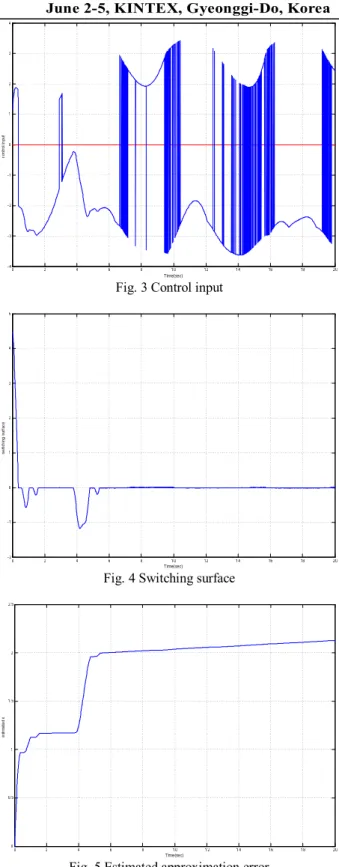
edt=0, gf =9, ge =0.1. The universe of discourse of inputs x1 , x2 and u are respectively [-2,2],[-2,2] and [-4,4]. In order to determine the control input u so that the fuzzy output follows the given desired trajectory, the inversion principle is applied, at each sampling time, to the 5 subsystems that can be activated.The simulation results of the application of the proposed control design approach are depicted in from Fig. 2 to Fig. 5. Fig.2 shows that the output y tracks the reference input yd
effectively and Fig. 3 illustrates the history of the control input
u . In Fig. 4 and Fig. 5, we display respectively response of
switching surface and the estimated approximation error. The results of the simulation show the proposed controller have satisfactory transient performance and small tracking error.
6. CONCLUSIONS
In this paper, we proposed the indirect adaptive fuzzy model based sliding mode controller to control nonaffine nonlinear systems. Takagi-Sugano fuzzy systems is used to represent the nonaffine nonlinear system and then inverted to design the controller at each sampling time. Also sliding mode component is employed to eliminate the effects of disturbances, while a fuzzy model component equipped with an adaptation mechanism reduces modeling uncertainties by approximating model uncertainties. The proposed controller and adaptive laws guarantee that the closed-loop system is stable in the sense of Lyapunov and the output tracks a desired trajectory asymptotically. 0 2 4 6 8 10 12 14 16 18 20 -2 -1.5 -1 -0.5 0 0.5 1 1.5 2 Time(sec) Desired output yd System output y
Fig. 2 system output and desired output
Fig. 3 Control input
Fig. 4 Switching surface
Fig. 5 Estimated approximation error
REFERENCES
[1] L. A. Zedeh, “Fuzzy sets”, Information and Control, vol. 8, pp. 338-353, 1965.
[2] L. A. Zedeh, , “Fuzzy algorithms”, Information and
Control, vol. 12, pp. 94-102, 1968.
[3] D. Driankov, et al., An Introduction to Fuzzy Control, Springer-Verlag, New York, 1993.
nonlinear multivariable systems: a tutorial”,
Proceedings of the IEEE, vol. 76, no. 3, pp.212-232,
1988.
[5] K. K. D. Young, “Controller design of a manipulator using theory of variable structure systems”, IEEE
Trans. Syst. Man and Cybern., vol. 8, no. 12, pp.
101-109, 1977.
[6] J. J. Soutine and S. S. Sastry, “Tracking control of nonlinear systems using sliding surfaces with applications to robot manipulators”, Int. Journal of
Control, Vol. 38, pp.465-492. 1983.
[7] U. Itkis, , Control Systems of Variable Structure, John Wiley & Sons, New York, 1976.
[8] R. Palm, “Sliding mode fuzzy control”, Proceedings
of the IEEE International Conference on Fuzzy Systems, San Diego, CA, pp.519-526, 1992.
[9] R. Palm, “Robust control by fuzzy sliding mode”,
Automatica, Vol. 30, no. 9, pp. 1429-1437, 1994.
[10] L. X. Wang, “Stable adaptive fuzzy controllers with application to inverted tracking” IEEE Trans. Fuzzy
Systems, Vol. 26, no. 5, pp. 677-691, 1996
[11] S. W. Kim and J. J. Lee, “Design of a fuzzy controller with sliding surface”, Fuzzy Sets and
Systems, Vol. 71, pp. 359-367, 1995.
[12] A. Isidori, Nonlinear Control System, New York, Springer Verlag, 1989.
[13] R. Boukezzoula, S. Galichet and L. Foully, “Fuzzy Adaptive linearizing control for nonaffine systems”,
The IEEE International conference on Fuzzy Systems,