Apolipoprotein E (ApoE) is an important substance responsible for the lipoprotein metabolism and the transportation of lipid and known to play an important role in the body's physiological and pathological processes. ApoE is synthesized mainly in the liver, but is also found in other tissues such as the brain, kidney, and spleen. In peripheral tissues, it is mainly produced by liver and macrophages and mediates cholesterol metabolism and in the central nervous system, it is mainly produced by hepatic stellate cells and transports the cholesterol to the nerve cells via a member of the ApoE receptor of low density lipoprotein receptor gene family. The importance of ApoE was recognized for the
first time in lipoprotein metabolism and cardiovascular disease. Recently, it has been studied for its role in various biological processes associated with Alzheimer's disease and immune regulation. ApoE gene is located in a cluster made apolipoprotein C1 and C2 on Chromosome 19, with four exons and three introns composed of a total of 3,597 base pairs. ApoE is activated by the X receptor and nuclear receptors to form heterodimers with peroxisome proliferator-activated receptor ã and retinoid X receptor1). ApoE gene has three type of single allele, E2, E3, E4 and six genotypes, E2/E2, E2/E3, E2/E4, E3/E3, E3/E4, E4/E42,3). ApoE gene shows polymorphism and has three subtypes, ApoE2 (cys 112, cys 158), ApoE3 (cys112, arg158), and ApoE4 (arg112, arg158)4). E2 is found in approximately 7% of the population5) and this type of apoprotein has a weak affinity for surface receptors compared to E3 and E4, and associated with atherosclerosis. E3 is found in about 79 % of the population and regarded as "neutral" ApoE genotype. E4is found in about 14% of the population and related with
Real-Time Quantitative Polymerase Chain Reaction for Apolipoprotein E genotyping
Young Hwan Park
1, Young Ree Kim
2,3, Sun Hyung Kim
2, Sung Ha Kang
2 1From medical course in Jeju National University School of Medicine,2Jeju National University School of Medicine, 3Jeju National University Institute of Medical Science, Jeju, Korea
(Received April 20, 2015; Revised April 27, 2015; Accepted May 4, 2015)
Background : Apolipoprotein E (ApoE) is an important substance responsible for the lipoprotein metabolism and the transportation of lipid and known to play an important role in the body's physiological and pathological processes. Recently, ApoE genotyping test has been applied to the field of diagnostic methods for predicting high risk of Alzheimer's disease, cardiovascular diseases, as well as new diseases such as immune regulation disorders. Therefore, a faster and more accurate ApoE genotyping test is required for the prevention of related disease and the general public health.
Methods : We evaluated 220 serum specimens using two kinds of assays: one-stop Real-Q ApoE genotyping (BioSewoom, Seoul, Korea) and Seeplex ApoE ACE genotyping (Seegene, Seoul, Korea). The results were finally confirmed using sequencing as the reference. Statistical analysis was performed for the concordance rates between each assay and sequencing and the sensitivity and specificity were calculated with their 95% confidence intervals.
Results : Sequencing results of 220 DNA samples showed 1 case of E2/E2, 139 of E3/E3, 9 of E4/E4, 17 of E2/E3, 4 of E2/E4, 50 of E3/E4. The concordance rate between One-step Real-Q ApoE genotyping and sequencing was 100% (220/220), and that between Seeplex ApoE ACE genotyping and sequencing was 99.5% (219/220). Both sensitivity and specificity of One-step Real-Q ApoE genotyping for every genotypes was 100%. The sensitivities and specificities of Seeplex ApoE ACE genotyping were almost 100%, with two exception: 99.3% sensitivity in E3/E3 and 99.5% specificity in E2/E2.
Conclusions : The performances of One-step Real-Q ApoE genotyping and Seeplex ApoE ACE genotyping were comparable overall. However, the former showed better sensitivity and specificity comparable with those of sequencing. Hence, One-step ApoE genotyping could be a faster and more accurate option for ApoE genotyping. (J Med Life Sci 2015;12(1):30-34)
Key Words
: One-step ApoE Genotyping, Sequencing, Concordance rateIntroduction
Correspondence to : Young Ree Kim
Jeju National University, School of Medicine and Department of Laboratory Medicine, Jeju National University Hospital 1753-3, Ara-1Dong, Jeju-si, Jeju Special Self-Governing Province, Korea 690-716
E-mail : [email protected]
atherosclerosis6), Alzheimer's disease7), cognitive impairment8), reduced hippocampal volume9), the rapid disease progression in multiple sclerosis10) and ischemic brain there vascular disease11). As genotypes, E2/E2 homozygote is observed in more than 90% of patients with type III hyperlipoproteinemia and E4/E4 homozygote has been known as a major risk factor for coronary heart disease and Alzheimer's disease. Recently, ApoE genotyping test has been applied to the field of diagnostic methods for predicting high risk of Alzheimer's disease, cardiovascular diseases, as well as new diseases such as immune regulation disorders. Therefore, a faster and more accurate ApoE genotyping test is required for the prevention of related disease and the general public health. Many laboratories use a PCR-RFLP (Polymerase Chain Reaction-Restriction Fragment Length Polymorphism) method12) and PCR-SSP (PCR-Sequencing Specific Primer) method13). The former is a time-consuming and may have incomplete action or the read error of the restriction enzymes electrophoresis, the latter, there is a limit to the number of samples that can be tested at a time. There are the exact method such as capillary electrophoresis method14) and PCR-Sequencing Method15), however, they have costly disadvantage. Therefore, we aim to apply the real-time quantitative polymerase chain reaction for ApoE genotyping, while relatively reducing the time and cost of obtaining accurate test results.
Study population and Design
We evaluated 220 serum specimens and the biospecimen and data used in this study were provided by the Biobank of Jeju National University Hospital, a member of Korea Biobank Network, which is supported by the Ministry of Health and Welfare.All samples obtained were from Korean individuals and were collected together with written informed consent according to protocol approved by the Institutional Review Board of the Jeju National University Hospital. We performed three kinds of assays: Real-Q ApoE genotyping (BioSewoom, Seoul, Korea) and Seeplex ApoE ACE genotyping (Seegene, Seoul, Korea). The results were finally confirmed using Sequencing (BigDyeⓇTerminator v1.1 Cycle Sequencing Kit,
Applied Biosystems) as the reference.
Nucleic acid extraction and ApoE genotyping
Genomic DNA was extracted from EDTA-anticoagulated whole blood using Quick Gene (Kurabo, Co, Japan) according to the manufacturer’s instructions. For the multiplex PCR
based on the DPO (Dual Primer Oligo) technology, the Seeplex ApoE ACE genotyping Assay (Seegene, Seoul, Korea), 17μL of master mix were remixed with 3μL of genomic DNA. After a pre-heating step at 94℃ for 15 minutes, 35 reaction cycles (denaturation at 94℃ for 30 seconds, annealing at 65℃ for 30 seconds, extension at 72℃ for 60 seconds), and post-step at 72℃ for 10 minutes using MyCycler Thermal Cycler System (Bio-Rad Laboratories, CA, USA ).
For the one-stop Real-Q ApoE genotyping assay, we mixed 21μL of master mix (including 17.5μL of reaction mixture, 3μL of a primer mixture for codon 112 and 158, and 0.5μL of sterile water) with 4μL of genomic DNA. After pre-heating step at 95℃ for 10 minutes, 40 reaction cycles (denaturation at 95℃ for 20 seconds, annealing at 60℃ for 30 seconds, and extension at 72℃ for 30 seconds) which were performed on the 7500 Real-Time PCR System (Applied Biosystems, CA, USA) and the results were analysed by the standard curve method.
For sequencing analysis, an aliquot of 2μL of the amplicon product from above reaction was used with BigDyeⓇ Terminator v1.1 Cycle Sequencing Kit (Applied Biosystems, CA, USA). The amplified fragments were analyzed using an ABI PRISMⓇ 377 Analyzer (Applied Biosystems) and Chromas v 2.33 software and analyzed using the Basic Local Alignment Search Tool (BLAST) from The National Center for Biotechnology Information (http://www.ncbi.nlm.nih.gov/BLAST).
Statistical analysis
The concordance rates between each ApoE genotyping assay and sequencing were obtained. For each assay, sensitivity and specificity were calculated with their 95% confidence intervals (CI). The proportions between the two ApoE genotyping assays were compared using chi-squared test. Statistical analysis was performed using Analyse-it Software (Analyse-it Software, Ltd, Leeds, UK) and MedCalc Software (version 12.1.4, MedCalc Software, Mariakerke, Belgium). P values of equal to or less than 0.05 were considered statistically significant. Statistical analysis was performed for the concordance rates between each assay and sequencing and the sensitivity and specificity were calculated with their 95% confidence intervals.
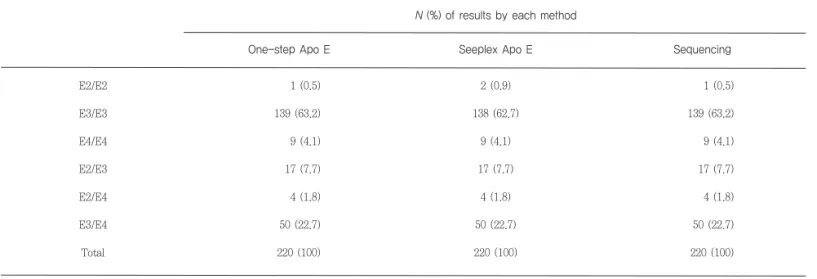
Sequencing results of 220 DNA samples showed 1 case of E2/E2, 139 of E3/E3, 9 of E4/E4, 17 of E2/E3, 4 of E2/E4, 50 of E3/E4 (Table 1, 2). The concordance rate between One-step Real-Q Ap E genotyping and sequencing was 100% (220/220), and that between Seeplex ApoE ACE
Material and Methods
genotyping and sequencing was 99.5% (219/220) (Table 3, 4). Both sensitivity and specificity of One-step Real-Q ApoE genotyping for every genotypes was 100%. The sensitivities
and specificities of Seeplex ApoE ACE genotyping were almost 100%, with two exception: 99.3% sensitivity in E3/E3 and 99.5% specificity in E2/E2.
Table 1. Results of two Apo E genotypings
Cases Cases One-step Apo E Apo E geneotype seeplex Apo E 1 139 9 17 4 50 220 E2/E2 E3/E3 E4/E4 E2/E3 E2/E4 E3/E4 Total 2 138 9 17 4 5 220
Table 2. Results of Sequencing
Apo E geneotype E2/E2 E3/E3 E4/E4 E2/E3 E2/E4 E3/E4 Count 1 139 9 17 4 50 112 TGC + + -+ + + 112CGC -+ -+ + 158TGC + -+ + -158CGC -+ + + + + Sequencing E2/E2 E3/E3 E4/E4 E2/E3 E2/E4 E3/E4
Table 3. Results of Apo E genotypes by two PCR assays and sequencing
E2/E2 E3/E3 E4/E4 E2/E3 E2/E4 E3/E4 Total
N (%) of results by each method
One-step Apo E Seeplex Apo E Sequencing
1 (0.5) 139 (63.2) 9 (4.1) 17 (7.7) 4 (1.8) 50 (22.7) 220 (100) 2 (0.9) 138 (62.7) 9 (4.1) 17 (7.7) 4 (1.8) 50 (22.7) 220 (100) 1 (0.5) 139 (63.2) 9 (4.1) 17 (7.7) 4 (1.8) 50 (22.7) 220 (100)
Multiplex AS-PCR ApoE Genotyping assay is known to be also rapid, reliable, simple method, but, it has a disadvantage leading to incorrect genotyping due to the hinded amplification in the case of unexpected nucleotide polymorphisms or mutations located in the DNA template or adjacent to the 3′end of the primer-binding site17). By Korean Institute of Genetic Testing Evaluation in 201318), 41 institutions are performing ApoE genotyping and Seeplex ApoE ACE Genotyping (Seegene, Seoul, Korea) was most commonly used (in 11 Korean institutions, 26.8%), followed by the Bio-Core ApoE genotyping PCR KIT (BioBio-Core, Seoul, Korea), which was used by 7 institutions (17.1%). But, genotyping errors can still occur due to polymorphisms near codons 112 and 158 in the human ApoE gene, though ApoE genotyping may appear to be uncomplicated and a relatively easy test to perform17).
The performances of One-step Real-Q ApoE genotyping and Seeplex ApoE ACE genotyping were comparable overall, However, the formershowed better sensitivity and specificity comparable with those of sequencing. The Real-Q ApoE genotyping kit yielded correct genotyping results for all ApoE genotypes and provided concordant results with the sequencing results. Hence, One-step Real-Q ApoE genotyping
could be a faster and more accurate option for ApoE genotyping.
1) Chawla A, Boisvert WA, Lee CH, Laffitte BA, Barak Y, Joseph SB, et al. "A PPAR gamma-LXR-ABCA1 pathway in macrophages is involved in cholesterol efflux and atherogenesis". Mol Cell 7 2001;1:161–71.
2) Singh PP, Singh M, Mastana SS. "APOE distribution in world populations with new data from India and the UK". Annals of Human Biology 2006;33(3):279–308. 3) Eisenberg DTA, Kuzawa CW, Hayes MG. "Worldwide
allele frequencies of the human apoliprotein E (APOE) gene: climate, local adaptations and evolutionary history". American Journal of Physical Anthropology 2010;143(1):100–11.
4) Ghebranious N, Ivacic L, Mallum J, and Dokken C. "Detection of ApoE E2, E3 and E4 alleles using MALDI-TOF mass spectrometry and the homogeneous mass-extend technology". Nucleic Acids Res 2005;33(17):e149. 5) Alzheimer Research Forum: Meta-Analyses of
apolipoprotein E AD Association Studies.
6) Mahley RW (April 1988). "Apolipoprotein E: cholesterol transport protein with expanding role in cell biology". Science 240(4852):622–30.
7) Corder EH, Saunders AM, Strittmatter WJ, Schmechel
Discussion
References
Table 3. Results of Apo E genotypes by two PCR assays and sequencing* Concordance rate(%) = (number of corresponding results by both mothods/number of corresponding results by either methods) х 100
Apo E, Apolipoprotein E, PCR, Polymerase Chain Reaction, N, Number
E2/E2 E3/E3 E4/E4 E2/E3 E2/E4 E3/E4 Total
N (%) of Concordence among the method One-step Apo E vs Seeplex Apo E One-step Apo E vs Sequencing Seeplex Apo E vs Sequencing 1/2 (50.0) 138/139 (99.3) 9/9 (100) 17/17 (100) 4/4 (100) 50/50 (100) 220/222 (99.1) 1/1 (100) 138/138 (100) 9/9 (100) 17/17 (100) 4/4 (100) 50/50 (100) 220/222 (99.1) 1/2 (50.0) 138/139 (99.3) 9/9 (100) 17/17 (100) 4/4 (100) 50/50 (100) 220/222 (99.1)
DE, Gaskell PC, Small GW, et al. "Gene dose of apolipoprotein E type 4 allele and the risk of Alzheimer's disease in late onset families". Science 1993;261(5123):921–3.
8) Deary IJ, Whiteman MC, Pattie A, Starr JM, Hayward C, Wright AF, et al. "Cognitive change and the APOE epsilon 4 allele". Nature 2002;418(6901):932.
9) Farlow MR, He Y, Tekin S, Xu J, Lane R, Charles HC. "Impact of APOE in mild cognitive impairment.". Neurology 2004;63(10):1898–901.
10) Chapman J, Vinokurov S, Achiron A, Karussis DM, Mitosek-Szewczyk K, Birnbaum M, et al. "APOE genotype is a major predictor of long-term progression of disability in MS". Neurology 2001;56(3):312–6. 11) McCarron MO, Delong D, Alberts MJ. "APOE genotype
as a risk factor for ischemic cerebrovascular disease: a meta-analysis". Neurology 1999;53(6):1308–11.
12) Zivelin A, Rosenberg N, Peretz H, Amit Y, Kornbrot N, Seligsohn U. Improved method for genotyping apolipoprotein E polymorphisms by a PCR-based assay simultaneously utilizing two distinct restriction enzymes. Clin Chem 1997;43:1657–9.
13) Pantelidis P, Lambert-Hammill M, Wierzbicki AS. Simple sequence-specific-primer-PCR method to identify the
three main apolipoprotein E haplotypes. Clin Chem 2003;49:1945–8.
14) Somsen GW, Welten HT, Mulder FP, Swart CW, Kema IP, de Jong GJ. Capillary electrophoresis with laser-induced fluorescence detection for fast and reliable apolipoprotein E genotyping. J Chromatogr B: Anal Technol Biomed Life Sci 2002;775:17–26.
15) Srinivasan JR, Kachman MT, Killeen AA, Akel N, Siemieniak D, Lubman DM. Genotyping of apolipoprotein E by matrix-assisted laser desorption/ionization timeof-flight mass spectrometry. Rapid Commun Mass Spectrom 1998;12:1045–50.
16) Hwang SH, Oh HB, Chae JM, Seo MK, Jung SY, Choi SE et al. Development of a Web-based Program to Calculate Sample Size for Evaluating the Performance of In Vitro Diagnostic Kits. Korean J Lab Med 2006;26:299-306.
17) Park CH, Lee ST, Ki CS, Kim JW. Discrepancy in Genotyping of Apolipoprotein E between Allele-Specific PCR and Fluorescence Resonance Energy Transfer or Sequencing. Korean J Lab Med 2010;30:325-8.
18) Participant Summary Report. Molecular Genetic Tests 2013-2. Korean Institute of Genetic Testing Evaluation.