http://www.medicinalcrop.org
http://dx.doi.org/10.7783/KJMCS.2020.28.6.445
산삼 부정배양근의 진세노사이드 함량 증진과 성분 변환
김철중
1· 최재후
2· 오영선
3· 성은수
4· 임정대
5· 유창연
6· 이재근
7†Enhancement and Conversion of Ginsenoside Contents in
Cultured Wild Ginseng Adventitious Root
Chul Joong Kim
1, Jae Hoo Choi
2, Yeong Seon Oh
3, Eun Soo Seong
4, Jung Dae Lim
5,
Chang Yeon Yu
6and Jae Geun Lee
7†서
언
산삼 (Panax ginseng C. A. Meyer)의 유효성분 진세노사 이드는 triterpenoid 화합물로 dammarane과 oleanane으로 구분 된다. 이중 dammarane은 탄소 3, 20 번에 수산기 (hydroxyl group)가 결합된 protopanaxadiol (PPD)과 탄소 3, 6, 20 번 에 수산기가 결합된 portpanaxatriol (PPT) 계열로 나뉘며, 현 재까지 30 여종 이상의 주요 진세노사이드가 보고되었다 (Lee et al., 2013b; Park, 2019). 진세노사이드 약리작용은 항암, 면역 활성 증강, 혈압강하, 항염증 및 항산화 (Seo et al., 2019), 인지능력 및 기억력개 선 (Yeo et al., 2012; An et al., 2019), 치매예방 (Kim et al., 2018), 혈당감소 (Zhou et al., 2019), 주름개선 (Shin et al., 2017), 발기부전 (Liu et al., 2015) 등이 보고되고 있다.
식품공전에 수록된 Panax ginseng C. A. Meyer은 수삼 (水 蔘), 백삼 (白蔘), 홍삼 (紅蔘), 흑삼, 야산삼 (野山蔘), 별직삼 (別直蔘), 산양삼 (山養蔘), 태극삼 (太極蔘), ginseng, Korean ginseng으로 구분되고 있으며, 식품·건강기능식품·생약의 주원 ABSTRACT Received: 2020 September 16 1st Revised: 2020 November 4 2nd Revised: 2020 November 24 3rd Revised: 2020 December 1 Accepted: 2020 December 1 This is an open access article distributed under the terms of the Creative Commons Attribution Non-Commercial License (http:// creativecommons.org/licenses/ by-nc/3.0/) which permits unrestricted non-commercial use, distribution, and reproduction in any medium, provided the original work is properly cited.
Background: Culturing wild ginseng adventitious root using plant factory technology provides genetic safety and high productivity. This production technology is drawing attention in the fields of functional raw materials and product development. The cultivation method using elicitors is key technology for controlling biomass and increasing secondary metabolites.
Methods and Results: Elicitor treatments using methyl jasmonate, pyruvic acid, squalene, β-sis-tosterol were performed to amplify total ginsenosides (Rb1, Rc, Rb2, Rb3, and Rd) of cultured wild ginseng adventitious root. Thereafter, fermentation and steaming processes were performed to convert total ginsenosides into minor molecular ginsenosides (Rg3, Rk1, and Rg5). The result indi-cated that methyl jasmonate minimizes the reduction in fresh weight of cultured wild ginseng adventitious root and maximizes total ginsenosides (sum of Rb1, Rc, Rb2, Rb3, and Rd). Ginseno-side conversion results showed a maximum degree of conversion of 131 ㎎/g.
Conclusions: In this study, we demonstrated that the optimal elicitor treatment method increased the content of total ginsenosides, while the steaming and fermentation processing method increased the content of minor ginsenosides.
Key Words: Panax ginseng C. A. Meyer, Cultured Wild Ginseng Adventitious Root, Elicitor, Gin-senoside, Lactic Acid Bacteria, Methyl Jasmonate
†Corresponding author: (Phone) +82-33-258-6801 (E-mail) [email protected]
1㈜화진바이오코스메틱 과장 / Manager, Research Institute of Biotechnology, HwajinBioCosmetic, Chuncheon 24232, Korea. 2㈜화진바이오코스메틱 주임 / Assistant manager, Research Institute of Biotechnology, HwajinBioCosmetic, Chuncheon 24232, Korea. 3㈜화진바이오코스메틱 과장 / Manager, Research Institute of Biotechnology, HwajinBioCosmetic, Chuncheon 24232, Korea. 4수원여자대학교 약용식물과 교수 / Professor, Department of Medicinal Plant, Suwon Women’s University, Suwon 16632, Korea.
5강원대학교 바이오헬스융합학과 교수 / Professor, Department of Bio-Health Convergence, Kangwon National University, Chuncheon 24341, Korea. 6강원대학교 생물자원과학과 교수 / Professor, Department of Bio-Resource Sciences, Kangwon National University, Chuncheon 24341, Korea. 7㈜화진바이오코스메틱 소장 / Director, Research Institute of Biotechnology, HwajinBioCosmetic, Chuncheon 24232, Korea.
료 인삼은 육종연한이 길고, 연작이 불가능하며, 고온피해 방지 를 위한 해가림막 설치 등의 경제성을 고려해야 되고, 병충해 예방을 위한 농약살포와 토양에 잔류하는 중금속의 위해성 문 제를 야기하고 있다 (Park et al., 2012; Jang et al., 2019).
토양재배 문제점과 유용성 물질 생산성을 개선하기 위한 방 법으로 약용식물을 기내에서 대량 배양하는 조직배양 분야가 발전하였고, 희귀약용식물의 보급을 위한 기내도입과 순화를 통한 육묘배양 (Cho et al., 2012), LED 및 생장조절제 처리 를 통한 식물의 특정부위 및 캘러스 배양 기술이 실용화 되었 다 (Thomas, 2019). 이중 산삼의 모세포를 기내도입한 후, 부 정근 배양을 이용한 산삼 부정배양근 진세노사이드 생산기술 은 인삼 모상근 배양에 비하여 유전적 안전성과 높은 유용성 물질 생산성을 가지고 있어 기능성 식품 개발에 활용되고 있 다 (Song et al., 2005; Liang et al., 2019).
Elicitor는 식물의 방어기능을 자극하여 2차 대사산물의 생산 을 향상시킬 수 있는 가장 효과적인 방법 중 하나로 알려져 있고, 식물의 병원균 대응 방어기작 phytoalexin, phytoncide와 타식물 대응 방어기작 allelopathy, allelopathic으로 구분 된다 (Ramirez-Estrada et al., 2016). 대부분의 생물학적인 elicitor 는 세포막에 결합된 특정 수용체에 의해 인식되며, 유전적 특 성과 생리학적 상태에 의해서 조절되고 (Mcdowell and Woffenden, 2003; Bacete et al., 2018), 외부요인에 대한 식 물의 방어 메커니즘을 바탕으로 한 식물호르몬 처리에 연구적 초점을 두고 있다 (Santner and Estelle, 2009).
20세기 초에 발견된 옥신 (auxin), 앱시스산 (abscisic acid), 사이토키닌 (cytokinin), 지베렐린 (gibberellin)과 에틸렌 (ethylene)을 포함하여 브라시노스테로이드 (brassinosteroid), 자 스모네이트 (jasmonate), 살리실산 (salicylic acid), 스트리고락 톤 (strigolactone) 등이 발견되었고 (Chappell, 1995; Uggla et al., 1996), 옥신의 Aux/IAA-ARF 신호 전달경로를 통한 안토시아닌 생합성 조절효과 등 식물 호르몬을 활용한 방어물 질 관련 메커니즘 관련 연구의 중요성이 입증되고 있다 (Wang et al., 2018). 병원균 대응을 위해 식물호르몬이 2차 대사산물을 이용하는 대표적인 경우가 사포닌 화합물이며, Pollier 등 (2013)은 콩과 식물인 Medicago truncatula에서 자스모네이트가 ERAD (Endoplasmic reticulum associated degradation) 시스템과 3-hydroxy-3-methylglutaryl-CoA 환원효소에 대한 작용을 통하여 terpene의 전구체 isopentenyl diphosphate의 공급에 속도 조절 을 확인하였고, Han 등 (2012)은 식물 생장조건에서 인위적으 로 Cytochrome P450 CYP716A53v2 효소를 조절하여 진세 노사이드 전구물질인 protopanaxadiol의 합성에 따른 진세노사 이드 함량증진 연구결과를 보고하였다. 일반적인 진세노사이드는 고분자 형태로 947.15 - 1109.29 (Molecular Weight, M. W.)의 분자량을 갖고 있고, 3 개 이
상의 단당류 (glucose, arabinose, xylose, rhamnose)들이 강한 이중결합으로 붙어 있다. 고분자 진세노사이드에 결합된 당을 분해하기 위해서는 산처리, 열처리 (증숙), 발효와 같은 물리· 화학·생물학적인 공정을 거쳐야 되며 (Xu et al., 2018), 분해 된 저분자 진세노사이드는 체내흡수와 약리적 효과가 증가되 는 것으로 보고되고 있다. 대표적인 저분자 진세노사이드로는 Rg3, Rk1, Rg5, Compound K가 있으며, Rg3는 혈압저하 (Lee et al., 2016), 항암 (Park et al., 2014), Rg3, Rk1, Rg5는 치매예방 (Lee et al., 2013a), 골다공증 예방 (Siddiqi et al., 2014), Compound K는 항염 (Chen et al., 2019), 간 보호 (Chen et al., 2017) 등의 약리작용이 보고되고 있다.
본 연구에서는 산삼 부정배양근의 진세노사이드를 증가시키 기 위해 배양기간 중 식물의 방어기작을 자극을 하는 elicitor 물질 (methyl jasmonate, pyruvic acid, squalene, β-sitosterol) 을 처리하는 배양시험과 고분자 진세노사이드를 저분자로 변 환하는 증숙, 발효시험을 실시하였다.
재료 및 방법
1. 재료 및 시약
식물재료 기원은 강원도 양구군에서 채취한 35년 근 야생 산삼 (Panax ginseng C. A. Meyer)으로써 무균상태로 기내 도입한 후, 재분화 조건을 확립한 산삼 부정배양근 (cultured wild ginseng adventitious root), 발효균주 기원은 김치에서 유래된 유산균으로써 Pediococcus pentosaceus HLJG0702 (KACC 81017BP, Korean Agricultural Cutrue Collection, NIAS, RDA)를 (주)화진바이오코스메틱에서 공급받아 사용하 였다.
식물배양배지 조성물 중 Schenk & Hildebrandt (SH) 배지 는 Duchefa Biochemie (Haarlem, Netherlands), sucrose는 Q1 (Samyang Co., Seoul, Korea), indole-3-butyric acid (IBA)와 De Man, Rogosa and Sharpe (MRS) 배지는 기산 바이오텍 (Seoul, Korea), methyl jasmonate, pyruvic acid, squalene, β-sitosterol과 진세노사이드 표준품은 Sigma-Aldrich (St. Louis, MO, USA), water, acetonitrile, MeOH은 Thermo Fisher Scientific (Waltham, MA, USA) 제품을 구입하여 사 용하였다.
2. 진세노사이드 함량증진 2.1. Elicitor 처리 및 물질선별
산삼 부정배양근 (cultured wild ginseng adventitious root) 에 이차대사산물 진세노사이드 증진시험을 수행하기 위해 triterpenoid 생합성 경로에서 상호작용을 하는 elicitor 물질 (methyl jasmonate, pyruvic acid, squalene, β-sitosterol)을 선 별한 후, 처리하였다
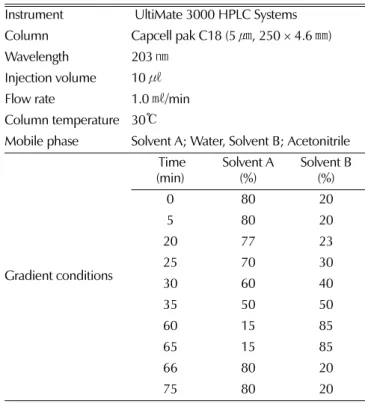
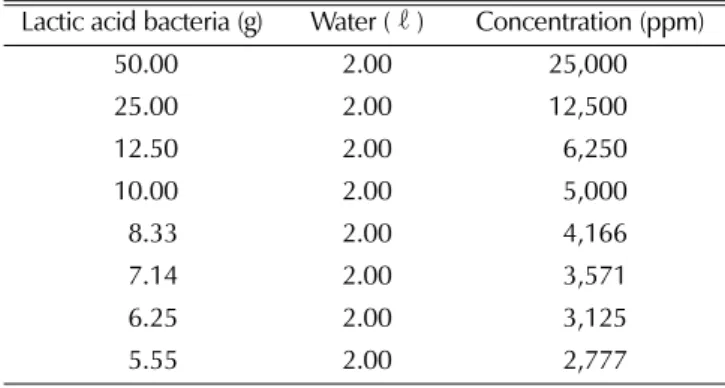
배양배지 조성물 SH 배지 64.5 g/15ℓ, sucrose 450 g/ 15ℓ, IBA 30 ㎎/15ℓ 를 증류수에 혼합한 후, methyl jasmonate, pyruvic acid, squalene, β-sitosterol을 62.5, 125.0, 250.0 µ㏖ 농도로 각각 첨가하였다. 이후 pH 5.75 ± 0.10로 보정하여, 18 ℓ 생물반응기에 배양배지를 넣고, 고온·고압 (121℃, 60 min, 0.12 mPa) 습윤 멸균한 후, 냉각된 배양배 지에 계대배양 중인 산삼 모세포를 접종하고, 총 배양기간을 8 주로 하여 생체중량과 진세노사이드 함량을 비교하였다. 2.2. Methyl jasmonate 조건배양 배양배지 조성물 SH 배지 64.5 g/15ℓ, sucrose 450 g/ 15ℓ, IBA 30 ㎎/15ℓ 를 증류수에 혼합한 후, pH 5.75 ± 0.10로 보정하여, 18 ℓ 생물반응기에 배양배지를 넣고, 고온· 고압 (121.0℃, 60 min, 0.12 mPa) 습윤 멸균하였다. 이후, 배양배지에 계대배양 중인 산삼 모세포를 접종하였고, 선별된 elicitor인 methyl jasmonate를 62.5 µ㏖ - 250.0 µ㏖ 농도로 하여, 1 주 - 7 주까지 주차별로 처리한 후, 총 배양기간을 8 주로 하여 생체중량과 진세노사이드 함량을 비교하였다. 3. 생체중량 측정 8 주간 배양된 산삼 부정배양근을 수확한 후, 생체표면에 뭍 은 수분을 드라이오븐에서 건조 (45℃, 10 min)하여 제거한 후, 대조군과 실험군의 생체중량을 측정하였다. 4. 진세노사이드 분석 산삼 부정배양근 생체는 70% EtOH로 추출 및 동결건조, 추출물은 동결건조 하여, 수분을 완전하게 제거한 후, 100% MeOH에 용해, 필터링하여 분석 시료로 사용하였다. 진세노 사이드 분석은 HPLC-UVD UltiMate 3000 HPLC Systems (Thermo Fisher Scientific Inc., San Jose, CA, USA)을 사 용하였고, 컬럼은 Capcell pak C18 (5 ㎛, 250 × 4.6 ㎜, Shiseido Ltd., Tokyo, Japan), 이동상 acetonitrile과 water를 사용하여 측정하였다 (Table 1). 정량방법은 측정된 면적 값을 진세노사이드 표준품 검량선 식에 대입하였고, 단위의 환산은 아래와 같은 식에 대입하여 산출하였다. 진세노사이드 함량 (㎎/g) = C × (a × b)/S × 1/1,000 C: 시험용액 중 개별 진세노사이드 농도 (㎍/㎖) a: 시험용액의 전량 (㎖) S: 시료 채취량 (g) b: 희석배수 1/1,000: 단위 환산 계수 5. 진세노사이드 함량변환 5.1. 증숙 조건선별 증숙시험은 추출물 증숙 방법으로 실시하였고, 산삼 부정배 양근을 70% EtOH 추출 및 동결건조 한 후, 건조분말 50 g 을 증류수 10 ℓ에 희석한 (5,000 ppm) 산삼 부정배양근 추 출물을 시료로 사용하였고, 온도 (100℃ - 120℃), 시간 (60 min - 270 min) 증숙 조건별 저분자 진세노사이드 (Rg3, Rk1, Rg5) 함량변환을 비교하였다. 5.2. 발효 조건선별 발효시험은 증숙시험 중 최적 합한 실험군 조건에 유산균을 농도별로 접종한 후, 처리하는 방법으로 실시하였다. 유산균 접종조건은 생균 50.00, 25.00, 12.50, 10.00, 8.33, 7.14, 6.25, 5.55 g을 증류수 2 ℓ 에 희석한 유산균 희석액을 시료 로 사용하였으며, 유산균 희석액 20% (v/v)와 산삼 부정배양 근 추출물 80% (v/v) 비율로 혼합한 후, pH value를 측정하 였다. 이후, 120℃, 210 min에서 반응시키고, 저분자 진세노사 이드 함량변환을 비교하였다 (Table 2). 6. 통계처리 배양시험은 9 회, 이외의 실험은 3 회 반복으로 진행하였으 며, 평균 ± 표준편차를 나타내었다. 시험결과와 관련된 통계처 리는 SPSS program (Statistical Package for Social Science, Version 24, IBM Co., Chicago, IL, USA)를 이용하여 분산 분석 (ANOVA)으로 5% 수준에서 Duncan`s Multiple Range Test (DMRT)에 의하여 대조군, 실험군 간 유의차를 검증하였 다 (p < 0.05).
Table 1. HPLC conditions of ginsenoside analysis in cultured wild ginseng adventitious root.
Instrument UltiMate 3000 HPLC Systems Column Capcell pak C18 (5 ㎛, 250 × 4.6 ㎜)
Wavelength 203 ㎚
Injection volume 10 ㎕
Flow rate 1.0 ㎖/min
Column temperature 30℃
Mobile phase Solvent A; Water, Solvent B; Acetonitrile
Gradient conditions Time (min) Solvent A (%) Solvent B (%) 0 80 20 5 80 20 20 77 23 25 70 30 30 60 40 35 50 50 60 15 85 65 15 85 66 80 20 75 80 20
결과 및 고찰
1. 진세노사이드 함량증진 1.1. Elicitor 처리, 물질선별
Triterpenoid 계열은 β-hydroxy β-methylglutaryl-CoA (HMG-CoA)가 β-hydroxy β-methylglutaryl-CoA reductase (HMGR)에 의해 환원되며, mevalonate 대사를 거쳐 terpene의 전구체인 isopropene diphosphate isomerase (IPP)의 형성을 기반으로 한다. 이후 isoprenoid pathway를 거쳐, 2,3-oxidosqualene 형성까지 모든 진세노사이드에서 동일하게 이루 어지며, 이후 cyclization 단계에서 나누어지게 된다 (Yang et al., 2018).
본 연구에서는 생합성 유도물질로 methyl jasmonate, pyruvic acid, squalene, β-sistosterol를 선발하여 사용하였다. Methyl jasmonate는 병원균에 allelopathy/allelopathic com-pounds 반응을 통해 식물에 함유된 triterpenoid 계열의 2차 대사물질을 증진시키는 것으로 알려져 있다 (Marsik et al., 2014).
Isopentenyl diphosphate (IPP)와 dimethylallyl diphosphate (DMAPP)의 경우, mevalonate (MVA) pathway와 별개로 non-mevalonate pathway인 methylerythritol 4-phosphate (MEP) pathway 경로가 관여하는 것으로 알려져 있으며 (Banerjee and Sharkey, 2014), MEP pathway는 식물색소체에서 효소 반응을 통해 pyruvic acid로 부터 1-deoxy-D-xylulose 5-phosphate (DXP)로의 합성과정에서 시작되는 것으로 보았을 때, 최초 전구체 물질인 pyruvic acid는 MEP pathway를 자 극하여 진세노사이드 합성에 관여되어 선별하였다.
Squalene은 식물과 인간을 포함한 거의 모든 동물에서 생 산되며 여러 방면에서 활용되며 (Boughton et al., 1957), squalene epoxidase (SQE)에 의해 2,3-oxidosqualene으로 전 환되는 물질이며, β-sitosterol은 phytosterol로 squalene이 squalene 2,3-oxide, chair-boat-chair-boat, cycloartenol을 거쳐
서 생산되는데, squalene의 생합성 경로에서 경쟁적 억제제 또 는 상승제 역할을 하여 선별하였다 (Aboobucker and Suza, 2019).
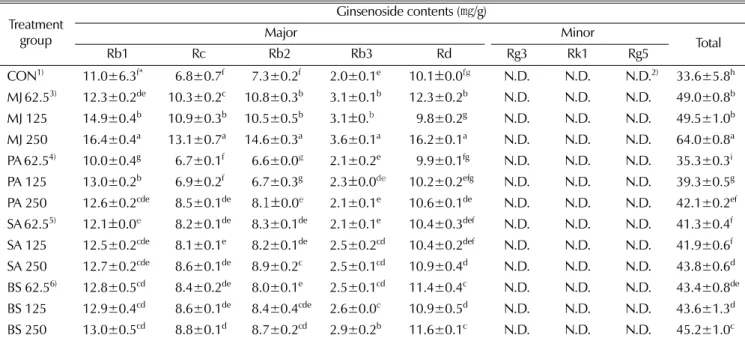
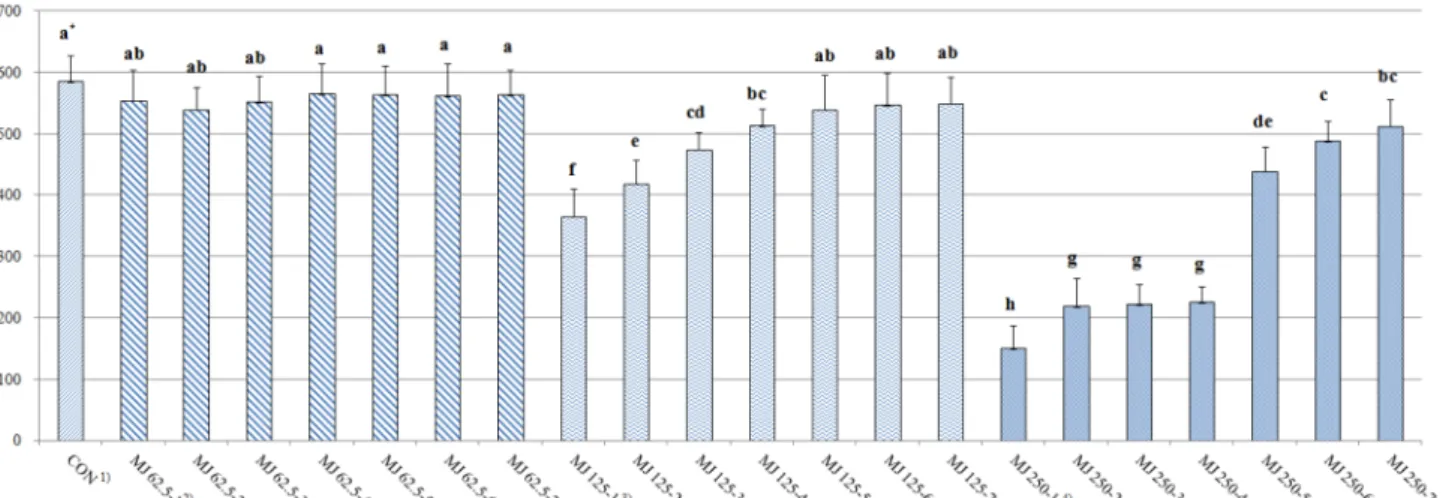
Elicitor 물질 methyl jasmonate (MJ), pyruvic acid (PA), squalene (SA), β-sistosterol (BS)를 배양배지에 62.5 µ㏖ -250.0 µ㏖ 농도별로 처리하여 배양한 결과, 생체중량은 PA 실험군, BS 실험군, SA 실험군, 대조군, MJ 실험군 순으로 감소하였고, PA 62.5 실험군이 602.5 ± 40.1 g으로 가장 높게 측정되었다. 반면, BS 실험군과 SA 실험군의 생체중량에 차 이를 나타내지 않았으며, MJ 실험군은 농도가 증가할수록 생 체중량은 감소하였다 (Fig. 1). 총 진세노사이드 함량은 MJ 실험군, BS 실험군, SA 실험 군, PA 실험군, 대조군 순으로 감소하였지만, 대조군 대비 모 두 증가하였다. 이중, MJ 실험군은 농도가 증가할수록 총 함 량이 증가하여, MJ 250 실험군에서 64.0 ± 0.8 ㎎/g으로 가장 높은 값을 나타내었다 (Table 3). 1.2. Methyl jasmonate 조건배양 (처리농도, 처리기간별) Methyl jasmonate를 62.5 µ㏖ - 250.0 µ㏖ 농도로 하여, 1 주 - 7 주까지 주차별로 처리한 후, 생체중량과 총 진세노사 이드 함량의 상관관계를 비교하였다. 생체중량은 MJ 62.5-1에서 MJ 62.5-7까지, MJ 125-5에서 MJ 125-7의 실험군에서는 유의적으로 증가되거나 감소되지 않 은 반면에, MJ 125-1에서 MJ 125-4까지, MJ 250-1에서 MJ 250-7 까지의 실험군에서는 methyl jasmonate 농도증가와 처 리기간이 길어질수록 생체중량이 감소하였고, MJ 250-1 실험 군에서 150.0 ± 37.9 g까지 감소하였다 (Fig. 2). 총 진세노사이드는 함량은 대조군 대비 모두 증가하였고, MJ 62.5-1에서 MJ 62.5-4 까지의 실험군, MJ 125-1에서 MJ 125-4까지, MJ 250-1에서 MJ 250-4 까지의 실험군, MJ 62.5-5 실험군, MJ 125-5 실험군 순으로 증가하였다. 특히, MJ 250-5 실험군에서 188.1 ± 4.9 ㎎/g으로 가장 높은 값을 나타내었다 (Table 4).
Wu 등 (2020)은 고려 인삼 모상근 (Panax ginseng C.A. Meyer)을 30 일간 배양한 후, methyl jasmonate를 처리하고 8 일이 경과되었을 때, 진세노사이드 함량이 최대 13 ㎎/g까지 증가하였고, Wang 등 (2016) 북미 인삼 모상근 (Panax Quinquefolium L.)을 28 일간 배양한 후, methyl jasmonate 5 ㎎/ℓ을 처리하고 12 일이 경과되었을 때, 43.66 ㎎/g (대 조군 8.32 ㎎/g)까지 증가하였으며, 배양기간 중 부정근이 유 기된 후, 영양생장을 한 상태에서 elicitor 처리방법이 효과적 이라는 연구결과를 보고하였다. 식물세포의 세포생장 곡선은 일반적으로 S 모형을 나타내 고, 이차대사산물은 생장곡선이 증가하지 않는 단계에 이르러 생산되는 것으로 알려져 있다. 이는 탄소와 같은 물질들이 세
Table 2. The bioconversion conditions of cultured wild ginseng adventitious root extract according to lactic acid bacteria treatment.
Lactic acid bacteria (g) Water (ℓ) Concentration (ppm)
50.00 2.00 25,000 25.00 2.00 12,500 12.50 2.00 6,250 10.00 2.00 5,000 8.33 2.00 4,166 7.14 2.00 3,571 6.25 2.00 3,125 5.55 2.00 2,777
포구성물 생성 및 세포호흡과 같은 1차 대사에 사용되기 때문 이며, 2차 대사산물의 합성은 세포생장 곡선 중 lag phase와 log phase에서 나타나지 않는 효소들의 활성에 의해 생성되는 것으로 알려져 있다 (Marisol et al., 2016). 본 실험을 통하여 산삼 부정배양근 생체중량과 총 진세노사 이드 함량의 상관관계를 비교하였을 때, methyl jasmonate를 250 µ㏖ 농도에서 5주차에 처리하였을 때, 가장 적합한 실험 군인 것으로 확인되었다. 선행연구와 결과를 비교하였을 때, methyl jasmonate를 저농도 (53 ㎎/ℓ)로 처리하고, 배양기간 을 증가시켰을 때 (16 일), 최대 4.3 배 (w/w) 이상 높은 함
Fig. 1. The comparison of bio-mass according to elicitor treatment in cultured wild ginseng adventitious roots. Each value is means ± SD of nine replicate tests. *Means within a column followed by the same letter are not significantly different based on the Duncan`s Multiple Range Test (DMRT, p < 0.05). 1)CON; Control (non-treatment culture), 2)MJ 62.5 - MJ 250; methyl
jasmonate 62.5 µ㏖ - 250 µ㏖ treatment culture, 3)PA 62.5 - PA 250; pyruvic acid 62.5 µ㏖ - 250 µ㏖ treatment culture, 4)SA 62.
- SA 250; squalene 62.5 µ㏖ - 250 µ㏖ treatment culture, 5)BS 62.5 - BS 250; β-sistosterol 62.5 µ㏖ - 250 µ㏖ treatment culture.
Table 3. The comparison of total ginsenoside according to elicitor treatment in cultured wild ginseng adventitious roots.
Treatment group Ginsenoside contents (㎎/g) Major Minor Total Rb1 Rc Rb2 Rb3 Rd Rg3 Rk1 Rg5 CON1) 11.0±6.3f* 06.8±0.7f 07.3±0.2f 2.0±0.1e 10.1±0.0fg N.D. N.D. 2)N.D.2) 33.6±5.8h MJ62.53) 12.3±0.2de 10.3±0.2c 10.8±0.3b 3.1±0.1b 12.3±0.2b N.D. N.D. N.D. 49.0±0.8b MJ 125 14.9±0.4b 10.9±0.3b 10.5±0.5b 3.1±0.b 09.8±0.2g N.D. N.D. N.D. 49.5±1.0b MJ 250 16.4±0.4a 13.1±0.7a 14.6±0.3a 3.6±0.1a 16.2±0.1a N.D. N.D. N.D. 64.0±0.8a PA62.54) 10.0±0.4g 06.7±0.1f 06.6±0.0g 2.1±0.2e 09.9±0.1fg N.D. N.D. N.D. 35.3±0.3i PA 125 13.0±0.2b 06.9±0.2f 06.7±0.3g 2.3±0.0de 10.2±0.2efg N.D. N.D. N.D. 39.3±0.5g PA 250 12.6±0.2cde 08.5±0.1de 08.1±0.0e 2.1±0.1e 10.6±0.1de N.D. N.D. N.D. 42.1±0.2ef SA62.55) 12.1±0.0e 08.2±0.1de 08.3±0.1de 2.1±0.1e 10.4±0.3def N.D. N.D. N.D. 41.3±0.4f SA 125 12.5±0.2cde 08.1±0.1e 08.2±0.1de 2.5±0.2cd 10.4±0.2def N.D. N.D. N.D. 41.9±0.6f SA 250 12.7±0.2cde 08.6±0.1de 08.9±0.2c 2.5±0.1cd 10.9±0.4d N.D. N.D. N.D. 43.8±0.6d BS 62.56) 12.8±0.5cd 08.4±0.2de 08.0±0.1e 2.5±0.1cd 11.4±0.4c N.D. N.D. N.D. 43.4±0.8de BS 125 12.9±0.4cd 08.6±0.1de 08.4±0.4cde 2.6±0.0c 10.9±0.5d N.D. N.D. N.D. 43.6±1.3d BS 250 13.0±0.5cd 08.8±0.1d 08.7±0.2cd 2.9±0.2b 11.6±0.1c N.D. N.D. N.D. 45.2±1.0c Each value is means ± SD of nine replicate tests. *Means within a column followed by the same letter are not significantly different based on the Duncan's Multiple Range Test (DMRT, p < 0.05). 1)CON; control (non-elicitor treatment culture), 2)N.D.; not detected, 3)MJ 62.5 - MJ 250;
methyl jasmonate 62.5 µ㏖ - 250 µ㏖ treatment culture, 4)PA 62.5 - PA 250; pyruvic acid 62.5 µ㏖ - 250 µ㏖ treatment culture, 5)SA 62. - SA 250; squalene 62.5 µ㏖ - 250 µ㏖ treatment culture, 6)BS 62.5 - BS 250; β-sistosterol 62.5 µ㏖ - 250 µ㏖ treatment culture.
Fig. 2. The comparison of bio-mass according to methyl jasmonate treatment (concentration, duration) in cultured wild ginseng adventitious roots. Each value is means ± SD of nine replicate tests. *Means within a column followed by the same letter are not significantly different based on the Duncan's Multiple Range Test (DMRT, p < 0.05). 1)CON; control (non-elicitor treatment
culture), 2)MJ 62.5-1 - MJ 62.5-1-7; methyl jasmonate 62.5 µ㏖ 1 week - 7 week injection. 3)MJ 125-1 - MJ 125-7; methyl
jasmonate 125 µ㏖ 1 week - 7 week injection. 4)MJ 250-1 - MJ 250-7; methyl jasmonate 250 µ㏖ 11 week - 7 week injection.
Table 4. The comparison of total ginsenoside according to methyl jasmonate treatment (concentration, duration) in cultured wild ginseng adventitious roots. Treatment group Ginsenoside contents (㎎/g) Major Minor Total Rb1 Rc Rb2 Rb3 Rd Rg3 Rk1 Rg5 CON1) 11.3±0.2hi* 08.0±0.4j 07.7±0.3o 2.0±0.2hi 10.0±0.3klm N.D. N.D. 2)N.D.2) 039.2±1.0i MJ 62.5-13) 12.7±0.2fgh 10.3±0.2fg 11.1±0.1hi 2.8±0.0efg 12.5±0.1hij N.D. N.D. N.D. 049.6±0.4f MJ 62.5-2 13.2±1.0fgh 08.8±0.2hij 09.5±1.1lmn 2.4±0.1fghi 11.5±0.1ijk N.D. N.D. N.D. 045.6±2.1fgh MJ 62.5-3 14.5±0.0fgh 09.7±0.2gh 10.3±0.2jklm 2.2±0.1ghi 12.3±0.1hij N.D. N.D. N.D. 049.2±0.1f MJ 62.5-4 14.4±0.2fgh 09.6±0.3gh 11.4±0.2hij 2.3±0.2ghi 11.7±0.3ij N.D. N.D. N.D. 049.5±0.9f MJ 62.5-5 31.5±0.5d 19.0±0.7c 19.3±0.2d 4.8±0.3d 18.3±0.2de N.D. N.D. N.D. 093.2±2.0c MJ 62.5-6 26.1±0.2e 17.2±1.0d 17.9±0.7e 5.1±0.3d 17.4±1.1e N.D. N.D. N.D. 083.8±2.6d MJ 62.5-7 12.3±0.5ghi 07.7±0.3j 09.0±0.3mn 2.2±0.1ghi 11.2±0.6jkl N.D. N.D. N.D. 042.6±1.2ghi MJ 125-14) 14.8±0.6fg 10.4±0.2fg 11.0±0.3hi 3.0±0.2ef 09.2±0.9m N.D. N.D. N.D. 048.5±2.1fg MJ 125-2 09.2±7.3i 11.1±0.1f 12.1±0.1ghi 3.0±0.0ef 13.5±0.1gh N.D. N.D. N.D. 049.1±7.6f MJ 125-3 11.9±0.6ghi 10.4±0.5fg 10.9±0.7hij 2.7±0.3efgh 12.8±0.7hi N.D. N.D. N.D. 048.9±1.3fg MJ 125-4 12.0±0.5ghi 10.4±0.5fg 10.7±0.7ijk 2.3±0.2fghi 12.3±0.7hij N.D. N.D. N.D. 047.9±1.2fg MJ 125-5 39.9±1.0b 31.1±0.9b 29.4±1.5b 8.8±0.9a 34.0±1.7c N.D. N.D. N.D. 143.4±6.1b MJ 125-6 23.3±1.3e 19.9±0.9c 19.1±0.5de 5.1±0.7d 19.2±0.9e N.D. N.D. N.D. 086.7±4.5d MJ 125-7 13.6±0.6fgh 09.5±0.5ghi 09.7±0.3klmn 3.3±0.2e 09.8±0.4lm N.D. N.D. N.D. 046.1±2.2fgh MJ 250-15) 16.0±0.8f 13.0±0.8e 13.7±0.5f 3.4±0.2e 15.2±0.9f N.D. N.D. N.D. 061.5±3.4e MJ 250-2 16.0±0.3f 13.0±0.6e 12.4±0.7fgh 3.0±0.1ef 15.0±0.8fg N.D. N.D. N.D. 059.6±2.6e MJ 250-3 15.0±0.9fg 12.6±0.4e 13.0±0.8fg 2.8±0.1efg 15.3±1.1f N.D. N.D. N.D. 058.9±2.5e MJ 250-4 15.0±0.9fg 12.4±0.7e 13.7±0.4f 1.9±0.1i 15.0±0.8fg N.D. N.D. N.D. 058.2±3.0e MJ 250-5 51.5±1.3a 38.1±1.1a 34.3±1.2a 8.0±0.5b 55.9±0.8a N.D. N.D. N.D. 188.1±4.9a MJ 250-6 36.3±1.3c 30.9±1.3b 28.2±1.1c 6.2±0.6c 39.1±1.8b N.D. N.D. N.D. 140.9±6.3b MJ 250-7 14.2±0.3fgh 08.3±0.7ij 08.7±0.6ij 2.6±0.0fghi 07.0±0.9n N.D. N.D. N.D. 040.9±2.7hi Each value is mean ± standard deviation of nine replicate tests. *Means within a column followed by the same letter are not significantly different based oDuncan's Multiple Range Test (DMRT, p < 0.05). 1)CON; control (non-elicitor treatment culture), 2)N.D.; not detected, 3)MJ 62.5-1 - MJ
62.5-7; methyl jasmonate 62.5 µ㏖ 1 week - 7 week injection. 4)MJ 125-1 - MJ 125-7; methyl jasmonate 125 µ㏖ 1 week - 7 week injection.
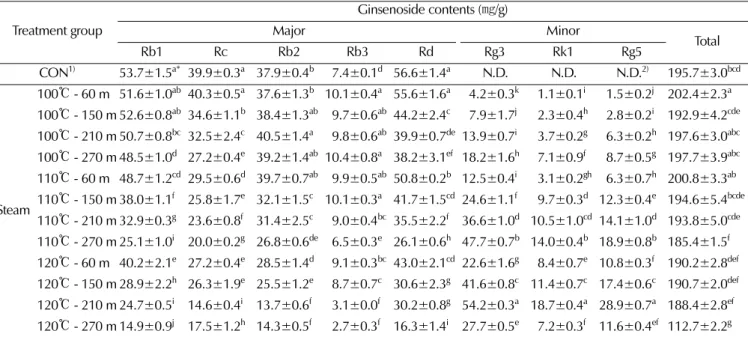
량이 검출되었다. 따라서, 본 실험군의 시료를 이용하여 진세 노사이드 함량변환 (증숙, 발효) 시험을 실시하였다. 2. 진세노사이드 함량변환 2.1. 증숙 조건선별 (온도, 시간별) 산삼 부정배양근 추출물의 온도 (100℃ - 120℃), 시간 (60 min - 270 min)별 증숙 실시한 결과, 온도와 시간이 증가 될수록 고분자 진세노사이드 Rb1, Rc, Rb2, Rb3, Rd는 감소 하는 반면, 저분자 진세노사이드 Rg3, Rk1, Rg5는 증가하였 고, 120℃ -210 h 실험군에서 Rg3 54.2 ± 0.3 ㎎/g, Rk1 18.7 ± 0.4 ㎎/g, Rg5 28.9 ± 0.7 ㎎/g으로 가장 많은 함량변환 을 나타내었다 (Table 5). Lee 등 (2018)은 산삼 부정배양근을 온도 (60℃ - 120℃)와 시간 (30 min - 120 min) 조건으로 나누어 증숙한 결과, 120℃ 를 처리하였을 때, 저분자 진세노사이드 Rh4, Rg3, Rk1, Rg5, Rh2, Rh3가 증가되었으며, Xu 등 (2018)은 인삼을 증 숙시킬 때, Rg3 비율은 100℃에서 0.030%, 120℃에서 0.338%로 약 11 배 이상이 증가되었다. Kim 등 (2000)도 120℃로 증숙하였을 때, Rg3와 Rg5가 새롭게 생성되어 전체 함량의 36%, 19%를 차지하였고, Yu 등 (2019)은 인삼을 80 ℃ - 110℃, 48 시간 동안 증숙 하였을 때, 100℃, 12 시간 실험군에서 총 진세노사이드 함량이 최대로 증가되는 것을 보 고하여, 증숙에 의한 고분자 진세노사이드 감소와 저분자 진 세노사이드 증가는 선행 연구와 유의적인 결과가 확인되었다. 2.1. 발효 조건선별 (유산균 농도별) 증숙 조건에서 전환되는 저분자 진세노사이드를 증가시키기 위해 유산균을 농도별로 접종한 후, 120℃, 210 min에서 반응 을 실시한 결과, 유산균 농도가 증가할수록 저분자 진세노사 이드 함량이 감소하다가 3,125 ppm을 혼합하였을 때, 진세노 사이드 Rg3 70.8 ± 1.6 ㎎/g, Rk1 25.4 ± 0.4 ㎎/g, Rg5 36.9 ± 0.9 ㎎/g으로 가장 많은 함량변환을 나타내었다 (Table 6). 유산균 농도에 따른 진세노사이드 Rg3, Rk1, Rg5 변환과 pH value 상관관계를 비교하였을 때, 진세노사이드 함량이 최 대로 증가되는 실험군과의 유의성은 확인되지 않았다. Choi 등 (2014)은 인삼을 고온으로 증숙하였을 때 Rg2 2.13㎎/g, Rg3 2.04 ㎎/g, Rh2 1.33 ㎎/g, Compound K 1.14㎎/g이 검출되었고, 고온과 발효균을 복합적으로 처리 하였을 때 Rg2 3.23 ㎎/g, Rg3 7.58 ㎎/g, Rh2 1.95 ㎎/g, Compound K 2.47 ㎎/g으로 저분자 진세노사이드 함량이 2.1 배 증가된다고 보고하였다. 진세노사이드의 저분자화는 고분 자 진세노사이드와 결합된 배당체의 β-glucoside 결합을 끊을 수 있는 물리, 화학, 생물학적인 반응을 거쳐야 하며, 이중 발 효공정은 β-glucosidase 효소 활성이 우수한 유산균을 선발하 여 대량 배양한 후, 효소를 정제하여 사용하거나, 유산균 자체 를 직접 활용하여 변환하는 것으로 알려져 있다 (Han and Moon, 2019). 발효 시험에서 진세노사이드 Rg3, Rk1, Rg5 함량이 증가된 것은 미생물에 의해 고분자 진세노사이드가 저 분자로 변환 것으로 사료되어 진다. 본 연구에서는 산삼 부정배양근 생체중량 감소율을 최소화
Table 5. The comparison of total ginsenoside according to steam (temperature, time) treatment in cultured wild ginseng adventitious roots of methyl jasmonate treatments.
Treatment group Ginsenoside contents (㎎/g) Major Minor Total Rb1 Rc Rb2 Rb3 Rd Rg3 Rk1 Rg5 CON1) 53.7±1.5a* 39.9±0.3a 37.9±0.4b 07.4±0.1d 56.6±1.4a N.D. N.D. N.D.2) 195.7±3.0bcd Steam 100℃ - 60 m 51.6±1.0ab 40.3±0.5a 37.6±1.3b 10.1±0.4a 55.6±1.6a 04.2±0.3k 01.1±0.1i 01.5±0.2j 202.4±2.3a 100℃ - 150 m 52.6±0.8ab 34.6±1.1b 38.4±1.3ab 09.7±0.6ab 44.2±2.4c 07.9±1.7j 02.3±0.4h 02.8±0.2i 192.9±4.2cde 100℃ - 210 m 50.7±0.8bc 32.5±2.4c 40.5±1.4a 09.8±0.6ab 39.9±0.7de 13.9±0.7i 03.7±0.2g 06.3±0.2h 197.6±3.0abc 100℃ - 270 m 48.5±1.0d 27.2±0.4e 39.2±1.4ab 10.4±0.8a 38.2±3.1ef 18.2±1.6h 07.1±0.9f 08.7±0.5g 197.7±3.9abc 110℃ - 60 m 48.7±1.2cd 29.5±0.6d 39.7±0.7ab 09.9±0.5ab 50.8±0.2b 12.5±0.4i 03.1±0.2gh 06.3±0.7h 200.8±3.3ab 110℃ - 150 m 38.0±1.1f 25.8±1.7e 32.1±1.5c 10.1±0.3a 41.7±1.5cd 24.6±1.1f 09.7±0.3d 12.3±0.4e 194.6±5.4bcde 110℃ - 210 m 32.9±0.3g 23.6±0.8f 31.4±2.5c 09.0±0.4bc 35.5±2.2f 36.6±1.0d 10.5±1.0cd 14.1±1.0d 193.8±5.0cde 110℃ - 270 m 25.1±1.0i 20.0±0.2g 26.8±0.6de 06.5±0.3e 26.1±0.6h 47.7±0.7b 14.0±0.4b 18.9±0.8b 185.4±1.5f 120℃ - 60 m 40.2±2.1e 27.2±0.4e 28.5±1.4d 09.1±0.3bc 43.0±2.1cd 22.6±1.6g 08.4±0.7e 10.8±0.3f 190.2±2.8def 120℃ - 150 m 28.9±2.2h 26.3±1.9e 25.5±1.2e 08.7±0.7c 30.6±2.3g 41.6±0.8c 11.4±0.7c 17.4±0.6c 190.7±2.0def 120℃ - 210 m 24.7±0.5i 14.6±0.4i 13.7±0.6f 03.1±0.0f 30.2±0.8g 54.2±0.3a 18.7±0.4a 28.9±0.7a 188.4±2.8ef 120℃ - 270 m 14.9±0.9j 17.5±1.2h 14.3±0.5f 02.7±0.3f 16.3±1.4i 27.7±0.5e 07.2±0.3f 11.6±0.4ef 112.7±2.2g Each value is mean ± standard deviation of nine replicate tests. *Means within a column followed by the same letter are not significantly different based on Duncan`s Multiple Range Test (DMRT, p < 0.05). 1)CON; control (non-steam treatment), 2)N.D.; not detected.
하고, 총 진세노사이드 (Rb1, Rc, Rb2, Rb3, Rd의 합)를 최 대로 증진시킬 수 있는 elicitor 물질 methyl jasmonate의 처 리조건을 확인하였다. 이후, 저분자 진세노사이드 (Rg3, Rk1, Rg5의 합)를 변환시킬 수 있는 조건시험 (증숙, 발효)을 통해 최대 131 ㎎/g의 함량을 나타내는 진세노사이드 변환공정 연 구결과를 도출하였다.
REFERENCES
Aboobucker SI and Suza WP. (2019). Why do plants convert sitosterol to stigmasterol?. Frontiers in Plant Science. 10:354. https://www.frontiersin.org/articles/10.3389/fpls.2019.00354/full (cited by 2020 Aug 11).
An KS, Choi YO, Lee SM, Ryu HY, Kang SJ, Yeon Y, Kim YR, Lee JG, Kim CJ, Lee YJ, Kang BJ, Choi JE and Song KS. (2019). Ginsenosides Rg5 and Rk1 enriched cultured wild ginseng root extract bioconversion of pediococcus pentosaceus HLJG0702: Effect on scopolamine-induced memory dysfunction in mice. Nutrients. 11:1120. https://www.mdpi.com/2072-6643/ 11/5/1120/htm (cited by 2020 July 4).
Bacete L, Mélida H, Miedes E and Molina A. (2018). Plant cell wall-mediated immunity: Cell wall changes trigger disease resistance responses. Plant Journal. 93:614-636.
Banerjee A and Sharkey TD. (2014). Methylerythritol 4-phosphate (MEP) pathway metabolic regulation. Natural Product Reports. 31:1043-1098.
Boughton B, MacKenna RMB, Wheatley VR and Wormall A. (1957). Studies of sebum. 8. observations on the squalene and cholesterol content and the possible functions of squalene in human sebum. Biochemical Journal. 66:32-38.
Chappell J. (1995). Biochemistry and molecular biology of the
isoprenoid biosynthetic pathway in plants. Annual Review of Plant Physiology and Plant Molecular Biology. 46:521-547. Chen J, Si M, Wang Y, Liu L, Zhang Y, Zhou A and Wei W.
(2019). Ginsenoside metabolite compound K exerts anti-inflammatory and analgesic effects via downregulating COX2. Inflammopharmacology. 27:157-166.
Chen XJ, Liu WJ, Wen ML, Liang H, Wu SM, Zhu YZ, Zhao JY, Dong XQ, Li MG, Bian L, Zou CG and Ma LQ. (2017). Ameliorative effects of compound K and ginsenoside Rh1 on non-alcoholic fatty liver disease in rats. Scientific Reports. 7:41144. https://www.nature.com/articles/srep41144 (cited by 2020 June 23).
Cho MS, Ku BS and Park SG. (2012). Effect of light emitting diodes and cytokinin on in vitro growth and development of gerbera hybrida. Flower Research Journal. 20:7-15.
Choi WY, Lim HW, Choi GP and Lee HY. (2014). Enhancement of ginsenosides conversion yield by steaming and fermentation process in low quality fresh ginseng. Korean Journal of Medicinal Crop Science. 22:223-230.
Efferth T. (2019). Biotechnology applications of plant callus cultures. Engineering. 5:50-59.
Han JY, Hwang HS, Choi SW, Kim HJ and Choi YE. (2012). Cytochrome P450 CYP716A53v2 catalyzes the formation of protopanaxatriol from protopanaxadiol during ginsenoside bio-synthesis in Panax ginseng. Plant and Cell Physiology. 53:1535-1545.
Han MH and Moon GS. (2019). Bioconversion of ginseng using microorganisms. Journal of Biotechnology and Bioindustry. 7:5-11.
Jang IB, Moon JW, Yu J, Jang IB, Suh SJ and Chun CH. (2019). Analysis of microclimate responses and high-tempera-ture injury in ginseng as affected by shading. Korean Journal of Medicinal Crop Science. 27:278-283.
Table 6. The comparison of ginsenoside contents and pH value to lactic acid bacteria (concentration) treatment in cultured wild ginseng adventitious roots of methyl jasmonate treatments.
Treatment group pH value
Ginsenoside contents (㎎/g) Major Minor Total Rb1 Rc Rb2 Rb3 Rd Rg3 Rk1 Rg5 CON1) 5.68±0.05ab*48.9±0.7a 36.5±0.2a 39±0.6a 9.8±0.6a 55.6±0.5a N.D. N.D. N.D.2) 189.9±2.5a Steam treatment 5.71±0.04a 25.0±0.5b15.7±0.3b18.5±0.9b4.6±2.1b 32.1±0.7b49.4±0.7c 17.0±0.3d24.4±0.2cd 187.2±5.2a Steam + lactic acid bacteria (ppm) 25,0003) 5.10±0.01g N.D. N.D. N.D. N.D. N.D. 15.9±1.8e 04.9±0.1g07.8±0.2f 028.7±2.1e 12,500 5.37±0.00f N.D. N.D. N.D. N.D. N.D. 25.5±0.1d09.3±0.1f 13.8±0.4e 048.7±0.6d 06,250 5.51±0.03e 01.5±0.0e 00.9±0.0f 1.0±0.0f 0.5±0.0cd 02.7±0.1h27.2±0.6d09.8±0.1f 14.2±0.3e 058.0±1.5c 05,000 5.54±0.01de06.6±0.3d04.0±0.1ae4.6±0.1e 2.1±0.0d 11.1±0.2g 53.4±0.7b18.8±0.1b27.4±0.4b 128.3±0.5b 04,166 5.57±0.02cd08.1±0.1d05.1±0.1de6.3±0.5d 1.2±0.7cd 12.6±0.3f 51.5±1.2bc18.0±0.3c26.1±0.5bc 129.3±2.5b 03,571 5.57±0.00cd09.3±0.3d05.8±0.3d6.7±0.2d 0.4±0cd 14.1±0.3e 51.2±0.2c 17.9±0c 25.7±0.1bc 131.5±1.7b 03,125 5.59±0.00c 13.9±0.4c 07.8±0.6c 10.1±0.6c 4.5±0.5b 18.0±0.9d70.8±1.6a 25.4±0.4a36.9±0.9a 187.8±5.3a 02,777 5.66±0.00b 27.6±6.8b15.2±3.0b19.3±2.3b5.7±1.9b 27.3±1.3c 49.6±2.1c 16.3±1.1e23.1±2.7d 184.4±3.0a
*Each value is means ± standard deviation of three replicate tests. *Means within a column followed by the same letter are not significantly
different based on the Duncan`s Multiple Range Test (DMRT, p < 0.05). 1)CON; control (non-steam treatment), 2)N.D.; not detected. 3)Lactic
Kim HJ, Jung SW, Kim SY, Cho IH, Kim HC, Rhim HW, Kim MH and Nah SY. (2018). Panax ginseng as an adjuvant treatment for alzheimer's disease. Journal of Ginseng Research. 42:401-411.
Kim WY, Kim JM, Han SB, Lee SK, Kim ND, Park MK, Kim CK and Park JH. (2000). Steaming of ginseng at high temperature enhances biological activity. Journal of Natural Products. 12:1702-1704.
Lee BB, Sur BJ, Park JH, Kim SH, Kwon SO, Yeom MJ, Shim IS, Lee HJ and Hahm DH. (2013a). Ginsenoside Rg3 alleviates lipopolysaccharide-induced learning and memory impairments by anti-inflammatory activity in rats. Biomolecules and Therapeutics. 21:381-390.
Lee DY, Kim JK, Shrestha S, Seo KH, Lee YH, Noh HJ, Kim GS, Kim YB, Kim SY and Baek NI. (2013b). Quality evaluation of panax ginseng roots using a rapid resolution LC-QTOF/MS-based metabolomics approach. Molecules. 18:14849-14861.
Lee KH, Bae IY, Park SI, Park JD and Lee HG. (2016). Antihypertensive effect of korean red ginseng by enrichment of ginsenoside Rg3 and arginine-fructose. Journal of Ginseng Research. 40:237-244.
Lee YJ, Kim HK, Go EJ, Choi JH, Jo AR, Kim CJ, Lee JG, Lim JD, Choi SK and Yu CY. (2018). Extraction of low molecular weight ginsenosides from adventitious roots culture of wild mountain ginseng by steam processing. Korean Journal of Medicinal Crop Science. 26:148-156.
Liang WX, Wang SH, Yao L, Wang J and Gao WY. (2019). Quality evaluation of Panax ginseng adventitious roots based on ginsenoside constituents, functional genes, and ferric-reducing antioxidant power. Journal of Food Biochemistry. 43:e12901. https://onlinelibrary.wiley.com/doi/abs/10.1111/jfbc.12901 (cited by 2020 July 2).
Liu T, Peng Y, Jia C, Yang B, Tao X, Li J and Fang X. (2015). Ginsenoside Rg3 improves erectile function in streptozotocin-induced diabetic rats. The Journal of Sexual Medicine. 12:611-620.
Marsik P, Langhansova L, Dvorakova M, Cigler P, Hruby M and Vanek T. (2014). Increased ginsenosides production by elicitation of in vitro cultivated panax ginseng adventitious roots. Medicinal and Aromatic Plants. 3:1. https://www.researchgate. net/publication/298212525_Increased_Ginsenosides_Production_ by_Elicitation_of_In_vitro_Cultivated_Panax_Ginseng_Adventiti ous_Roots (cited by 2020 June 23).
McDowell JM and Woffenden BJ. (2003). Plant disease resistance genes: Recent insights and potential applications. Trends in Biotechnology. 21:178-183.
Ochoa-Villarreal M, Howat S, Hong SM, Jang MO, Jin YW, Lee EK and Loake GJ. (2016). Plant cell culture strategies for the production of natural products. BMB Reports. 49:149-158. Park EH, Kim YJ, Yamabe N, Park SH, Kim HK, Jang HJ,
Kim JH, Cheon GJ, Ham JY and Kang KS. (2014). Stereospecific anticancer effects of ginsenoside Rg3 epimers isolated from heat-processed American ginseng on human gastric cancer cell. Journal of Ginseng Research. 38:22-27. Park H. (2019). The role of gut microbiota in ginsenoside
metabolism and biotransformation of ginsenoside by lactic acid
bacteria. Current Topics in Lactic Acid Bacteria and Probiotics. 5:1-12. https://www.elabp.org/archive/view_article?pid=labp-5-1-1 (cited by 2020 May 2https://www.elabp.org/archive/view_article?pid=labp-5-1-1).
Park SJ, Yoo SM and Kim YE. (2012). Nutritional characteristics and screening of biological activity of cultured wild ginseng roots. Korean Journal of Food and Nutrition. 25:729-736. Pollier J, Moses T, González-Guzmán M, Geyter ND, Lippens
S, Bossche RV, Marhavý P, Kremer A, Morreel K, Guérin CJ, Tava A, Oleszek W, Thevelein JM, Campos N, Goormachtig S and Goossens A. (2013). The protein quality control system manages plant defence compound synthesis. Nature. 504:148-152.
Ramirez-Estrada K, Vidal-Limon H, Hidalgo D, Moyano E, Golenioswki M, Cusidó RM and Palazon J. (2016). Elicitation, an effective strategy for the biotechnological production of bioactive high-added value compounds in plant cell factories. Molecules. 21:182. https://www.mdpi.com/1420-3049/21/2/182 (cited by 2020 July 7).
Santner A and Estelle M. (2009). Recent advances and emerging trends in plant hormone signalling. Nature. 459:1071-1079. Seo BY, Choi MJ, Kim JS and Park EJ. (2019). Comparative
analysis of ginsenoside profiles: Antioxidant, antiproliferative, and antigenotoxic activities of ginseng extracts of fine and main roots. Preventive Nutrition and Food Science. 24:128-135. Shin SW, Lee JA, Son DH, Park DH and Jung ES. (2017).
Anti-skin-aging activity of a standardized extract from Panax ginseng leaves in vitro and in human volunteer. Cosmetics. 4:18. https://www.mdpi.com/2079-9284/4/2/18 (cited by 2020 Sep 2).
Siddiqi MH, Siddiqi MZ, Ahn SG, Kang SR, Kim YJ, Veerappan K, Yang DU and Yang DC. (2014). Stimulative effect of ginsenosides Rg5:Rk1 on murine osteoblastic MC3T3-E1 cell. Phytotherapy Research. 28:1447-1455.
Song SW, Yang DC and Choung SY. (2005). Acute oral toxicity of adventitous roots extract derived from wild ginseng in beagle dogs. Toxicological Research. 21:51-55.
Uggla C, Moritz T, Sandberg G and Sundberg B. (1996). Auxin as a positional signal in pattern formation in plants. Proceedings of the National Academy of Sciences of the United States of America. 93:9282-9286.
Wang J, Li1 J, Li J, Liu S, Wu X, Li1 J and Gao W. (2016). Transcriptome profiling shows gene regulation patterns in ginsenoside pathway in response to methyl jasmonate in Panax Quinquefolium adventitious root. 6:37263. https://www.nature. com/articles/srep37263 (cited by 2020 Sep 2).
Wang Y, Wang N, Xu H, Jiang S, Fang H, Su M, Zhang Z, Zhang T and Chen X. (2018). Auxin regulates anthocyanin biosynthesis through the Aux/IAA-ARF signaling pathway in apple. Horticulture Research. 5:59. https://www.nature.com/articles/ s41438-018-0068-4 (cited by 2020 sep 2).
Wu X, Fan M, Li X, Piao X, Gao R and Lian M. (2020). Involvement of putrescine, nitric oxide, and hydrogen peroxide in methyl jasmonate-induced ginsenoside synthesis in adventitious root cultures of Panax ginseng C.A. Meyer. Journal of Plant Growth Regulation. 16:10-20.
Xu X, Gao Y, Xu S, Liu H, Xue X, Zhang Y, Zhang H, Liu M, Xiong H, Lin R and Li X. (2018). Remarkable impact of
steam temperature on ginsenosides transformation from fresh ginseng to red ginseng. Journal of Ginseng Research. 42:277-287.
Yang J, Hu Z, Zhang T, Gu A, Gong T and Zhu P. (2018). Progress on the studies of the key enzymes of ginsenoside biosynthesis. Molecules. 23:589. https://doi.org/10.3390/molecules 23030589 (cited by 2020 Sep 2).
Yeo HB, Yoon HK, Lee HJ, Kang SG, Jung KY and Kim L. (2012). Effects of korean red ginseng on cognitive and motor function: A double-blind, randomized, placebo-controlled trial.
Journal of Ginseng Research. 36:190-197.
Yu J, Jang IB, Moon JW, Jang IB, Lee SW and Suh SJ. (2019). Physicochemical characteristics of a 4-year-old ginseng based on steaming temperatures and times. Korean Journal of Medicinal Crop Science. 27:86-95.
Zhou P, Xie W, He S, Sun Y, Meng X, Sun G and Sun X. (2019). Ginsenoside Rb1 as an anti-diabetic agent and its underlying mechanism analysis. Cells. 8:204. https://www.mdpi. com/2073-4409/8/3/204 (cited by 2020 Sep 2).