Review
Mini review: Genome mining approaches for the identification of
secondary metabolite biosynthetic gene clusters in Streptomyces
Namil Lee
a, Soonkyu Hwang
a, Jihun Kim
a, Suhyung Cho
a, Bernhard Palsson
b,c,d, Byung-Kwan Cho
a,e,f,⇑aDepartment of Biological Sciences, Korea Advanced Institute of Science and Technology, Daejeon 34141, Republic of Korea b
Department of Bioengineering, University of California San Diego, La Jolla, CA 92093, USA
c
Department of Pediatrics, University of California San Diego, La Jolla, CA 92093, USA
d
Novo Nordisk Foundation Center for Biosustainability, Technical University of Denmark, Lyngby 2800, Denmark
e
Innovative Biomaterials Research Center, KI for the BioCentury, Korea Advanced Institute of Science and Technology, Daejeon 34141, Republic of Korea
f
Intelligent Synthetic Biology Center, Daejeon 34141, Republic of Korea
a r t i c l e i n f o
Article history:
Received 28 February 2020
Received in revised form 12 June 2020 Accepted 14 June 2020
Available online 21 June 2020 Keywords:
Streptomyces Secondary metabolites Biosynthetic gene clusters Genome mining
a b s t r a c t
Streptomyces are a large and valuable resource of bioactive and complex secondary metabolites, many of which have important clinical applications. With the advances in high throughput genome sequencing methods, various in silico genome mining strategies have been developed and applied to the mapping of the Streptomyces genome. These studies have revealed that Streptomyces possess an even more signif-icant number of uncharacterized silent secondary metabolite biosynthetic gene clusters (smBGCs) than previously estimated. Linking smBGCs to their encoded products has played a critical role in the discov-ery of novel secondary metabolites, as well as, knowledge-based engineering of smBGCs to produce altered products. In this mini review, we discuss recent progress in Streptomyces genome sequencing and the application of genome mining approaches to identify and characterize smBGCs. Furthermore, we discuss several challenges that need to be overcome to accelerate the genome mining process and ultimately support the discovery of novel bioactive compounds.
Ó 2020 The Author(s). Published by Elsevier B.V. on behalf of Research Network of Computational and Structural Biotechnology. This is an open access article under the CC BY-NC-ND license ( http://creative-commons.org/licenses/by-nc-nd/4.0/).
Contents
1. Introduction . . . 1549
2. Current status of the Streptomyces genome sequencing projects . . . 1549
2.1. Features of Streptomyces genomes . . . 1549
2.2. Currently available Streptomyces genomes . . . 1549
2.3. Importance of high-quality genome sequences for genome mining . . . 1550
3. Genome mining for smBGCs . . . 1551
3.1. Classical approaches for the identification of smBGCs . . . 1551
3.2. In silico tools for genome mining of smBGCs. . . 1551
3.3. Characterizing smBGCs identified by genome mining . . . 1551
4. Summary and outlook . . . 1554
CRediT authorship contribution statement . . . 1554
Declaration of Competing Interest . . . 1554
Acknowledgments . . . 1554
Author contributions . . . 1554
References . . . 1554
https://doi.org/10.1016/j.csbj.2020.06.024
2001-0370/Ó 2020 The Author(s). Published by Elsevier B.V. on behalf of Research Network of Computational and Structural Biotechnology. This is an open access article under the CC BY-NC-ND license (http://creativecommons.org/licenses/by-nc-nd/4.0/).
⇑Corresponding author at: Department of Biological Sciences, Korea Advanced Institute of Science and Technology, Daejeon 34141, Republic of Korea. E-mail address:[email protected](B.-K. Cho).
using traditional biochemical screening approaches, since cultured soil microorganism constitutes less than 0.1% of the total of soil microorganisms, the rediscovery rate of known species and com-pounds has continuously increased and reached 99% in the late 1980s, with no new classes of antibiotics being approved since [2,3]. Meanwhile, with the rapid emergence of broad-spectrum antibiotic resistance, it is increasingly important that we isolate novel classes of antimicrobial compounds. This search for new bioactive products has reinvigorated the field of Streptomyces research[4].
One bottleneck in the traditional screening methods is that Streptomyces often downregulates or inactivates secondary metabolite production under axenic laboratory culture conditions. Secondary metabolites are produced from the multi enzyme com-plexes encoded by the secondary metabolite biosynthetic gene clusters (smBGCs). smBGCs generally contain whole pathways that facilitate precursor biosynthesis, assembly, modification, resis-tance, and regulation of their product. The expression of these clus-ters is tightly controlled by complex regulatory networks governed by biotic and abiotic stresses found in the bacteria’s natural habitat [5]. Therefore, only a small fraction of secondary metabolites can be produced under laboratory culture conditions, especially when we do not know the precise environmental stimuli needed to induce their synthesis. To fully realize the biosynthetic potential of Streptomyces, it is necessary to develop tools to identify all of the smBGCs, including those that are silenced under laboratory conditions, in their entirety encoded in the Streptomyces genomes. With the recent advances in DNA sequencing technology, the number of fully sequenced Streptomyces genomes has increased exponentially[6,7]. As a result, it has become increasingly neces-sary to develop a suite of bioinformatics tools that can be used to annotate and mine these genomes. Several bioinformatics tools have been developed, including BAGEL[8], ClustScan[9], CLUSEAN [10], NP.searcher[11], PRISM[12], and antiSMASH[13], to identify smBGCs within the genome, with most of these technologies rely-ing on the highly conserved sequences within the smBGCs to map their location. Genome mining approaches have revealed that each Streptomyces species possesses about 30 smBGCs, including many clusters whose products are not yet identified. These findings have supported the hypothesis that the biosynthetic potential of Strepto-myces has been underestimated[14]. Genome mining approaches enable prediction of smBGCs from Streptomyces genome data quickly and easily, but characterizing these predicted smBGCs still requires extensive laboratory work, including the activation of silenced smBGCs, purification of the final products, and determina-tion of their chemical structure. Therefore, accelerating the process linking the product with their corresponding smBGCs is of para-mount importance in the effort to advance our practical
under-2.1. Features of Streptomyces genomes
Unlike other bacteria, Streptomyces have large linear chromo-somes with high G + C content. The origin of replication (oriC) is usually located at the center of the linear chromosome and termi-nal inverted repeats sequences (TIRs), which covalently bind with the terminal proteins, are found at each end[15]. Interestingly, the lengths and sequences of the TIRs are highly variable between species, and the number of TIR iterations does not correlate with the size of the genome[16]. The most distinct feature of the Strep-tomyces genome is the high degree of chromosomal instability, which leads to frequent spontaneous deletions and rearrange-ments, especially at the ends of the chromosome. For example, about 0.5% of the germinating spores of Streptomyces lividans undergo large deletions removing up to 25% of the genome (~2 Mbp) under laboratory-culture conditions[17]. As a result, essen-tial genes related to cell maintenance, including transcription, translation, and DNA replication, are located in the ‘‘core” region of the chromosome. In contrast, conditionally adaptive genes, especially those related to the secondary metabolism, are usually located within the ‘‘arm” regions of the chromosome [18]. This chromosomal plasticity results in a high degree of variation in the smBGCs, which could have been acquired via prevalent gene duplications and horizontal gene transfer with other Streptomyces species or bacteria[19].
2.2. Currently available Streptomyces genomes
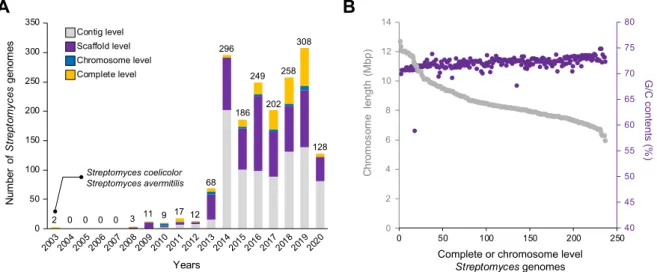
Since the whole genome sequences of Streptomyces coelicolor A3 (2) and Streptomyces avermitilis were completed by shotgun sequencing in 2003 [20,21], a number of Streptomyces genome sequences has been reported. Next Generation Sequencing (NGS) has revolutionized the field and enabled a drastic increase in the number of reported genomes for Streptomyces since 2013 (Fig. 1A). According to the RefSeq database, a total of 1,749 Strep-tomyces genomes had been deposited as of the 6th of February 2020, and more than 73% of the genomes were sequenced by NGS techniques, such as Illumina, PacBio, 454, and MinION. The 1,749 Streptomyces genomes composed of 867 contig level (i.e., genomes include only contigs), 646 scaffold level (i.e., genomes include scaffolds and contigs), 36 chromosome level (i.e., genomes include chromosomes, scaffolds, and contigs), and 200 complete genomes (Fig. 1A)[6]. Considering that the 36 chromosome level genomes were assembled using ambiguous (N) bases, and that three of the complete genomes contained ambiguous (N) bases, high-quality Streptomyces genomes comprise only about 11% of the total Streptomyces genomes available. The length of the 236
scaffold and complete chromosomes ranged from 5.9 to 12.7 Mbp and an average G + C content of 71.7% (B). Large genome size and unusually high G + C content are the representative features of the Streptomyces genome as mentioned above. Interestingly, the shorter the chromosome length, the higher the G + C content observed (Fig. 1B). This is probably because G + C content in the ‘‘core” region is highly conserved between various species, while the ‘‘arms” are less conserved and contain relatively low G + C content.
2.3. Importance of high-quality genome sequences for genome mining SmBGC prediction using contig-level genome is usually inap-propriate because genes in an smBGC are often predicted to be scattered through several contigs. As described above, approxi-mately 90% of the reported Streptomyces genomes are incomplete, containing varying degrees of contig or ambiguous sequence con-tributions. Securing high-quality Streptomyces genome sequences is challenging as a result of the low fidelity of current sequencing techniques when dealing with high G + C and repetitive sequences [7]. Furthermore, because of its linear chromosome, it is difficult to evaluate the completeness of the genome assembly when com-pared to other bacteria with circular chromosomes. Completeness of the genome is typically quantified using Benchmarking Univer-sal Single-Copy Orthologs (BUSCO), which measures the number of copies of single copy genes in the sequence data and provides a quantitative assessment of genome assembly and gene sets[22]. In 2016, genome completeness of 653 Streptomyces genomes was analyzed using BUSCO, which revealed that about 36% of Strepto-myces genomes have poor completeness[23]. Given that the Strep-tomyces BUSCO markers used in this analysis included only 40 genes, and the fact that the number of single copy genes in the Streptomyces genome now sits at 352, even the reported complete-ness of the Streptomyces genomes needs to be reassessed.
In addition to the completeness of genome assembly, quality of genome sequence (i.e., quality of bases) is also important for deter-mining smBGC, in the aspect of accurate coding sequence (CDS) prediction. Especially as most of the smBGCs are composed of long core biosynthetic genes (>5 kb) containing repetitive sequences, thus, inaccurate genome sequence often results in frameshift errors during the prediction of CDSs within the smBGCs. For instance, the genome sequence of Streptomyces clavuligerus ATCC 27064, which producesb-lactam class antibiotic clavulanic acid,
has been determined, but the quality of the reported genomes was poor and contained a large number of ambiguous (N) sequences[24,25]. Recently, a high-quality genome sequence for S. clavuligerus was obtained using PacBio and Illumina sequencing methods, revealing that 2,184 genes out of a total of 7,163 genes were miss- or not-predicted in the previous low-quality genome sequences, including 47 genes encoded in smBGCs. The accurate CDS prediction often improves the functional annotation of genes. For example, in a low-quality genome, CRV15_02370, which located in terpene BGC, was annotated as unknown lipoprotein. Meanwhile, in the high-quality genome, the exact sequence of tan-dem ambiguous (N) sequences located at the upstream region of CRV15_02370 was determined, resulting in correction and re-annotation of the CRV15_02370 as 1-hydroxy-2-methyl-2-butenyl 4-diphosphatereductase[26]. As in the case of S. clavuli-gerus, applying both the PacBio sequencing method generates long reads of several kb, and the Illumina sequencing method, which has a low error rate, could be the solution to obtaining high-quality Streptomyces genomes[6,26]. In addition, Oxford nanopore sequencing method, which has been dominating the long-read sequencing platform with PacBio sequencing method, is more cost-effective and provides even longer reads (current record of 2.3 Mbp) than PacBio sequencing method[27]. Thus, Oxford nano-pore sequencing method is expected to be an attractive alternative to PacBio sequencing method for securing high-quality Strepto-myces genomes.
Nevertheless, the functional annotation of high-quality Strepto-myces genome still yields a considerable amount of hypothetical proteins, due to the limited number of experimentally validated genes in the database. Indeed, about 24% of total S. clavuligerus genes and 25% of smBGC encoded genes were annotated as unknown genes. Even worse, the currently automated gene anno-tation pipelines utilize incorrect annoanno-tation existing in previous genomes to annotate new genomes because the public annotation database does not update any corrected annotation errors, neglect-ing the spread of misinformed functional role of the gene[28]. These incomplete functional annotations have been hampered the accurate genome mining of smBGCs and mechanistic under-standing of secondary metabolite biosynthesis. Frequent and effi-cient update of the smBGC database with the support of individual functional genomic studies would mitigate these problems.
Fig. 1. Current status ofStreptomyces genome sequences. (A) Annual number of deposited Streptomyces genomes in RefSeq database as of the 6th of Feb 2020. (B) Chromosome length and G + C content of 236 scaffold and complete level Streptomyces genomes.
producing non-ribosomally synthesized peptides (NRP) which are assembled by the core enzymes of large multi-modular complexes consisting of highly conserved domains and sequences. Designing probes based on these conserved sequences and screening for smBGCs using Southern blots was a popular and widely used approach for several decades. One example of this approach is the identification of the aminocoumarin antibiotic clorobiocin BGC discovered by screening the cosmid library of Streptomyces roseochromogenes using two heterologous probes designed against the sequence of the novobiocin BGC[33].
3.2. In silico tools for genome mining of smBGCs
Development of in silico nucleotide or amino acid sequence alignment tools, such as BLAST, Diamond, and HMMer, enabled researchers to mine for novel smBGCs in databases and genome sequences using a conserved sequence without the time-consuming processes of performing a Southern blot. The first microbial natural-product biosynthetic loci database for in silico genome mining of smBGCs was DECIPHER, which is a proprietary database constructed by Ecopia Biosciences Inc.[34]. Since then, various free databases and tools for smBGC prediction have been developed, including BAGEL[8], ClustScan[9], CLUSEAN[10], and NP.searcher[11]. Many of these tools have already been compre-hensively reviewed, and the recently released web portal called ‘‘Secondary Metabolite Bioinformatics Portal” provides a descrip-tion of and manual for each of these mining software and data-bases [35]. However, most of these tools are limited to the discovery of specific classes of secondary metabolites, including PKS and NRPS.
PRISM and antiSMASH are representative in silico tools for pre-dicting various types of smBGCs [12,13]. These tools predict smBGC types by employing a sequence alignment-based profile in a Hidden Markov Model (HMM) of genes that are specific for certain types of smBGCs. For example, antiSMASH identifies smBGCs based on the highly conserved core biosynthetic enzymes and evaluates the results using a set of manually curated BGC clus-ter rules, followed by discarding false positives using negative models (e.g., fatty acid synthases are homologous to PKSs). The lat-est version, PRISM version 3, can identify 22 different types of smBGCs, and antiSMASH version 5 can predict up to 52 different types of smBGCs. Both tools are user-friendly web applications, which provide rapid gene annotation when bacterial genomes are submitted in FASTA format, making them popular tools in cur-rent mining studies. These are the most used genome mining tools, but these rule-based tools are restricted to detect similar smBGCs to known pathways. Accordingly, recently, smBGC mining tools that utilize machine learning strategies like ClusterFinder and
available Streptomyces genomes suggested the importance of gen-ome mining at the strain level as it increases the likelihood that researchers discover useful derivatives of known secondary metabolites and expands the diversity of recognized secondary metabolites used in new mining approaches[14].
3.3. Characterizing smBGCs identified by genome mining
Although genome mining approaches showcase the full biosyn-thetic potential of Streptomyces, it is worthless without linking the predicted smBGCs to their product. In this section, we describe sev-eral examples of genome mining approaches, which connect vari-ous metabolites with their corresponding smBGCs using (i) reverse (metabolites to genes) or (ii) forward (genes to metabo-lites) approaches. The reverse approach allows researchers to determine the BGCs of known secondary metabolites, and forward approach identifies the products of novel smBGCs (Fig. 2).
In the pre-genomic era, especially in the golden age of antibiotic discovery (1950 to 1960), plenty of Streptomyces species were iso-lated from the environment and screened for antimicrobial activ-ity. However, after isolation, only antimicrobial compounds were identified via chemistry-based methods, and in most cases, the cor-responding smBGCs were not determined as a result of the lack of information and relevant technologies, including DNA sequencing method[39,40]. In recent years, advances in genome mining tools have allowed researchers to adopt a reverse approach to determin-ing the BGCs of known secondary metabolites produced from Streptomyces. These efforts have enabled us to identify and eluci-date the biosynthetic pathways of various important secondary metabolites much faster and more efficiently than conventional randomized mutagenesis-based methods (Table 1). For example, anthracimycin, a macrolide antibiotic that exhibits antibacterial activity against methicillin-resistant Staphylococcus aureus and vancomycin-resistant enterococci[41], was isolated from Strepto-myces sp. T676 in 1995, but its BGC could not be determined at the time[42]. Recently, the genome sequence of Streptomyces sp. T676 was captured, and two type I modular PKS gene clusters were identified by genome mining using antiSMASH. Through additional bioinformatics analysis, one PKS gene cluster was identified as the candidate pathway for the production of anthracimycin, and heterologous expression of this BGC in S. coelicolor resulted in the production of anthracimycin [42]. SmBGC information obtained from reverse approaches has expanded smBGC databases, increasing the accuracy of the genome mining tools and the num-ber of predictable smBGC types.
Accumulated Streptomyces genome sequences and advanced genome mining tools provide opportunities for the forward approach to smBGC identification, which allows researchers to identify the novel smBGCs from the genome, then identify the
pro-duct of this smBGC (Table 2). Curacozole is the first sequential oxazole/methyloxazole/thiazole ring-containing macrocyclic pep-tide compound identified using a genome mining based approach. Genome mining of Streptomyces curacoi isolated a new precursor peptide gene for ribosomally synthesized and post-translationally modified peptides (RiPPs). Purifying and determining the structure
of the product of this RiPP BGC using ESI-MS and NMR resulted in the discovery of new cytotoxic compound, curacozole[43]. In the case of curacozole, the structural prediction of RiPPs from the genomic data is comparatively easier than that of other secondary metabolites, because the entire sequence of the core peptides translated from the nucleotide sequence is generally retained in
Fig. 2. Overview of genome mining approaches to identify smBGCs inStreptomyces. Minimum Information about a Biosynthetic Gene cluster (MIBiG) is repository for secondary metabolite biosynthetic gene clusters.
Table 1
Selected examples of the reverse approach in smBGC genome mining from Streptomyces.
Strains Genome mining methods Compound name Year Ref.
Streptomyces chromofuscus ATCC 49982 PKS gene search Herboxidiene 2012 [54]
Streptomyces netropsis CGMCC 4.1650 BLAST Pyrroleamides 2014 [55]
Streptomyces sp. T676 antiSMASH Anthracimycin 2015 [42]
Streptomyces paulus NRRL 8115 antiSMASH Paulomycin 2015 [60]
Streptomyces olivaceus strain FXJ7.023 antiSMASH Lobophorin 2016 [56]
Streptomyces sp. MSC090213JE08 antiSMASH Ishigamide 2016 [57]
Streptomyces leeuwenhoekii DSM 42122 antiSMASH Chaxamycin 2016 [58]
Streptomyces sp. CNR-698 BLASTP Ammosamides 2016 [59]
Stretpomyces anulatus 3533-SV4 RiPP gene search Telomestatin 2017 [61]
Streptomyces lydicus A02 BLASTP and antiSMASH Natamycin 2017 [62]
Streptomyces sp. MP131-18 antiSMASH Lynamicins and spiroindimicins 2017 [63]
Streptomyces sp. SD85 antiSMASH Sceliphrolactam 2018 [64]
Streptomyces sp. strain fd1-xmd antiSMASH Streptothricin and tunicamycin 2018 [65]
Streptomyces koyangensis SCSIO 5802 antiSMASH Neoabyssomicin and abyssomicin 2018 [66]
Streptomyces olivaceus FXJ8.012 BLAST Mycemycin 2018 [67]
Streptomyces sp. ATCC 14903 antiSMASH and BLAST Actinonin 2018 [68]
Streptomyces aureofaciens ATCC 31442 antiSMASH Triacsins 2018 [69]
Streptomyces lunaelactis MM109T
antiSMASH Ferroverdins and bagremycins 2019 [70]
Streptomyces nigrescens HEK616 BLASTP Streptoaminals 2019 [71]
Streptomyces sp. Tu 4128 antiSMASH Bagremycin 2019 [72]
Streptomyces caniferus CA-271066 antiSMASH Caniferolides 2019 [73]
Streptomyces sp. S816 antiSMASH Pentamycin 2019 [74]
Streptomyces humidus CA-100629 antiSMASH Humidimycin 2020 [75]
the final product. To overcome the low productivity of curacozole and allow its robust purification, S. curacoi was treated with rifam-picin to induce mutations, one of which occurred within the RNA polymeraseb subunit, which facilitated an increased production of secondary metabolites. Thus, successful forward approaches for smBGC genome mining require two things; (i) there needs to be a predictable draft structure of the final product and (ii) the novel smBGCs need to be expressed at a high enough level to pro-duce detectable quantities of the secondary metabolite.
There are several computational methods to predict the puta-tive products of smBGCs, which use databases of experimentally characterized smBGCs as a reference, especially for PKSs and NRPSs. These methods use the basic rules of structure prediction which consider the substrate specificity of the catalytic domains of PKSs and the NRPSs modules to construct the backbone struc-ture of the product, which is followed by the identification of tai-loring domains to estimate further modifications or cyclization of the compounds and these results are mapped back to the database to give the user an idea of the secondary metabolite produced by their unknown smBGC. Comprehensive genome mining tools, anti-SMASH and PRISM, also provide the chemical structure predictions of putative products from unknown smBGCs[44]. The accuracy of chemistry prediction is dependent on the algorithm and the data-base used to predict the catalytic domains of the enzyme and the substrate specificity of the domains. When PRISM version 1 was released, it was the unique tool capable of predicting the chemical structure of type II PKs, and the chemistry prediction accuracy for NRPs and type I PKs was also much higher than antiSMASH version 3.0 or NP.searcher[45]. After further improvement, PRISM version 3 became available for chemical structure prediction of products arising from non-modular biosynthetic paradigms, including RiPPs, aminocoumarins, antimetabolites, bisindoles, and phosphonate-containing natural product[12]. AntiSMASH also improved chem-istry prediction when updated to version 4.0, but it provides con-servative structure prediction compared to PRISM, which
generates a wide range of combinatorial libraries of predicted structures by considering the uncertainty of tailoring sites [46]. Although the chemistry prediction accuracy of the most recent ver-sions of PRISM version 4 and antiSMASH version 5.0 has never been compared, it is appropriate to use both tools according to the user’s research purposes. Despite the aforementioned advances in chemistry prediction, lack of information on tailoring enzymes and frequent assignment of nearby smBGCs as hybrid smBGCs still require further experimental validation of the chemistry prediction.
To fulfill the second requirement for forward mapping approaches, several other technologies were integrated into the genome mining approach to increase secondary metabolite pro-duction or activate silent smBGCs. Since, most smBGCs of Strepto-myces are silent under laboratory-culture condition, altering the expression level of smBGCs to produce enough amount of sec-ondary metabolites have to come before linking the secsec-ondary metabolites to the corresponding smBGCs. This method relies on the treatment of cultures with elicitors or mutagens to increase the expression of smBGCs as in the case of curacozole discovery. Genome engineering is also a suitable method for inducing silent smBGCs, for example, one study used CRISPR-Cas9 to introduce constitutive promoters to silent novel smBGCs loci forcing the pro-duction of unique metabolites which were then evaluated by NMR [47]. Since smBGCs consist of dozens of genes, to efficiently acti-vate the entire cluster, most of the studies have engineered the expression level of global or cluster-specific regulatory genes. Gen-ome engineering of Streptomyces for the characterization of silent smBGCs has strengthened with the development of synthetic biol-ogy tools for Streptomyces[48]. However, genome engineering is not always applicable as a result of the difficulty in manipulating the genome of these bacteria and their slow growth rates. Heterol-ogous expression of silent smBGCs in other Streptomyces is also a suitable alternative[49]. To enable this, there has been a signifi-cant amount of efforts put into the construction of a Streptomyces
Streptomyces sp. YIM 130001 antiSMASH Thiopeptide Antibiotic 2018 [94]
Streptomyces avermitilis KA-320 PKS gene search Phthoxazolin A 2018 [95]
Streptomyces actuosus ATCC 25421 antiSMASH Avermipeptin Analogue 2018 [96]
Streptomyces sp. YIM 130001 antiSMASH Geninthiocin B 2018 [94]
Streptomyces sp. DUT11 antiSMASH and BLAST Tunicamycin 2018 [97]
Streptomyces curacoi NBRC 12761T antiSMASH and BLAST Curacozole (cytotoxic peptide) 2019 [43]
Streptomyces albus subsp. Chlorinus NRRL B-24108 antiSMASH Nybomycin 2018 [98]
Streptomyces isolatess ICC1 and ICC4 antiSMASH 20,50–dimethoxyflavone and nordentatin 2019 [99]
Streptomyces hawaiiensis NRRL 15010 antiSMASH and BLAST Acyldepsipeptide (ADEP) 2019 [100]
Streptomyces atratus SCSIO ZH16 antiSMASH Atratumycin 2019 [101]
Streptomyces leeuwenhoekii C34T
antiSMASH Leepeptin 2019 [102]
Streptomyces olivaceus SCSIO T05 antiSMASH Lobophorin CR4 2019 [103]
chassis strain, which has a reduced chemical diversity as a result of the removal of its endogenous smBGCs, meaning that it can be used as a heterologous expression host for novel smBGCs charac-terization with reduced confounding effects[50].
Forward experimentation is significantly more challenging than the reverse method when it comes to chemical characterization of secondary metabolites. Notably, the existence of a large number of completely unknown genes, which may encode enzymes catalyz-ing the product tailorcatalyz-ing steps, prevent the accuracy of predictions for the forward approach. As the smBGC database constantly expands along with the accumulation of individual functional genomics experiments, the forward approach will continue to evolve and has the most potential for the isolation and identifica-tion of novel bioactive compounds from Streptomyces.
4. Summary and outlook
In this mini review, we discussed the current status of Strepto-myces genome sequencing data and in silico genome mining tools for smBGCs prediction. Technical advances in DNA sequencing and the rapid development of in silico genome mining tools demonstrate that the biosynthetic potential of Streptomyces has been vastly underestimated. We went on to discuss the fact that mining of smBGCs from the Streptomyces genome and characteri-zation of their corresponding products using forward and reverse approaches are feasible and illustrated this with several examples. Reverse approaches link known secondary metabolites to their cor-responding smBGCs and expand the current smBGC database pools enhancing the accuracy and versatility of in silico genome mining tools. In contrast, forward approaches enable the discovery of novel bioactive compounds from the Streptomyces, securing new drug candidates. The important lesson from the genome mining examples is that major bottlenecks in this process are limitation on detecting poorly characterized classes of smBGCs and determin-ing final products of detected smBGCs. Several challenges must be overcome to enable the efficient discovery of novel secondary metabolites from Streptomyces. For accurate in silico structure pre-dictions of putative products from smBGCs, mechanistic under-standing of secondary metabolite biosynthesis based on accumulated knowledge is still lacking. Simultaneously, the induc-tion of silent smBGCs to experimentally validate the structure of final products remains difficult, which means that there needs to be a focus on the development of synthetic biology tools for gen-ome engineering and the construction of a Streptomyces chassis strain to facilitate heterologous expression.
The final use of Streptomyces smBGC information obtained from genome mining approaches will be the knowledge-based repur-posing of smBGCs to produce derivatives of original products or non-natural compounds to improve human health and industry. Recently, several groups undertook the construction of a new assembly line for the production of fuels and synthetic industrial compounds facilitated by the rearrangement of PKS and NRPs modules[51,52]. In addition, ClusterCAD, an in silico toolkit for designing novel PKS assembly lines, has been developed and applied in several retro-biosynthesis studies[53]. If genome min-ing and characterization of smBGCs’ products are repeated in a positive feedback cycle, it could ultimately be used to design and generate synthetic BGCs for the production of novel bioactive compounds.
CRediT authorship contribution statement
Namil Lee: Conceptualization, Formal analysis, Writing - origi-nal draft, Writing - review & editing. Soonkyu Hwang: Formal analysis. Jihun Kim: Formal analysis. Suhyung Cho: Writing -
orig-inal draft. Bernhard Palsson: Writing - origorig-inal draft. ByungKwan Cho: Conceptualization, Writing original draft, Writing -review & editing.
Declaration of Competing Interest
The authors declare that they have no known competing finan-cial interests or personal relationships that could have appeared to influence the work reported in this paper.
Acknowledgments
This work was supported by a grant from the Novo Nordisk Foun-dation (grant number NNF10CC1016517). This research was also supported by the Basic Science Research Program (2018R1A1A3A04079196 to S.C.), the Basic Core Technology Devel-opment Program for the Oceans and the Polar Regions (2016M1A5A1027458 to B.-K.C.), and the Bio & Medical Technol-ogy Development Program (2018M3A9F3079664 to B.-K.C.) through the National Research Foundation (NRF) funded by the Ministry of Science and ICT.
Author contributions
B.-K.C. conceived and supervised the study. N.L., S.H., and J.K. performed the analysis. N.L., S.C., B.P., and B.-K.C. wrote the manuscript.
References
[1] O’Brien J, Wright GD. An ecological perspective of microbial secondary metabolism. Curr Opin Biotechnol 2011;22:552-8. .
[2] Handelsman J, Rondon MR, Brady SF, Clardy J, Goodman RM. Molecular biological access to the chemistry of unknown soil microbes: a new frontier for natural products. Chem Biol 1998;5:R245–9. https://doi.org/10.1016/ s1074-5521(98)90108-9.
[3] Shore CK, Coukell A. Roadmap for antibiotic discovery. Nat Microbiol 2016;1:16083.https://doi.org/10.1038/nmicrobiol.2016.83.
[4] McClure NS, Day T. A theoretical examination of the relative importance of evolution management and drug development for managing resistance. Proc Biol Sci 2014;281.https://doi.org/10.1098/rspb.2014.1861.
[5] Craney A, Ahmed S, Nodwell J. Towards a new science of secondary metabolism. J Antibiot (Tokyo) 2013;66:387–400.https://doi.org/10.1038/ ja.2013.25.
[6] Lee N, Kim W, Hwang S, Lee Y, Cho S, Palsson B, et al. Thirty complete Streptomyces genome sequences for mining novel secondary metabolite biosynthetic gene clusters. Sci Data 2020;7:55. https://doi.org/10.1038/ s41597-020-0395-9.
[7] Harrison J, Studholme DJ. Recently published Streptomyces genome sequences. Microb Biotechnol 2014;7:373–80. https://doi.org/10.1111/ 1751-7915.12143.
[8] de Jong A, van Hijum SA, Bijlsma JJ, Kok J, Kuipers OP. BAGEL: a web-based bacteriocin genome mining tool. Nucleic Acids Res 2006;34:W273–9.https:// doi.org/10.1093/nar/gkl237.
[9] Starcevic A, Zucko J, Simunkovic J, Long PF, Cullum J, Hranueli D. ClustScan: an integrated program package for the semi-automatic annotation of modular biosynthetic gene clusters and in silico prediction of novel chemical structures. Nucleic Acids Res 2008;36:6882–92.https://doi.org/10.1093/nar/ gkn685.
[10] Weber T, Rausch C, Lopez P, Hoof I, Gaykova V, Huson DH, et al. CLUSEAN: a computer-based framework for the automated analysis of bacterial secondary metabolite biosynthetic gene clusters. J Biotechnol 2009;140:13–7.https://doi.org/10.1016/j.jbiotec.2009.01.007.
[11] Li MH, Ung PM, Zajkowski J, Garneau-Tsodikova S, Sherman DH. Automated genome mining for natural products. BMC Bioinf 2009;10:185.https://doi. org/10.1186/1471-2105-10-185.
[12] Skinnider MA, Merwin NJ, Johnston CW, Magarvey NA. PRISM 3: expanded prediction of natural product chemical structures from microbial genomes. Nucleic Acids Res 2017;45:W49–54.https://doi.org/10.1093/nar/gkx320. [13] Blin K, Shaw S, Steinke K, Villebro R, Ziemert N, Lee SY, et al. antiSMASH 5.0:
updates to the secondary metabolite genome mining pipeline. Nucleic Acids Res 2019;47:W81–7.https://doi.org/10.1093/nar/gkz310.
[14] Belknap KC, Park CJ, Barth BM, Andam CP. Genome mining of biosynthetic and chemotherapeutic gene clusters in Streptomyces bacteria. Sci Rep 2020;10:2003.https://doi.org/10.1038/s41598-020-58904-9.
microorganism Streptomyces avermitilis. Nat Biotechnol 2003;21:526–31.
https://doi.org/10.1038/nbt820.
[22] Simao FA, Waterhouse RM, Ioannidis P, Kriventseva EV, Zdobnov EM. BUSCO: assessing genome assembly and annotation completeness with single-copy orthologs. Bioinformatics 2015;31:3210–2. https://doi.org/10.1093/ bioinformatics/btv351.
[23] Studholme DJ. Genome update. Let the consumer beware: Streptomyces genome sequence quality. Microb Biotechnol 2016;9:3–7.https://doi.org/ 10.1111/1751-7915.12344.
[24] Medema MH, Trefzer A, Kovalchuk A, van den Berg M, Muller U, Heijne W, et al. The sequence of a 1.8-mb bacterial linear plasmid reveals a rich evolutionary reservoir of secondary metabolic pathways. Genome Biol Evol 2010;2:212–24.https://doi.org/10.1093/gbe/evq013.
[25] Song JY, Jeong H, Yu DS, Fischbach MA, Park HS, Kim JJ, et al. Draft genome sequence of Streptomyces clavuligerus NRRL 3585, a producer of diverse secondary metabolites. J Bacteriol 2010;192:6317–8. https://doi.org/ 10.1128/JB.00859-10.
[26] Hwang S, Lee N, Jeong Y, Lee Y, Kim W, Cho S, et al. Primary transcriptome and translatome analysis determines transcriptional and translational regulatory elements encoded in the Streptomyces clavuligerus genome. Nucleic Acids Res 2019;47:6114–29.https://doi.org/10.1093/nar/gkz471.
[27] Amarasinghe SL, Su S, Dong X, Zappia L, Ritchie ME, Gouil Q. Opportunities and challenges in long-read sequencing data analysis. Genome Biol 2020;21:30.https://doi.org/10.1186/s13059-020-1935-5.
[28] Salzberg SL. Next-generation genome annotation: we still struggle to get it right. Genome Biol 2019;20:92. https://doi.org/10.1186/s13059-019-1715-2.
[29] Rudd BA, Hopwood DA. Genetics of actinorhodin biosynthesis by Streptomyces coelicolor A3(2). J Gen Microbiol 1979;114:35–43.https://doi. org/10.1099/00221287-114-1-35.
[30] Malpartida F, Hopwood DA. Molecular cloning of the whole biosynthetic pathway of a Streptomyces antibiotic and its expression in a heterologous host. Nature 1984;309:462–4.https://doi.org/10.1038/309462a0.
[31] Ikeda H, Kotaki H, Omura S. Genetic studies of avermectin biosynthesis in Streptomyces avermitilis. J Bacteriol 1987;169:5615–21. https://doi.org/ 10.1128/jb.169.12.5615-5621.1987.
[32] Ziemert N, Alanjary M, Weber T. The evolution of genome mining in microbes - a review. Nat Prod Rep 2016;33:988–1005. https://doi.org/10.1039/ c6np00025h.
[33] Pojer F, Li SM, Heide L. Molecular cloning and sequence analysis of the clorobiocin biosynthetic gene cluster: new insights into the biosynthesis of aminocoumarin antibiotics. Microbiology 2002;148:3901–11. https://doi. org/10.1099/00221287-148-12-3901.
[34] Zazopoulos E, Huang K, Staffa A, Liu W, Bachmann BO, Nonaka K, et al. A genomics-guided approach for discovering and expressing cryptic metabolic pathways. Nat Biotechnol 2003;21:187–90. https://doi.org/ 10.1038/nbt784.
[35] Weber T, Kim HU. The secondary metabolite bioinformatics portal: computational tools to facilitate synthetic biology of secondary metabolite production. Synth Syst Biotechnol 2016;1:69–79.https://doi.org/10.1016/j. synbio.2015.12.002.
[36] Hannigan GD, Prihoda D, Palicka A, Soukup J, Klempir O, Rampula L, et al. A deep learning genome-mining strategy for biosynthetic gene cluster prediction. Nucleic Acids Res 2019;47:. https://doi.org/10.1093/nar/ gkz654e110.
[37] Cimermancic P, Medema MH, Claesen J, Kurita K, Wieland Brown LC, Mavrommatis K, et al. Insights into secondary metabolism from a global analysis of prokaryotic biosynthetic gene clusters. Cell 2014;158:412–21.
https://doi.org/10.1016/j.cell.2014.06.034.
[38] Doroghazi JR, Metcalf WW. Comparative genomics of actinomycetes with a focus on natural product biosynthetic genes. BMC Genomics 2013;14:611.
https://doi.org/10.1186/1471-2164-14-611.
[39]Waksman SA, Reilly HC, Johnstone DB. Isolation of streptomycin-producing strains of Streptomyces griseus. J Bacteriol 1946;52:393–7.
4.0-improvements in chemistry prediction and gene cluster boundary identification. Nucleic Acids Res 2017;45:W36–41. https://doi.org/ 10.1093/nar/gkx319.
[47] Zhang MM, Wong FT, Wang Y, Luo S, Lim YH, Heng E, et al. CRISPR-Cas9 strategy for activation of silent Streptomyces biosynthetic gene clusters. Nat Chem Biol 2017.https://doi.org/10.1038/nchembio.2341.
[48] Lee N, Hwang S, Lee Y, Cho S, Palsson B, Cho BK. Synthetic biology tools for novel secondary metabolite discovery in Streptomyces. J Microbiol Biotechnol 2019;29:667–86.https://doi.org/10.4014/jmb.1904.04015.
[49] Nah HJ, Pyeon HR, Kang SH, Choi SS, Kim ES. Cloning and heterologous expression of a large-sized natural product biosynthetic gene cluster in Streptomyces Species. Front Microbiol 2017;8:394.https://doi.org/10.3389/ fmicb.2017.00394.
[50] Bu QT, Yu P, Wang J, Li ZY, Chen XA, Mao XM, et al. Rational construction of genome-reduced and high-efficient industrial Streptomyces chassis based on multiple comparative genomic approaches. Microb Cell Fact 2019;18:16.
https://doi.org/10.1186/s12934-019-1055-7.
[51] Liu Q, Wu K, Cheng Y, Lu L, Xiao E, Zhang Y, et al. Engineering an iterative polyketide pathway in Escherichia coli results in single-form alkene and alkane overproduction. Metab Eng 2015;28:82–90.https://doi.org/10.1016/j. ymben.2014.12.004.
[52] Yuzawa S, Mirsiaghi M, Jocic R, Fujii T, Masson F, Benites VT, et al. Short-chain ketone production by engineered polyketide synthases in Streptomyces albus. Nat Commun 2018;9:4569.https://doi.org/10.1038/s41467-018-07040-0. [53] Eng CH, Backman TWH, Bailey CB, Magnan C, Garcia Martin H, Katz L, et al.
ClusterCAD: a computational platform for type I modular polyketide synthase design. Nucleic Acids Res 2018;46:D509–15. https://doi.org/10.1093/nar/ gkx893.
[54] Shao L, Zi J, Zeng J, Zhan J. Identification of the herboxidiene biosynthetic gene cluster in Streptomyces chromofuscus ATCC 49982. Appl Environ Microbiol 2012;78:2034–8.https://doi.org/10.1128/AEM.06904-11.
[55] Hao C, Huang S, Deng Z, Zhao C, Yu Y. Mining of the pyrrolamide antibiotics analogs in Streptomyces netropsis reveals the amidohydrolase-dependent ‘‘iterative strategy” underlying the pyrrole polymerization. PLoS ONE 2014;9:.https://doi.org/10.1371/journal.pone.0099077e99077.
[56]Yue C, Niu J, Liu N, Lu Y, Liu M, Li Y. Cloning and identification of the lobophorin biosynthetic gene cluster from marine Streptomyces olivaceus strain FXJ7.023. Pak J Pharm Sci 2016;29:287–93.
[57] Du D, Katsuyama Y, Onaka H, Fujie M, Satoh N, Shin-Ya K, et al. Production of a novel amide-containing polyene by activating a cryptic biosynthetic gene cluster in Streptomyces sp. MSC090213JE08. ChemBioChem 2016;17:1464–71.https://doi.org/10.1002/cbic.201600167.
[58] Castro JF, Razmilic V, Gomez-Escribano JP, Andrews B, Asenjo JA, Bibb MJ. Identification and heterologous expression of the chaxamycin biosynthesis gene cluster from Streptomyces leeuwenhoekii. Appl Environ Microbiol 2015;81:5820–31.https://doi.org/10.1128/AEM.01039-15.
[59] Jordan PA, Moore BS. Biosynthetic pathway connects cryptic ribosomally synthesized posttranslationally modified peptide genes with pyrroloquinoline alkaloids. Cell Chem Biol 2016;23:1504–14. https://doi. org/10.1016/j.chembiol.2016.10.009.
[60] Li J, Xie Z, Wang M, Ai G, Chen Y. Identification and analysis of the paulomycin biosynthetic gene cluster and titer improvement of the paulomycins in Streptomyces paulus NRRL 8115. PLoS ONE 2015;10:.https://doi.org/10.1371/ journal.pone.0120542e0120542.
[61] Amagai K, Ikeda H, Hashimoto J, Kozone I, Izumikawa M, Kudo F, et al. Identification of a gene cluster for telomestatin biosynthesis and heterologous expression using a specific promoter in a clean host. Sci Rep 2017;7:3382.https://doi.org/10.1038/s41598-017-03308-5.
[62] Wu H, Liu W, Shi L, Si K, Liu T, Dong D, et al. Comparative genomic and regulatory analyses of natamycin production of Streptomyces lydicus A02. Sci Rep 2017;7:9114.https://doi.org/10.1038/s41598-017-09532-3.
[63] Paulus Constanze, Rebets Yuriy, Tokovenko Bogdan, Nadmid Suvd, Terekhova Larisa P, Myronovskyi Maksym, Zotchev Sergey B, Rückert Christian, Braig Simone, Zahler Stefan, Kalinowski Jörn, Luzhetskyy Andriy. New natural
products identified by combined genomics-metabolomics profiling of marine Streptomyces sp. MP131-18. Sci Rep 2017;7(1). https://doi.org/10.1038/ srep42382.
[64] Low ZJ, Pang LM, Ding Y, Cheang QW, Le Mai Hoang K, Thi Tran H, et al. Identification of a biosynthetic gene cluster for the polyene macrolactam sceliphrolactam in a Streptomyces strain isolated from mangrove sediment. Sci Rep 2018;8:1594.https://doi.org/10.1038/s41598-018-20018-8. [65] Yu Y, Tang B, Dai R, Zhang B, Chen L, Yang H, et al. Identification of the
streptothricin and tunicamycin biosynthetic gene clusters by genome mining in Streptomyces sp. strain fd1-xmd. Appl Microbiol Biotechnol 2018;102:2621–33.https://doi.org/10.1007/s00253-018-8748-4.
[66] Tu J, Li S, Chen J, Song Y, Fu S, Ju J, et al. Characterization and heterologous expression of the neoabyssomicin/abyssomicin biosynthetic gene cluster from Streptomyces koyangensis SCSIO 5802. Microb Cell Fact 2018;17:28.
https://doi.org/10.1186/s12934-018-0875-1.
[67] Song F, Liu N, Liu M, Chen Y, Huang Y. Identification and characterization of mycemycin biosynthetic gene clusters in Streptomyces olivaceus FXJ8.012 and Streptomyces sp. FXJ1.235. Mar Drugs 2018;16. https://doi.org/10.3390/ md16030098.
[68] Wolf F, Leipoldt F, Kulik A, Wibberg D, Kalinowski J, Kaysser L. Characterization of the actinonin biosynthetic gene cluster. ChemBioChem 2018.https://doi.org/10.1002/cbic.201800116.
[69] Twigg FF, Cai W, Huang W, Liu J, Sato M, Perez TJ, et al. Identifying the biosynthetic gene cluster for triacsins with an N-hydroxytriazene moiety. ChemBioChem 2019;20:1145–9.https://doi.org/10.1002/cbic.201800762. [70] Martinet L, Naome A, Deflandre B, Maciejewska M, Tellatin D, Tenconi E, et al.
A single biosynthetic gene cluster is responsible for the production of bagremycin antibiotics and ferroverdin iron chelators. mBio 2019;10. . [71] Ozaki T, Sugiyama R, Shimomura M, Nishimura S, Asamizu S, Katsuyama Y,
et al. Identification of the common biosynthetic gene cluster for both antimicrobial streptoaminals and antifungal 5-alkyl-1,2,3,4-tetrahydroquinolines. Org Biomol Chem 2019;17:2370–8. https://doi.org/ 10.1039/c8ob02846j.
[72] Ye J, Zhu Y, Hou B, Wu H, Zhang H. Characterization of the bagremycin biosynthetic gene cluster in Streptomyces sp. Tu 4128. Biosci Biotechnol Biochem 2019;83:482–9.https://doi.org/10.1080/09168451.2018.1553605. [73] Perez-Victoria I, Oves-Costales D, Lacret R, Martin J, Sanchez-Hidalgo M, Diaz
C, et al. Structure elucidation and biosynthetic gene cluster analysis of caniferolides A-D, new bioactive 36-membered macrolides from the marine-derived Streptomyces caniferus CA-271066. Org Biomol Chem 2019;17:2954–71.https://doi.org/10.1039/c8ob03115k.
[74] Zhou S, Song L, Masschelein J, Sumang FAM, Papa IA, Zulaybar TO, et al. Pentamycin biosynthesis in Philippine Streptomyces sp. S816: Cytochrome P450-catalyzed installation of the C-14 hydroxyl group. ACS Chem Biol 2019;14:1305–9.https://doi.org/10.1021/acschembio.9b00270.
[75] Sanchez-Hidalgo M, Martin J, Genilloud O. Identification and heterologous expression of the biosynthetic gene cluster encoding the lasso peptide humidimycin, a caspofungin activity potentiator. Antibiotics (Basel) 2020;9.
https://doi.org/10.3390/antibiotics9020067.
[76] Kaweewan I, Hemmi H, Komaki H, Kodani S. Isolation and structure determination of a new antibacterial peptide pentaminomycin C from Streptomyces cacaoi subsp. cacaoi. J Antibiot (Tokyo) 2020;73:224–9.
https://doi.org/10.1038/s41429-019-0272-y.
[77] Lautru S, Deeth RJ, Bailey LM, Challis GL. Discovery of a new peptide natural product by Streptomyces coelicolor genome mining. Nat Chem Biol 2005;1:265–9.https://doi.org/10.1038/nchembio731.
[78] Song L, Barona-Gomez F, Corre C, Xiang L, Udwary DW, Austin MB, et al. Type III polyketide synthase beta-ketoacyl-ACP starter unit and ethylmalonyl-CoA extender unit selectivity discovered by Streptomyces coelicolor genome mining. J Am Chem Soc 2006;128:14754–5. https://doi.org/ 10.1021/ja065247w.
[79] Goto Y, Li B, Claesen J, Shi Y, Bibb MJ, van der Donk WA. Discovery of unique lanthionine synthetases reveals new mechanistic and evolutionary insights. PLoS Biol 2010;8:.https://doi.org/10.1371/journal.pbio.1000339e1000339. [80] Laureti L, Song L, Huang S, Corre C, Leblond P, Challis GL, et al. Identification of
a bioactive 51-membered macrolide complex by activation of a silent polyketide synthase in Streptomyces ambofaciens. Proc Natl Acad Sci U S A 2011;108:6258–63.https://doi.org/10.1073/pnas.1019077108.
[81] Rackham EJ, Gruschow S, Goss RJ. Revealing the first uridyl peptide antibiotic biosynthetic gene cluster and probing pacidamycin biosynthesis. Bioeng Bugs 2011;2:218–21.https://doi.org/10.4161/bbug.2.4.15877.
[82] Zhang H, Wang H, Wang Y, Cui H, Xie Z, Pu Y, et al. Genomic sequence-based discovery of novel angucyclinone antibiotics from marine Streptomyces sp. W007. FEMS Microbiol Lett 2012;332:105–12. https://doi.org/10.1111/ j.1574-6968.2012.02582.x.
[83] Park HM, Kim BG, Chang D, Malla S, Joo HS, Kim EJ, et al. Genome-based cryptic gene discovery and functional identification of NRPS siderophore peptide in Streptomyces peucetius. Appl Microbiol Biotechnol 2013;97:1213–22.https://doi.org/10.1007/s00253-012-4268-9.
[84] Meguro A, Tomita T, Nishiyama M, Kuzuyama T. Identification and characterization of bacterial diterpene cyclases that synthesize the
cembrane skeleton. ChemBioChem 2013;14:316–21. https://doi.org/ 10.1002/cbic.201200651.
[85] Mohimani H, Kersten RD, Liu WT, Wang M, Purvine SO, Wu S, et al. Automated genome mining of ribosomal peptide natural products. ACS Chem Biol 2014;9:1545–51.https://doi.org/10.1021/cb500199h.
[86] Iftime D, Jasyk M, Kulik A, Imhoff JF, Stegmann E, Wohlleben W, et al. Streptocollin, a Type IV lanthipeptide produced by Streptomyces collinus Tu 365. ChemBioChem 2015;16:2615–23. https://doi.org/10.1002/ cbic.201500377.
[87] Elsayed SS, Trusch F, Deng H, Raab A, Prokes I, Busarakam K, et al. Chaxapeptin, a lasso peptide from extremotolerant Streptomyces leeuwenhoekii strain C58 from the hyperarid atacama desert. J Org Chem 2015;80:10252–60.https://doi.org/10.1021/acs.joc.5b01878.
[88] Park OK, Choi HY, Kim GW, Kim WG. Generation of new complestatin analogues by heterologous expression of the complestatin biosynthetic gene cluster from Streptomyces chartreusis AN1542. ChemBioChem 2016;17:1725–31.https://doi.org/10.1002/cbic.201600241.
[89] Thanapipatsiri A, Gomez-Escribano JP, Song L, Bibb MJ, Al-Bassam M, Chandra G, et al. Discovery of unusual biaryl polyketides by activation of a silent Streptomyces venezuelae biosynthetic gene cluster. ChemBioChem 2016;17:2189–98.https://doi.org/10.1002/cbic.201600396.
[90] Remali J, Sarmin NM, Ng CL, Tiong JJL, Aizat WM, Keong LK, et al. Genomic characterization of a new endophytic Streptomyces kebangsaanensis identifies biosynthetic pathway gene clusters for novel phenazine antibiotic production. PeerJ 2017;5:.https://doi.org/10.7717/peerj.3738e3738. [91] Ma J, Huang H, Xie Y, Liu Z, Zhao J, Zhang C, et al. Biosynthesis of ilamycins
featuring unusual building blocks and engineered production of enhanced anti-tuberculosis agents. Nat Commun 2017;8:391.https://doi.org/10.1038/ s41467-017-00419-5.
[92] Ye S, Molloy B, Brana AF, Zabala D, Olano C, Cortes J, et al. Identification by genome mining of a type I polyketide gene cluster from Streptomyces argillaceus involved in the biosynthesis of pyridine and piperidine alkaloids argimycins P. Front Microbiol 2017;8:194. https://doi.org/10.3389/ fmicb.2017.00194.
[93] Pait IGU, Kitani S, Roslan FW, Ulanova D, Arai M, Ikeda H, et al. Discovery of a new diol-containing polyketide by heterologous expression of a silent biosynthetic gene cluster from Streptomyces lavendulae FRI-5. J Ind Microbiol Biotechnol 2018;45:77–87.https://doi.org/10.1007/s10295-017-1997-x. [94] Schneider O, Simic N, Aachmann FL, Ruckert C, Kristiansen KA, Kalinowski J,
et al. Genome mining of Streptomyces sp. YIM 130001 isolated from lichen affords new thiopeptide antibiotic. Front Microbiol 2018;9:3139.https://doi. org/10.3389/fmicb.2018.03139.
[95] Suroto DA, Kitani S, Arai M, Ikeda H, Nihira T. Characterization of the biosynthetic gene cluster for cryptic phthoxazolin A in Streptomyces avermitilis. PLoS ONE 2018;13:. https://doi.org/10.1371/journal. pone.0190973e0190973.
[96] Liu W, Sun F, Hu Y. Genome mining-mediated discovery of a new avermipeptin analogue in Streptomyces actuosus ATCC 25421. ChemistryOpen 2018;7:558–61.https://doi.org/10.1002/open.201800130. [97] Xu XN, Chen LY, Chen C, Tang YJ, Bai FW, Su C, et al. Genome mining of the
marine Actinomycete Streptomyces sp. DUT11 and discovery of tunicamycins as anti-complement agents. Front Microbiol 2018;9:;1318.https://doi.org/ 10.3389/fmicb.2018.01318.
[98] Rodriguez Estevez M, Myronovskyi M, Gummerlich N, Nadmid S, Luzhetskyy A. Heterologous expression of the nybomycin gene cluster from the marine strain Streptomyces albus subsp. chlorinus NRRL B-24108. Mar Drugs 2018;16.
https://doi.org/10.3390/md16110435.
[99] Gosse JT, Ghosh S, Sproule A, Overy D, Cheeptham N, Boddy CN. Whole genome sequencing and metabolomic study of cave Streptomyces Isolates ICC1 and ICC4. Front Microbiol 2019;10:1020. https://doi.org/10.3389/ fmicb.2019.01020.
[100] Thomy D, Culp E, Adamek M, Cheng EY, Ziemert N, Wright GD, et al. The ADEP biosynthetic gene cluster in Streptomyces hawaiiensis NRRL 15010 reveals an accessory clpP gene as a novel antibiotic resistance factor. Appl Environ Microbiol 2019;85.https://doi.org/10.1128/AEM.01292-19.
[101] Sun C, Yang Z, Zhang C, Liu Z, He J, Liu Q, et al. Genome mining of Streptomyces atratus SCSIO ZH16: Discovery of atratumycin and identification of its biosynthetic gene cluster. Org Lett 2019;21:1453–7.https://doi.org/10.1021/ acs.orglett.9b00208.
[102] Gomez-Escribano JP, Castro JF, Razmilic V, Jarmusch SA, Saalbach G, Ebel R, et al. Heterologous expression of a cryptic gene cluster from Streptomyces leeuwenhoekii C34(T) yields a novel lasso peptide, leepeptin. Appl Environ Microbiol 2019;85.https://doi.org/10.1128/AEM.01752-19.
[103] Zhang C, Ding W, Qin X, Ju J. Genome sequencing of Streptomyces olivaceus SCSIO T05 and activated production of lobophorin CR4 via metabolic engineering and genome mining. Mar Drugs 2019;17. https://doi.org/ 10.3390/md17100593.
[104] Qian Z, Bruhn T, D’Agostino PM, Herrmann A, Haslbeck M, Antal N, et al. Discovery of the streptoketides by direct cloning and rapid heterologous expression of a cryptic PKS II gene cluster from Streptomyces sp. Tu 6314. J Org Chem 2020;85:664–73.https://doi.org/10.1021/acs.joc.9b02741.