Si-On Jeon1,2, Hun Soo Chang2, Hwa-Young Lee1,2, Byung-Joo Ham1,2, Rhee-Hun Kang1,2, Yoo-Jung Jeong2 & Min-Soo Lee1,2
1Department of Psychiatry, College of Medicine, Korea University, Seoul, 136-705, Korea
2Pharmacogenomic Research Center for Psychotropic Drugs, Korea University, Seoul 136-705, Korea
Correspondence and requests for materials should be addressed to M. S. Lee ([email protected])
Accepted 22 October 2009
Abstract
Drug metabolism is a critical determinant of the ther-apeutic and adverse effects of many psychotropic drugs. The metabolism depends on the pharmacoki-netics of a drug, which includes its absorption, distri-bution, and elimination. Psychotropic drugs are meta-bolized mainly by cytochrome P450 (CYP) enzymes; about 20 of these enzymes exist and they are often responsible for the rate-limiting step of drug metabo-lism. CYP2D6 is the best-characterized P450 enzyme that exhibits polymorphism in humans. This study determined the relationship between the CYP2D6*10 (P34S) polymorphism and the response to mirtaza-pine in 153 Koreans with major depressive disorder (MDD). The genotype frequencies were compared using logistic regression analysis, and between-geno-type differences in the decrease in the 21-item Hamil-ton Depression (HAMD21) score over the 12-week treatment period were analyzed using a linear regres-sion analysis. The proportion of remitters was lower in patients with MDD possessing the S allele than in P allele carriers after 2 weeks of mirtazapine treat-ment. Similarly, the reductions in the HAMD21 and Clinical Global Impression (CGI) scores in S allele carriers were smaller than those in patients with the P allele after 2 weeks of mirtazapine treatment. In the analysis of depression symptoms, the sleep and delu-sion scores had smaller reductions in S allele carriers. Based on the Liverpool University Neuroleptic Side
Effect Rating Scale (LUNSERS), the psychic adverse effects of mirtazapine were associated with CYP2D6 P34S, while weight gain was not. These results sug-gest that CYP2D6 P34S affects the outcome of mir-tazapine treatment in patients with MDD, and that this polymorphism may be a good genetic marker for predicting the clinical outcome of mirtazapine treatment.
Keywords: CYP2D6, Major depressive disorder, Mirtaza-pine, Treatment response
The hepatic cytochrome P450 system is responsible for the first phase in the metabolism and elimination of numerous endogenous and exogenous molecules, and ingested chemicals. P450 enzymes convert these substances into electrophilic intermediates, which are then conjugated by phase II enzymes to give hydro-philic derivatives that can be excreted1.
Drug metabolism and transport genes such as CYP2D6 and CYP2C19 are obvious pharmacogenetic candidates given their known interaction with drugs like selective serotonin reuptake inhibitors (SSRIs) and their metabolites in vivo2. Moreover, several of these pharmacokinetic genes have common variants that have been shown to impair enzyme function3. For example, Yin et al. found that homozygous car-riers of the nonfunctional allele of CYP2C19 show a 42% decrease in clearance of the SSRI citalopram com-pared to homozygous carriers of the wild-type allele4. Gräsmader et al. showed that the plasma concentra-tions of several antidepressants were significantly influ-enced by the CYP2D6 and CYP2C19 genotype, altho-ugh the clinical response was not associated with the plasma concentrations of these drugs5.
Despite these known in vivo relationships between antidepressant medications and pharmacogenetic genes, few epidemiological studies have investigated the relationship between the antidepressant response and pharmacokinetic gene variants. A retrospective study of 28 patients who experienced adverse events and 16 patients who were non-responsive to a variety of antidepressants showed an association with the CYP2D6 genotype6. A prospective study of 246
elder-CYP2D6 P34S Polymorphism and Mirtazapine Responses in
Koreans with Major Depression
ly subjects taking the SSRI paroxetine found that the CYP2D6 genotype was not associated with the side-effect burden7. Another recent study of 100 subjects with depression taking fluvoxamine found that the CYP2D6 genotype does not influence the frequency of gastrointestinal side effects, although when the CYP2D6 genotype was combined with a serotonin 2A receptor polymorphism, such an association was observed8. Despite the equivocal results of these stud-ies, some studies have advocated the use of pharma-cokinetic enzyme variant information to guide clinical therapy with SSRIs, particularly by adjusting the dose9.
Mirtazapine, which is a noradrenergic specific sero-tonergic antidepressant (NaSSA), enhances noradren-ergic transmission via the blockade of α2-adrenocep-tors10-12 and serotonergic transmission indirectly via noradrenergic stimulation of α1-adrenoceptors and blockade of α2-heteroreceptors13,14. It also has anx-iolytic, hypnotic, antiemetic, orexigenic, antihista-minic, and antipruritic effects via antagonism of the 5-HT2A, 5-HT2C, 5-HT3, and H1 neurotransmitter receptors15-17. Like most antidepressants, mirtazapine is metabolized by the cytochrome P450 system, espe-cially CYP2D618.
Ethnicity is a factor in the occurrence of CYP2D6 variability, which is based on the differences in the allele frequencies of CYP2D6 among populations. For example, about 10% of whites have the nonfunc-tional CYP2D6*4 allele, while about 50% of Asians possess the CYP2D6*10 allele, which should cause decreased CYP2D6 activity19.
Although an intuitive appeal exists in ascribing
dif-ferences in drug tolerance and efficacy to variation in pharmacokinetic genes, no adequately powered studies have consistently reported a significant clinical effect. This study examined the relationship between the CYP2D6*10 polymorphism (C188T or P34S) and the mirtazapine treatment response in Korean patients with major depressive disorder (MDD).
Clinical Characteristics of the Study Subjects and Hardy-Weinberg Equilibrium for the CYP2D6*10 Polymorphism
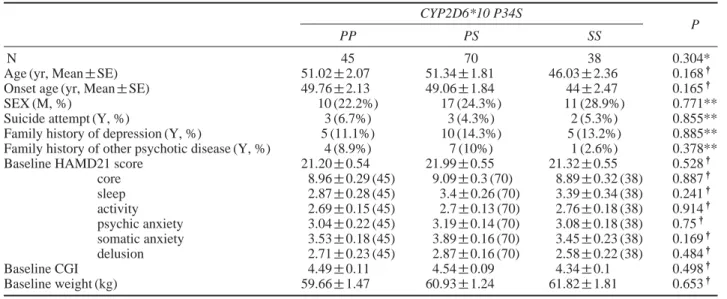
In the 153 initial subjects studied, the distribution of CYP2D6 P34S genotypes was in Hardy-Weinberg equilibrium (Table 1). Table 1 summarizes the patient gender, mean age, age at onset, frequency of suicide attempts, and family history of MDD or other psychot-ic diseases. None of these parameters differed signifi-cantly among the genotypes. The baseline HAMD21 score, each symptom score, and Clinical Global Im-pression (CGI) score also did not differ among the genotypes. In addition, the body weights of the study subjects were not associated with the CYP2D6 P34S genotypes.
Of the 153 patients chosen to participate in this study, 66 withdrew because of a failure to draw blood, lack of efficacy, personal conflict or other personal deci-sion, loss to treatment, or adverse events during 12 weeks of treatment. The genotype distributions did not differ from those of the initial patients (data not shown), which suggested that the subsequent genetic analysis was not affected by withdrawal.
Table 1. Demographic characteristics in the MDD intention-to-treat (ITT) group.
CYP2D6*10 P34S
P
PP PS SS
N 45 70 38 0.304*
Age (yr, Mean±SE) 51.02±2.07 51.34±1.81 46.03±2.36 0.168†
Onset age (yr, Mean±SE) 49.76±2.13 49.06±1.84 44±2.47 0.165†
SEX (M, %) 10 (22.2%) 17 (24.3%) 11 (28.9%) 0.771**
Suicide attempt (Y, %) 3 (6.7%) 3 (4.3%) 2 (5.3%) 0.855**
Family history of depression (Y, %) 5 (11.1%) 10 (14.3%) 5 (13.2%) 0.885** Family history of other psychotic disease (Y, %) 4 (8.9%) 7 (10%) 1 (2.6%) 0.378** Baseline HAMD21 score 21.20±0.54 21.99±0.55 21.32±0.55 0.528†
core 8.96±0.29 (45) 9.09±0.3 (70) 8.89±0.32 (38) 0.887† sleep 2.87±0.28 (45) 3.4±0.26 (70) 3.39±0.34 (38) 0.241† activity 2.69±0.15 (45) 2.7±0.13 (70) 2.76±0.18 (38) 0.914† psychic anxiety 3.04±0.22 (45) 3.19±0.14 (70) 3.08±0.18 (38) 0.75† somatic anxiety 3.53±0.18 (45) 3.89±0.16 (70) 3.45±0.23 (38) 0.169† delusion 2.71±0.23 (45) 2.87±0.16 (70) 2.58±0.22 (38) 0.484† Baseline CGI 4.49±0.11 4.54±0.09 4.34±0.1 0.498† Baseline weight (kg) 59.66±1.47 60.93±1.24 61.82±1.81 0.653†
*P value for Hardy-Weinberg equilibrium
Association between Remission Atatus and the CYP2D6 P34S Polymorphism
We also tested the association between the CYP2D6 P34S polymorphism and the remission status with mirtazapine treatment. As shown in Table 2, a signifi-cant association was seen after 2 weeks of treatment in the codominant model (P==0.042). The proportion of S allele homozygotes was lower in the patients entering remission than in non-remitters (13.6% vs. 29.5%, respectively), while the proportion of P allele homozygotes was higher in remitters (40.9% vs. 26.7 %, respectively).
Similar results were seen in the allele analysis, in which the remission status after 2 weeks of mirtaza-pine treatment was significantly associated with CYP2D6 P34S [P==0.030, odds ratio==2.16 (1.08-4.32); Table 2]. The frequency of the S allele in remit-ters was lower than that in patients who did not enter remission (36.4% vs. 51.4%, respectively).
These results suggest that CYP2D6 influences remis-sion status with mirtazapine treatment and that S allele carriers tend not to enter remission.
Association of the CYP2D6 P34S
Polymorphism and the Reduction in the HAMD21 Score with Mirtazapine Treatment
Since remission status was associated with CYP2D6 P34S, we also analyzed the association between the polymorphism and HAMD21 score using linear regres-sion. As shown in Figure 1A, a significant association was observed between them (P==0.032 in the recessive model). The HAMD21 score in the S allele homozy-gotic patients (14.24±0.95) was higher than in the patients possessing the PS genotype (12.59±0.69) and in PP homozygotes (11.81±0.79). In the allele analysis, the score of patients possessing an S allele was higher than that of P allele carriers (13.49±0.49 vs. 12.15±0.43, respectively; P==0.017). These results support the results of the logistic regression analysis and suggest that the S allele has a protective effect on the antidepressant action of mirtazapine.
Association of the CYP2D6 P34S
Polymorphism and the Reduction in the CGI Score with Mirtazapine Treatment
To confirm these results, we also tested the associa-tion between the CYP2D6 P34S polymorphism and the percent reduction of the CGI scores in the mirta-zapine-treated patients. Similar to the results of the HAMD21 analysis, a significant association was de-tected between the two after 2 weeks of mirtazapine treatment (Figure 1B). The reduction rate in SS homo-zygotic patients was 22.63±3.72%, which was lower than those in patients with the PP (31.01±3.18%) or
Table 2.
Association analysis of CYP2D6 P34S polymorphism with the remission status by mirtazapine treatment in MDD patients.
Duration Remission CYP2D6 P34S gentoype, % (N) Codominant Dominant Recessive CYP2D6 P34S allele, % (N) (weeks) status PP PS SS Total P * OR P * OR P* OR PS Total P * OR (± 95% CI) (± 95% CI) (± 95% CI) (± 95% CI) 1 Remission 40.0% (2) 20.0% (1) 40.0% (2) 100% (5) 0.772 0.83 0.648 1.53 0.322 0.39 50.0% (5) 50.0% (5) 100% (10) 0.768 0.83 (0.24-2.9) (0.24-9.64) (0.06-2.52) (0.23-2.94) Non-remission 29.3% (43) 46.3% (68) 24.5% (36) 100% (147) 52.4% (154) 47.6% (140) 100% (294) 2 Remission 40.9% (9) 45.5% (10) 13.6% (3) 100% (22) 0.042 2.01 0.094 2.34 0.089 3.17 63.6% (28) 36.4% (16) 100% (44) 0.030 2.16 (1.03-3.96) (0.87-6.33) (0.84-11.99) (1.08-4.32) Non-remission 26.7% (28) 43.8% (46) 29.5% (31) 100% (105) 48.6% (102) 51.4% (108) 100% (210) 4 Remission 28.6% (8) 53.6% (15) 17.9% (5) 100% (28) 0.527 1.21 0.99 0.99 0.279 1.84 55.4% (31) 44.6% (25) 100% (56) 0.496 1.24 (0.67-2.19) (0.38-2.58) (0.61-5.53) (0.67-2.29) Non-remission 30.2% (26) 41.9% (36) 27.9% (24) 100% (86) 51.2% (88) 48.8% (84) 100% (172) 8 Remission 25.0% (9) 44.4% (16) 30.6% (11) 100% (36) 0.609 0.86 0.749 0.85 0.602 0.78 47.2% (34) 52.8% (38) 100% (72) 0.579 0.84 (0.48-1.54) (0.33-2.25) (0.30-2.01) (0.46-1.54) Non-remission 27.9% (17) 45.9% (28) 26.2% (16) 100% (61) 50.8% (62) 49.2% (60) 100% (122) 12 Remission 26.3% (10) 42.1% (16) 31.6% (12) 100% (38) 0.529 0.83 0.966 0.98 0.326 0.61 47.4% (36) 52.6% (40) 100% (76) 0.522 0.82 (0.45-1.50) (0.37-2.60) (0.23-1.63) (0.45-1.51) Non-remission 26.5% (13) 51.0% (25) 22.4% (11) 100% (49) 52.0% (51) 48.0% (47) 100% (98)
PS (33.52±2.64%, P==0.036 in the codominant and
P==0.011 in the recessive model) genotype.
Association of CYP2D6 P34S and Changes in Depressive Symptoms with Mirtazapine Treatment
We tested the association between the polymorphism and the changes in each depressive symptom, based on the HAMD21 scores, with mirtazapine treatment (Table 3). We found that the symptom scores represen-ting sleep and delusion at 2 weeks were associated with CYP2D6 P34S. The sleep and delusion scores at 2 weeks were higher in SS homozygotes than in pati-ents with the PP or PS genotype (P==0.035 for sleep
scores and 0.049 for delusion scores in the recessive model). These results suggest that the antidepressant action of mirtazapine is influenced by the CYP2D6 P34S polymorphism, especially in symptoms related to sleep and delusion.
Association of CYP2D6 P34S and Mirtazapine-induced Weight Gain
We tested the association of CYP2D6 P34S with mirtazapine-induced adverse effects assessed using LUNSERS. The major adverse effects of mirtazapine treatment were psychic side effects (data not shown). The risk of psychic side effects was associated with CYP2D6 P34S at 1, 2, and 4 weeks of mirtazapine treatment (Table 4). The proportion of S allele homo-zygotes was higher in patients with psychic side effects than in other patients, and the odds ratio was between 2.06 and 6.44. This suggests that patients with the S allele of CYP2D6 P34S are more susceptible to deve-loping psychic adverse effects.
Mirtazapine can induce weight gain as an adverse effect, which may be a reason for reduced compliance. Therefore, we also tested the relationship between CYP2D6 P34S and the percent increase in body weight of patients after mirtazapine treatment; however, we
0 5 10 15 20 25 0 1 2 4 8 12
Total HAMD21 score
Treatment duration (weeks)
PP PS SS *P 0.032 0 20 40 60 80 100 120 0 1 2 4 8 12
% reduction of CGI score
Treatment duration (weeks) *P 0.011 (A) (B) = = + PP PS SS +
Figure 1. The changes of HAMD21 score (A) and the percent reduction of CGI scores (B) after mirtazapine treatment according to genotypes of CYP2D6 P34S. Data are presented by mean±SE. *P values were obtained using linear regression analysis control-ling age and sex as covariates.
Table 3. Association analysis of CYP2D6 P34S polymorphism with symptom scores at 2 weeks of mirtazapine treatment in MDD patients.
Symptoms Symptom score, Mean±SE (N) P values*
PP PS SS Cod Dom Rec
core 5.51±0.38 (37) 6±0.34 (56) 6.18±0.38 (34) 0.409 0.191 0.443 sleep 1.19±0.26 (37) 1.29±0.24 (56) 1.82±0.34 (34) 0.100 0.229 0.035 delusion 1.78±0.21 (37) 1.84±0.17 (56) 2.24±0.19 (34) 0.139 0.305 0.049 activity 1.59±0.17 (37) 1.73±0.15 (56) 2.03±0.2 (34) 0.197 0.191 0.100 psychic anxiety 1.92±0.17 (37) 2.11±0.15 (56) 2.21±0.19 (34) 0.481 0.261 0.398 somatic anxiety 2.24±0.18 (37) 2.57±0.19 (56) 2.53±0.25 (34) 0.410 0.181 0.581 *P values were obtained using linear regression analysis controlling age and sex as covariates.
could not find a significant association between them (data not shown).
Discussion
Cytochrome P450 CYP2D6 is an extensively char-acterized polymorphic drug-metabolizing enzyme. The CYP2D6 gene is highly polymorphic and more than 70 different alleles are known20,21. The activity of the enzyme varies markedly among individuals from poor to intermediate to extensive to ultra-rapid metabolism according to the polymorphisms of the CYP2D6 gene. Association studies provide growing evidence for the clinical importance of the CYP2D6 polymorphism and in investigating whether the CYP2D6 genotype distribution differs from that of the normal population either in patients developing marked adverse effects or in nonresponders during treatment with CYP2D6 substrates11,22,23. However, these important studies present less information on the dose adjustments necessary to individualize phar-macotherapy in a given clinical case11. With respect to psychopharmacological drug metabolism, several antidepressants have been characterized as CYP2D6 substrates24. Therefore, we investigated the genetic association between CYP2D6*10 and the outcome of mirtazapine treatment in patients with MDD.
Ethnicity is a factor in the occurrence of CYP2D6 variability. For example, the allele frequency of CYP2D6*4 is 20.7% in Caucasians25, but 0.2% in Japanese26. For CYP2D6*10, the frequency is 45% in Koreans27, but 1.53% in Caucasians25, and even differs among Asian populations; it is 38.1% in Japanese26and 51.3% in Chinese28. This variability suggests that the clinical outcome with the same drug can vary among populations. Lee et al. reported that the CYP2D6
alle-les with frequencies exceeding 5% in Koreans were *1, *2, *4, and *1027. Of these, we choose to study *10 based on statistical power and its effects on enzyme activity. In this study, the frequency of *10 was 47.7%, which concurs with a previous report.
Age, history of depression, and the baseline HAMD21 score and CGI did not differ among geno-types, which suggests that CYP2D6*10 is not a risk factor for developing depression. In fact, Bijl et al. reported that CYP2D6 was not associated with the susceptibility to depression or anxiety disorder in the elderly, although 5-methoxytryptamine (5-MT), a pre-cursor of serotonin, is a substrate of CYP2D6 and the concentration of serotonin in the brain was lower in poor metabolizers than in normal subjects29. Consider-ing their report and our observations, the enzyme acti-vity might not be a contributing factor to the develop-ment of depression.
Our study revealed that CYP2D6 P34S was signifi-cantly associated with remission status. More recently, Serretti et al. classified the drug metabolism of 278 Europeans as phenotypes according to the genotypes of five alleles: CYP2D6*3, *4, *6, *9, and *1930. They found no association between the phenotypes and either response or remission status with antidepressant treatment. Although our study focused on a single locus, P34S, and did not measure the enzyme activity, our results contradict their observation. A possible explanation is the difference in the study designs. Serretti et al. studied 21 drugs, including SSRIs, tricy-clic antidepressants, norepinephrine reuptake inhibi-tors, serotonin norepinephrine reuptake inhibiinhibi-tors, and NaSSA, and 278 subjects30. This caused the strati-fication of the study subjects, and just 21 subjects were treated with mirtazapine. These subjects were further divided into four phenotypes, poor (PM), inter-mediate (IM), extensive (EM), and ultrarapid (UM)
Table 4. Association analysis of CYP2D6 P34S polymorphism with the presence of mirtazapine-induced psychic side effects in
MDD patients.
Duration Psychic CYP2D6 P34S gentoype, % (N) Codominant Dominant Recessive
(weeks) side effects PP PS SS Total P* OR (±95%CI) P* OR (±95% CI) P* OR (±95% CI)
1 - 36.7% (18) 49% (24) 14.3% (7) 100% (49) 0.012 2.06 (1.17-3.61) 0.14 1.95 (0.8-4.75) 0.007 3.93 (1.47-10.55) + + 22.9% (11) 37.5% (18) 39.6% (19) 100% (48) 2 - 40% (26) 41.5% (27) 18.5% (12) 100% (65) 0.001 2.94 (1.54-5.59) 0.005 6.44 (1.78-23.37) 0.010 3.44 (1.34-8.78) + + 9.4% (3) 46.9% (15) 43.8% (14) 100% (32) 4 - 35.2% (25) 45.1% (32) 19.7% (14) 100% (71) 0.009 2.38 (1.24-4.56) 0.067 2.99 (0.93-9.64) 0.011 3.49 (1.33-9.18) + + 15.4% (4) 38.5% (10) 46.2% (12) 100% (26) 8 - 30.1% (25) 44.6% (37) 25.3% (21) 100% (83) 0.583 1.24 (0.58-2.63) 0.907 1.08 (0.31-3.76) 0.419 1.64 (0.49-5.45) + + 28.6% (4) 35.7% (5) 35.7% (5) 100% (14) Total - 44.4% (16) 44.4% (16) 11.1% (4) 100% (36) 0.003 2.49 (1.36-4.58) 0.018 2.95 (1.2-7.26) 0.011 4.51 (1.41-14.44) + + 21.3% (13) 42.6% (26) 36.1% (22) 100% (61)
metabolizers, which may have lowered the statistical power of the study. In our study, 153 subjects were treated with mirtazapine only, and were classified using the genotypes of a single polymorphism for which the allele frequency was about 0.47. In fact, the power of our analysis exceeded 80%. In addition, our finding of an association between remission status and CYP2D6 P34S was supported by the analysis of the HAMD21 and CGI scores. Therefore, we concluded that the S allele of CYP2D6 P34S is a risk factor for a low res-ponse to mirtazapine treatment.
Our result indicated that the association between CYP2D6 P34S and the treatment effect of mirtazapine was restricted to that at 2 weeks. After 4 weeks, no difference was seen in the HAMD21 score and remis-sion status among genotypes. These observations may have been due to the pharmacokinetics of mirtazapine. The blood mirtazapine concentration reaches a steady state 4-6 days after uptake18, and we can expect this time point to vary according to the enzyme activity; PM may need less than 6 days to reach a steady state and EM may need longer than PM or IM. After 2 weeks, all subjects reach an effective blood concen-tration regardless of their genotype. Consequently, the antidepressant activity of mirtazapine may not differ among subjects, although the psychic anxiety symp-tom score was associated with the CYP2D6 P34S at 8 weeks.
Two recent studies demonstrated an increased hos-pitalization rate in PMs treated with antidepressants and antipsychotics and an increased trend for develo-ping adverse effects in PMs as compared to Ems6,31. However, another study failed to detect differences in the CYP2D6 genotype distribution in psychiatric pati-ents with adverse drug effects7. We used LUNSERS to assess the adverse effects of mirtazapine, making ours the first study on antidepressant-induced side effects. We found that the major adverse effects of mirtazapine were psychic side effects, including diffi-culty staying awake during the day. These side effects may be based on the antihistamine effect of mirtaza-pine, although further studies on mirtazapine-induced psychic side effects are necessary. Furthermore, we found that this side effect was associated with CYP2D6 P34S, while weight gain, a major side effect of mir-tazapine32, was not; the S allele, which was associated with low efficacy, was also associated with the deve-lopment of psychic side effects. These observations suggest that PMs produce significantly higher plasma drug concentrations and may be more susceptible to psychic adverse effects, and that CYP2D6 activity may not be a risk factor for weight gain.
This study has several limitations; we evaluated only one SNP of the CYP2D6 gene. Therefore, whole-gene
screening and association studies for other variants of the CYP2D6 gene may be necessary to identify mark-ers associated with the response to antidepressants in various populations. We also cannot exclude the pres-ence of a population stratification bias33. However, because the Korean population is characterized by a relatively high degree of genetic homogeneity34, we consider such stratification bias unlikely in our sample. Previous pharmacogenetic studies have found asso-ciations between the CYP2D6*10 polymorphism and the clinical response to SSRIs. To our knowledge, no study has examined the relationship between the clini-cal outcome of mirtazapine administration and CYP2D6 polymorphisms; further studies are required.
In summary, we found that CYP2D6 P34S was asso-ciated with the remission status and decline in the HAMD21 score after 2 weeks of mirtazapine treat-ment, especially symptoms related to sleep and delus-ion, and it was also related to mirtazapine-induced psychic side effects. These results suggest that CYP2D6 P34S is a genetic marker predicting the clinical out-come of mirtazapine treatment.
Materials & Methods
Subjects
Trained psychiatrists examined all of the subjects using the Structured Clinical Interview for DSM-IV Axis I disorders (SCID-I) and the Korean version of the Diagnostic Interview for Genetic Studies (K-DIGS). The severity of depression was assessed using the 21-item Hamilton Depression Rating (HAMD21) scale. Only subjects with a minimum score of 18 on the HAMD21 scale were enrolled.
Subjects with primary or comorbid diagnoses of schizophrenia, schizoaffective disorder, rapid cycling bipolar disorder, dementia, and alcohol or substance dependence based on DSM-IV criteria within the pre-vious 6 months were excluded from the study. Patients with serious or unstable medical illness were also excluded. We also disqualified subjects with a per-sonal or family history of substance abuse/dependence. Patients already on medication were permitted a 2-week washout period. Demographic data, medical his-tory, and laboratory data were documented. All sub-jects were at least 18 years of age.
During the treatment period in the study, all subjects took mirtazapine (Remeron®; Schering-Plough, Kenil-worth, NJ, USA) at a daily dose of 15-60 mg. Psycho-tropic drugs such as benzodiazepines and mood stabi-lizers were not permitted. All subjects gave informed consent to participate in the study, and the study pro-tocol was approved by the ethics committee of the
Korea University Medical Center.
Clinical symptoms were evaluated using the HAMD21 scale at baseline and after 1, 2, 4, 8, and 12 weeks of treatment. Responders were those who show-ed a 50% or more decrease in the HAMD21 score compared to baseline, and remitters were defined by a HAMD21 total score of 7 points or less35. To eval-uate specific clusters of depressive symptoms, the HAMD21 items were grouped according to the fol-lowing factors, as described by Serretti et al.36: core (items 1, 2, 7, 8, 10, and 13), sleep (items 4, 5, and 6), activity (items 7 and 8), psychic anxiety (items 9 and 10), somatic anxiety (items 11, 12, and 13), and delu-sion (items 2, 15, and 20).
The side-effect profile during treatment was assessed using the modified Liverpool University Neuroleptic Side Effect Rating Scale (LUNSERS). To evaluate specific clusters of adverse effects, LUNSERS items were grouped as extrapyramidal (items 17, 25, 30, 36, and 40), psychic side effects (items 2, 4, 12, 16, 19, 21, 27, and 35), other autonomic (items 13, 14, 18, 23, and 31), allergic reactions (items 1 and 41), anticholi-nergic (items 6, 9, 28, 32, and 45), hormonal (items 7, 42, 15, 22, and 39), and miscellaneous side effects (items 5, 20, 33, and 37).
DNA Analysis
DNA was extracted from peripheral blood and the polymerase chain reaction (PCR) was performed using the sense primer 5′-CCA TTT GGT AGT GAG GCA GGT AT-3′ and antisense primer 5′-CAC CAT CCA TGT TTG CTT CTG GT-3′. Each amplification mix-ture contained 50 ng of DNA, 3μL of 10× PCR buf-fer, 2.5μL of 2.5 mM dNTP, 10 pmol of each primer, and 0.5μL of Taq polymerase (5 U/μL; TaKaRa, Kyo-to, Japan). Samples were amplified using a thermocy-cler (Perkin-Elmer, Boston, MA, USA) for an initial 7 min at 94�C, followed by 35 cycles of 45 s at 94�C, 45 s at 56�C, and 45 s at 72�C. After a final 5-min extension at 72�C, the reaction was terminated at 4�C. The amplified DNA was digested with the restriction endonuclease HphI (New England Biolabs, Ipswich, MA, USA), which cleaves at site 188C. The product was electrophoresed on 3% agarose gels stained with ethidium bromide; the 213- and 58-bp fragments cor-respond to the 188C (34Pro) allele and the 122-, 101-, and 58-bp fragments correspond to the 188T (34Ser) allele.
Statistical Analysis
The Hardy-Weinberg equilibrium for the CYP2D6*10 polymorphism was tested using the χ2test. The genet-ic association of the single nucleotide polymorphism (SNP) was analyzed using multiple logistic regression
for categorical data and linear regression for continu-ous variables, controlling for age and sex as covariates. A P value ‹0.05 was regarded as statistically signifi-cant. The power to detect associations given the sam-ple size was analyzed using G∙Power37. All statisti-cal analyses were performed using SPSS version 10.0 (SPSS Inc., Chicago, IL, USA).
Acknowledgements
This study was supported by a grant from the Korea Health 21 R&D Project, Ministry of Health and Wel-fare, Republic of Korea (no. 03-PJ10-PG13-GD01-0002, A050047).
References
1. Nebert, D. W. Polymorphisms in drug-metabolizing enzymes: what is their clinical relevance and why do they exist? (Editorial). Am J Hum Genet 60:265-271 (1997).
2. Brosen, K. Some aspects of genetic polymorphism in the biotransformation of antidepressants. Therapie 59: 5-12 (2004).
3. Kirchheiner, J. et al. Pharmacogenetics of antidepres-sants and antipsychotics: the contribution of allelic variations to the phenotype of drug response. Mol Psychiatry 9:442-473 (2004).
4. Yin, O. Q. et al. Phenotype-genotype relationship and clinical effects of citalopram in Chinese patients. J Clin Psychopharmacol 26:367-372 (2006).
5. Grasmäder, K. et al. Impact of polymorphisms of cytochrome-P450 isoenzymes 2C9, 2C19 and 2D6 on plasma concentrations and clinical effects of antide-pressants in a naturalistic clinical setting. European Journal of Clinical Pharmacology 60:329-336 (2004). 6. Rau, T. et al. Cyp2d6 genotype: impact on adverse
effects and nonresponse during treatment with antide-pressants-a pilot study. Clinical Pharmacology & Therapeutics 75:386-393 (2004).
7. Murphy, G. M., Jr, Kremer, C., Rodrigues, H. E. & Schatzberg, A. F. Pharmacogenetics of antidepressant medication intolerance. American Journal of Psychi-atry 160:1830-1835 (2003).
8. Suzuki, Y., Sawamura, K. & Someya, T. Polymor-phisms in the 5-hydroxytryptamine 2A receptor and cytochrome P4502D6 genes synergistically predict fluvoxamine-induced side effects in Japanese depres-sed patients. Neuropsychopharmacology 31: 825-831 (2006).
9. Mrazek, D., Smoller, J. & de Leon, J. Incorporating pharmacogenetics into clinical practice: Reality of a new tool in psychiatry. CNS Spectr 11:1-13 (2006). 10. De Boer, T. The effects of mirtazapine on central
nora-drenergic and serotonergic neurotransmission. Int
Clin Psychopharmacol 10(Suppl 4):19-23 (1995).
11. De Boer, T. & Ruigt, G. S. F. The selective 2-adreno-ceptor antagonist mirtazapine (Org 3770) enhances noradrenergic and 5-HT1A mediated serotonergic neurotransmission. CNS Drugs 4(Suppl 1):29-38 (1995).
12. De Boer, T., Ruigt, G. S. F. & Berendsen, H. H. G. The alpha2-selective adrenoceptor antagonist org 3770 (mirtazapine, Remeron®) enhances noradrenergic and
serotonergic transmission. Hum Psychopharmacol 10(S2):S107-S118 (1995).
13. De Montigny, C., Haddjeri, N., Mongeau, R. & Blier, P. The effects of mirtazapine on the interactions bet-ween central noradrenergic and serotonergic systems.
CNS Drugs 4(Suppl 1):13-17 (1995).
14. Haddjeri, N., Blier, P. & de Montigny, C. Noradrener-gic modulation of central serotonerNoradrener-gic neurotransmis-sion: acute and long-term actions of mirtazapine. Int
Clin Psychopharmacol 10(Suppl 4):11-17 (1995).
15. Anttila, S. A. & Leinonen, E. V. A review of the pharmacological and clinical profile of mirtazapine.
CNS Drug Reviews 7:249-64 (2001).
16. Fawcett, J. & Barkin, R. L. Review of the results from clinical studies on the efficacy, safety and tolerability of mirtazapine for the treatment of patients with major depression. J Affect Disord 51:267-285 (1998). 17. Nutt, D. J. Tolerability and safety aspects of
mirtaza-pine. Hum Psychopharmacol 17(Suppl 1):S37-41 (2002).
18. Timmer, C. J., Sitsen, J. M. & Delbressine, L. P. Clini-cal pharmacokinetics of mirtazapine. Clin
Pharmaco-kinet 38:461-474 (2000).
19. Droll, K. et al. Comparison of three CYP2D6 probe substrates and genotype in Ghanaians, Chinese and Caucasians. Pharmacogenetics 8:325-333 (1998). 20. Duman, R. S. & Charney, D. S. Cell atrophy and loss
in major depression. Biol Psychiatry 45:1083-1084 (1999).
21. Maisonpierre, P. C. et al. Human and rat brain-derived neurotrophic factor and neurotrophin-3: gene struc-tures, distributions, and chromosomal localizations.
Genomics 10:558-568 (1991).
22. Duman, R. S., Heninger, G. R. & Nestler, E. J. A molecular and cellular theory of depression. Arch Gen
Psychiatry 54:597-606 (1997).
23. Tsai, S. J., Cheng, C. Y., Yu, Y. W., Chen, T. J. & Hong, C. J. Association study of a brain-derived neuro-trophic-factor genetic polymorphism and major depres-sive disorders, symptomatology, and antidepressant response. Am J Med Genet B Neuropsychiatr Genet 123B:19-22 (2003).
24. Spina, E., Santoro, V. & D’Arrigo, C. Clinically
rele-vant pharmacokinetic drug interactions with second-generation antidepressants: An update. Clin
Thera-peutics 30:1206-1227 (2008).
25. Sachse, C. B. J., Bauer, S. & Roots, I. Cytochrome 450 2D6 variants in a Caucasian population: allele frequencies and phenotypic consequences. Am J Hum
Genet 60:284-295 (1997).
26. Nishida, Y., Fukuda, T., Yamamoto, I. & Azuma, J. CYP2D6 genotypes in a Japanese population: low frequencies of CYP2D6 gene duplication but high frequency of CYP2D6*10. Pharmacogenetics 10:567-570 (2000).
27. Lee, S.-Y. et al. Sequence-based CYP2D6 genotyping in the Korean population. Ther Drug Monit 28:382-387 (2006).
28. Ji, L. et al. Single-step assays to analyze CYP2D6 gene polymorphisms in Asians: allele frequencies and a novel *14B allele in mainland Chinese. Clin Chem 48:983-988 (2002).
29. Bijl, M. J. et al. Association between the CYP2D6*4 polymorphism and depression or anxiety in the elderly.
Pharmacogenomics 10:541-547 (2009).
30. Serretti, A. et al. Cytochrome P450 CYP1A2, CYP2C9, CYP2C19 and CYP2D6 genes are not associated with response and remission in a sample of depressive pati-ents. Int Clin Psychopharmacol 24:250-256 (2009). 31. Chou, W. H. et al. Extension of a pilot study: impact
from the cytochrome P450 2D6 polymorphism on out-come and costs associated with severe mental illness.
J Clin Psychopharmacol 20:246-251 (2000).
32. Laimer, M. et al. Effect of mirtazapine treatment on body composition and metabolism. J Clin Psychiatry 67:421-424 (2006).
33. Gorwood, P. Genetic association studies in behavioral neuroscience, in Handbook of molecular-genetic
tech-niques for brain and behavior research, W. Cruzio
and R. Gerlai, Editors. Elsevier: Amsterdam. 113-121 (1999).
34. Kim, J. W. Association study and the population admixture, in Human Neurobehavioral Genetics in
the 21st Century. Korean Society of Biological
Psy-chiatry: Seoul, Korea (2003).
35. Frank, E. et al. Conceptualization and rationale for consensus definitions of terms in major depressive disorder. Remission, recovery, relapse, and recurrence.
Arch Gen Psychiatry 48:851-855 (1991).
36. Serretti, A. et al. SSRIs antidepressant activity is influ-enced by G beta 3 variants. Eur
Neuropsychopharma-col 13:117-122 (2003).
37. Faul, F., Erdfelder, E., Buchner, A. & Lang, A. G. Statistical power analyses using G*Power 3.1: tests for correlation and regression analyses. Behav Res