J Inf Process Syst, Vol.9, No.4, pp.651~659, December 2013 http://dx.doi.org/10.3745/JIPS.2013.9.4.651
A Network-Based Handover Scheme in HIP-Based
Mobile Networks
Moneeb Gohar* and Seok-Joo Koh*
Abstract—In the Host Identity Protocol (HIP), the existing host-based handover scheme tends to induce large handover delays and packet loss rates. To deal with this problem, we are proposing a network-based handover scheme for HIP in the mobile networks, in which the access routers of the mobile node will establish a handover tunnel and will perform the route optimization for data transmission. We also discuss how to extend the HIP Update message to use the proposed handover scheme. From ns-2 simulations, we can see that the proposed handover scheme can significantly reduce the handover delay and packet losses during handover, as compared to the existing handover schemes. Keywords—HIP, network-based, handover, simulations
1.
I
NTRODUCTIONMobility management is one of the primary functions in future mobile networks. The Host Identity Protocol (HIP) has been proposed for identifier-locator (ID-LOC) separation [1, 2]. In HIP, a 128-bit Host Identity Tag (HIT) is used as the ID and the IP address of the host is used as the LOC. To support the mobility and multi-homing feature, the Rendezvous Server (RVS), which manages the HIT-LOC mappings of hosts, is employed [3, 4].
In the existing HIP handover [5], the HIP Update operations are performed between the two concerned hosts for route optimization after a handover takes place. However, this host-based handover scheme tends to induce large handover delays and packet loss rates. In [6], the authors proposed a localized handover scheme, in which the access routers in a mobile domain integrate the HIP proxy function, and the HIP Update operations are performed between the mobile host and the Local RVS (LRVS) after handover. In the meantime, a network-based HIP handover scheme was proposed in [7], in which a new mobility agent called the Local Mobility Manage-ment Server (LMMS) is employed. It combines the function of the RVS of the HIP with the Local Mobility Anchor of Proxy Mobile IPv6 (PMIPv6) [8].
In this paper, we propose a network-based handover scheme for handover in the HIP-based mobile networks and also discuss how to extend the HIP Update message so as to support the proposed scheme. As compared to the existing handover schemes, our proposed scheme can reduce handover delays and packet losses during handover.
The rest of this paper is organized as follows: in Section 2, we review the existing HIP hand-※ This research was supported by the Basic Science Research Program of NRF (2010-0020926).
Manuscript received February 1, 2013; first revision April 10 2013; accepted July 21, 2013.
Corresponding Author: Seok-Joo Koh ([email protected])
* School of Computer Science and Engineering, Kyungpook National University, Daegu, Korea ([email protected], [email protected])
pISSN 1976-913X eISSN 2092-805X
A Network-Based Handover Scheme in HIP-Based Mobile Networks
over schemes. Section 3 describes the proposed network-based handover scheme. In Section 4, we compare the existing and proposed handover schemes in terms of handover delay and packet loss rate by ns-2 simulations. Section 5 concludes this paper.
2.
R
ELATEDW
ORKSIn this section, we review the following existing handover schemes that have been proposed so far: HIP [4, 5] and a Mobility-enabled HIP Proxy [6]. The PMIPv6-based scheme [7] is not considered, since the scheme depends on the PMIPv6 from the perspective of mobility control.
2.1 HIP
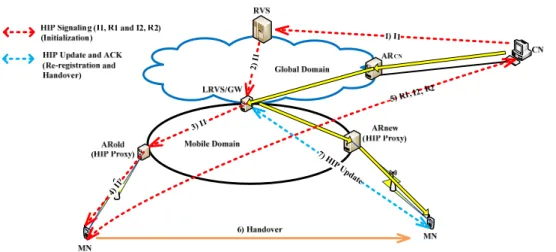
Fig. 1 shows the HIP operations for initial signaling and handover support in mobile networks [4, 5]. In the figure, the network consists of access routers (ARs), RVS, a mobile node (MN) and a correspondent node (CN).
Initially, the CN communicates with the MN through the HIP signaling operations for session setup (Steps 1, 2, and 3). Next, we considered the handover scenario, in which the MN moves from the ARold to the ARnew during data transmission with the CN (Step 4). When the MN is connected to the ARnew, it shall configure a new LOC using an IP address configuration scheme. After that, the MN updates its LOC with RVS for another CN (re-registration) by using the normal HIP Update messages (Step 5). Then, the MN sends a HIP Update message,which contains the new LOC of the MN, to the CN for data path optimization after handover (Step 6). After that, two more HIP Update (ACK) messages will be exchanged for the LOC validation between the MN and the CN, as per the HIP protocol (Step 6). The data packet is now delivered directly between the CN and the MN via the ARnew.
Fig. 1. Existing host-based HIP operations in mobile networks 2.2 Mobility-Enabled HIP Proxy
In the mobility-enabled HIP proxy scheme [6], it is assumed that each AR implements the HIP proxy functionality for mobility support. The AR with the HIP proxy performs the tracking
Moneeb Gohar and Seok-Joo Koh
and update of the MN location, security signaling, and the assigning of a network prefix per host identifier. In addition, a Local RVS (LRVS) is employed over the gateway (GW) to support local mobility in the mobile domain. To set up the HIP security association, the I1, I2, R1, and R2 messages are exchanged between the MN and the CN. During the establishment of the secu-rity association, all of the ARs along the path between the MN and the LRVS use the HIP proxy function.
Fig. 2 shows the handover operations of the mobility-enabled HIP proxy scheme. Initially, the CN communicates with the MN through the HIP signaling operations (Steps 1-5). The HIP sig-naling operation is performed with a security association establishment between the MN and the CN. By handover, the MN moves from the ARold to the ARnew during data transmission with the CN (Step 6). When the MN is connected to the ARnew, it shall configure a new LOC by using an IP address configuration scheme. Then, the MN updates the LOC to LRVS via the AR for re-registration and handover support (Step 7). The data packet is now delivered directly from the GW to the MN.
In Fig. 1 and Fig. 2, the handover delay occurs during the time interval from the time that the MN loses its connection to the ARold until the time that the MN receives the first data packet from the ARnew. This handover operation tends to induce a large handover delay. Moreover, during handover, the data packets of the CN may be lost. Based on this observation, we propose a network-based handover scheme for the HIP to reduce its handover delay and also to reduce the associated packet losses.
3.
P
ROPOSEDS
CHEMEIn this section, we describe the proposed handover scheme in HIP-based mobile networks.
3.1 Handover Operation
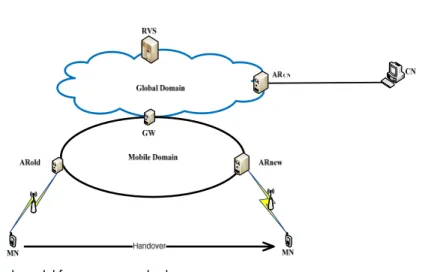
Fig. 3 shows the network model for the proposed network-based handover scheme in a mobile network that consists of access routers (ARs), RVS, a mobile node (MN), and a correspondent
2) I1 7) H IP U pdate 3) I1 4) I 1
A Network-Based Handover Scheme in HIP-Based Mobile Networks
node (CN). In the proposed scheme, we assume that each AR implements a function for estab-lishing the HIP security association, as done in [6]. Initially, the CN communicates with the MN through the HIP signaling operations. Then, the MN is moved from the ARold to the ARnew region by handover.
Fig. 4 shows the HIP operations of the proposed network-based scheme for initial signaling and handover support. First, the CN is communicating with the MN in the ARold region. To set up the HIP security association between the CN and the MN, the I1, I2, R1, and R2 messages are exchanged between the MN and the CN via the RVS and the ARold (Steps 1-5).
The MN is attached to the ARnew by a handover. Then, the MN sends an HIP Update mes-sage to the ARnew (Step 6). This HIP Update mesmes-sage shall contain the LOC parameters of the ARold and CN. Then, the ARnew sends a HIP Update (LOC) to the CN for handover support
Fig.4. The proposed network-based HIP handover Fig. 3. Network model for our proposed scheme
Moneeb Gohar and Seok-Joo Koh
(LOC update) and also HIP Update (Re-registration) messages to the RVS at the same time (Step 7). Note that the HIP Update (LOC) is for route optimization, whereas the HIP Update (Re-registration) is performed for a new (another) CN.
Then, the ARnew shall also send a HIP Update (with HO-Request) message to the ARold to establish a handover tunnel (Step 8), and the ARold will respond with a HIP Update (with HO-ACK) messages to ARnew (Step 9). By this operation, a handover tunnel is established between the ARold and the ARnew. By using the handover tunnel, the ARold can forward the data pack-ets to the ARnew, and then further on to the MN. Now, for completing the handover operation, the HIP Update (ACK) message is exchanged between the CN and the MN via the ARnew (Steps 10-13). The CN and the MN can now deliver the data packets over the optimized route.
It has been noted that the proposed handover scheme can reduce the handover delay and packet loss, as compared to the existing handover scheme, by using a handover tunnel between the ARold and the ARnew during handover.
3.2 Extension of the Packet Format
To support the proposed handover scheme, the HIP Update message is extended by adding the two flags, N and H, to the existing HIP Update message, as shown in Fig. 5. In the figure, the
N flag indicates that this message is used for the “network-based” handover scheme. The N flag
shall be set to 1 in all of the HIP Update messages. On the other hand, the H flag indicates that this HIP Update message is being used for the establishment of a handover tunnel. The H flag shall be set to 1 in the HIP Update (HO-Request and HO-ACK) messages that are exchanged between the ARnew and the ARold. In addition, each HIP Update message contains the LOC parameters of the ARold and the CN, as indicated in Fig. 5.
Next header N
Senders HIT Receivers HIT
HIP Parameters (LOC-ARold, LOC-CN, ACK, etc.)
0 1 2 3 4 5 6 7 8 9 0 1 2 3 4 5 6 7 8 9 0 1 2 3 4 5 6 7 8 9 0 1 0 1 2 3
Header Length 0 Packet Type VER. 1
Checksum Controls
H
RES.
Fig.5. Extension of the HIP Update message format
4.
P
ERFORMANCEA
NALYSIS BYS
IMULATIONTo conduct a performance analysis, we compared the existing and proposed handover schemes by using the ns-2 network simulator [9].
4.1 Test Network
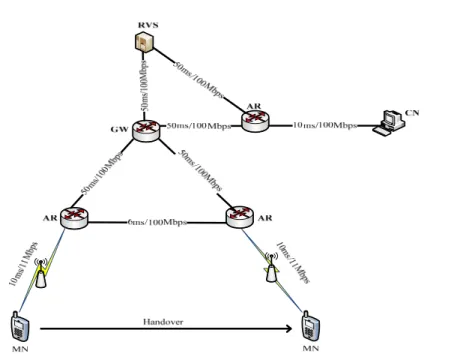
For ns-2 simulations, a test network was configured, as shown in Fig. 6. In the network, the CN is initially communicating to the MN, and then the MN moves into another AR region via handover.
A Network-Based Handover Scheme in HIP-Based Mobile Networks
Fig. 6. The test network for ns-2 simulation
In the figure, the access link between the CN and the AR has a bandwidth of 100 Mbps and a link delay of 10 ms, whereas, the wired links in the backbone network between the AR and the GW or between the ARs are configured with a bandwidth of 100 Mbps and a transmission delay of 50 ms. On the other hand, the wireless link between the AR and the MN has a bandwidth of 11 Mbps and a link delay of 10 ms. The wired link between two ARs in the mobile network has a bandwidth of 100 Mbps and a transmission delay of 6 ms. During simulation, the CN transmits data packets over the UDP with a packet size of 1,000 bytes, at the rate of 250 packets per se-cond.
4.2 Results and Discussion
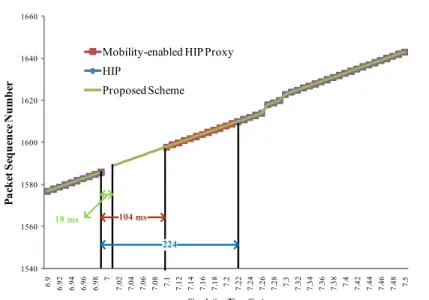
Fig. 7 shows the traces of the data packets that the MN receives from the CN during simula-tion. From the figure, we can see the handover delays that are experienced by the MN for the three candidate schemes. In the existing HIP scheme, the handover occurs during the time inter-val from 7 seconds to 7.224 seconds, which corresponds to handover delay of 224 ms. In the existing mobility-enabled HIP proxy scheme, the handover occurs during the time interval from 7 seconds to 7.104 seconds, which corresponds to the handover delay of 104 ms. On the other hand, the proposed scheme performs the handover during the time interval from 7 seconds to 7.018 seconds, which corresponds to a handover delay of 18 ms. Accordingly, the proposed scheme can reduce the handover delay of the existing HIP scheme by approximately 206 ms, and by 86 ms by the mobility-enabled HIP proxy scheme.
Fig. 8 compares the existing and proposed schemes in terms of handover delay. Fig. 8(a) shows the handover delays of candidate schemes for different transmission delays between two ARs. From the figure we can see that the transmission delay makes a significant impact on the proposed scheme. This is because the proposed scheme uses a handover tunnel between the two
Moneeb Gohar and Seok-Joo Koh
neighboring ARs. From the figure, we can see that the proposed scheme can reduce the hando-ver delays of the existing schemes by using the handohando-ver tunnel.
Fig. 8(b) shows the impacts of the transmission delay between the AR and the GW on the handover delay. In this case, the transmission delay between the AR and the GW makes a signif-icant impact on the existing HIP and mobility-enabled HIP proxy schemes. This is because the existing HIP handover scheme performs the HIP Update operation through the backbone net-work between the MN and the CN. In the case of the mobility-enabled HIP proxy scheme, the HIP Update operation for handover is performed with the LRVS/GW. In the meantime, the pro-posed scheme is not affected by the transmission delay between the AR and the GW. Overall, the proposed scheme provides better performance than the existing schemes, in terms of hando-ver delay. The gap in the performance between the existing and proposed schemes tends to get larger, as the transmission delay between the AR and the GW increases.
Fig. 9 compares the three candidate schemes in terms of the packet loss rate that is incurred
1540 1560 1580 1600 1620 1640 1660 6. 9 6. 92 6. 94 6. 96 6. 98 7 7. 02 7. 04 7. 06 7. 08 7.1 7. 12 7. 14 7. 16 7. 18 7.2 7. 22 7. 24 7. 26 7. 28 7.3 7. 32 7. 34 7. 36 7. 38 7.4 7. 42 7. 44 7. 46 7. 48 7.5 P ack et S eq u en ce N u m b er
Simulation Time (Sec) Mobility-enabled HIP Proxy HIP
Proposed Scheme
Fig. 7. Traces of the data packets by ns-2 simulation
(a) Impact of the transmission delay between ARs (b) Impact of the transmission delay between the AR and the GW Fig. 8. Comparison of the handover delays
A Network-Based Handover Scheme in HIP-Based Mobile Networks
by handover. Fig. 9(a) shows the impact of the transmission delay between ARs on the packet loss rate. We can observe that the packet loss rate slightly increases for the proposed scheme, as the delay between ARs gets larger. This is because the proposed scheme uses a handover tunnel between the ARs. Nevertheless, we can see that the proposed scheme can provide a better per-formance than the existing schemes. This is because in the proposed scheme the data packets can be delivered to the MN by using the handover tunnel during handover.
Fig. 9(b) shows the impacts of the transmission delay between the AR and the GW on the packet loss rate. We can see that the existing schemes are severely affected by the delay between the AR and the GW, whereas the proposed scheme is not affected by the transmission delay. This is because in the proposed scheme the HIP update operation for handover support is per-formed between the two neighboring ARs. Overall, we can see that the proposed scheme can reduce the packet loss rate, as compared to the existing handover schemes.
5.
C
ONCLUSIONSIn this paper, we have presented a network-based handover scheme for conducting handover s in HIP-based mobile networks. In the proposed scheme, the access routers associated with the handover are used to establish a handover tunnel to reduce handover delays and packet losses during a handover. It has been suggested that the associated HIP Update message format needs to be extended to support the proposed network-based handover scheme.
By conducting a simulation analysis, the proposed scheme was compared with the existing scheme in terms of the handover delay and packet loss rate. From the simulation results, we can see that the proposed network-based scheme provides a better performance than the existing host-based schemes, in terms of handover delays and packet loss rates.
(a) Impact of the transmission delay between ARs (b) Impact of the transmission delay between the AR and the GW Fig. 9. Comparison of packet loss rates
Moneeb Gohar and Seok-Joo Koh
R
EFERENCES[1] R. Moskowitz, et al., Host Identity Protocol, IETF RFC 5201, 2008.
[2] R. Moskowitz, et al., Host Identity Protocol Architecture, IETF RFC 4423, 2006.
[3] J. Laganier, et al., Host Identity Protocol (HIP) Rendezvous Extension, IETF RFC 5204, 2008. [4] T. Henderson, End-Host Mobility and Multihoming with the Host Identity Protocol, IETF RFC 5206,
2008.
[5] Samu Varjonen, et al., “Secure and Efficient IPv4/IPv6 Handovers Using Host-Based Identifier-Locator Split,” Proceeding of the 17th International Conference on Software, Telecommunications and Computer Networks (SoftCOM), 2009.
[6] Muhana M. Muslam, et al., “Network-Based Mobility and Host Identity Protocol,” Proceeding of the IEEE Wireless Communications and Networking Conference: Mobile and Wireless Networks, 2012. [7] Tao Yuan, et al., “L-HIP: A Localized Mobility Management Extension for Host Identity Protocol,”
Wireless Communications Networking and Mobile Computing (WiCOM), September 2010. [8] S. Gundavelli, et al., Proxy Mobile IPv6, IETF RFC 5213, 2008.
[9] Network Simulator NS-2, Available from http://www.isi.edu/nsnam/ns.
Moneeb Gohar
He received B. S. degree in Computer Science from University of Peshawar, Pakistan, and M. S. degree in Technology Management from Institute of Man-agement Sciences, Pakistan, in 2006 and 2009, respectively. He received Ph. D. degree from the school of Computer Science and Engineering in the Kyungpook National University, Korea, in 2012. He is now with the Kyungpook National Uni-versity, as a postdoctoral researcher. His current research interests include wire-less communication, mobile multicasting and Internet mobility.
Seok-Joo Koh
He received the B.S. and M.S. degrees in Management Science from KAIST in 1992 and 1994, respectively. He also received Ph.D. degree in Industrial Engi-neering from KAIST in 1998. From August 1998 to February 2004, he worked for Protocol Engineering Center in ETRI. He has been as a professor with the school of Computer Science and Engineering in Kyungpook National University since March 2004. His current research interests include mobility management in the future Internet, IP mobility, multicasting, and SCTP.
![Fig. 1 shows the HIP operations for initial signaling and handover support in mobile networks [4, 5]](https://thumb-ap.123doks.com/thumbv2/123dokinfo/5122765.86359/2.723.94.637.633.872/shows-operations-initial-signaling-handover-support-mobile-networks.webp)