Nonrelativistic factorizable scattering theory and the Calogero-Sutherland model
Changrim Ahn and Kong-Ju-Bock LeeDepartment of Physics, Ewha Womans University, Seoul 120-750, Korea Soonkeon Nam
Department of Physics, Kyung Hee University, Seoul 130-701, Korea ~Received 4 March 1996!
We solve the SU(N)-invariant Yang-Baxter equations imposing only the unitarity condition. The usual S matrices should satisfy the crossing symmetry which originates from the C PT invariance of relativistic quantum-field theory. In this paper, we consider nonrelativistic SU(N)-invariant factorizable S matrices by relaxing the crossing symmetry and making the amplitudes for creating and annihilating new particles vanish and find that these S matrices are exactly the same as those of the multicomponent Calogero-Sutherland model, the quantum-mechanical model with the hyperbolic potential between particles and antiparticles. This particu-lar solution is of interest since it cannot be obtained as a nonrelativistic limit of any known relativistic solutions of the SU(N)-invariant Yang-Baxter equations.@S1050-2947~96!06011-8#
PACS number~s!: 03.65.Nk, 11.55.Ds
Integrability plays an important role in understanding nonperturbative aspects of various models ranging from the field theoretical and statistical models to nonrelativistic quantum-mechanical many-body systems. If the number of conserved charges are equal to the degrees of freedom, the number of particles and their momenta are preserved and multiparticle interaction can be factorized into products of two-body interactions. A consistency condition for this fac-torization is the Yang-Baxter equation ~YBE!.
The YBE can determine the S matrices of the integrable quantum-field theories and the Boltzmann weights of equi-librium statistical mechanics models in two dimensions. To fix the S matrices completely, one should impose the unitar-ity and the crossing symmetry along with the particle spec-trum. The unitarity is the conservation law of the probability while the crossing symmetry arises from the C PT symmetry of the relativistic quantum-field theories.
In this paper, we find scattering amplitudes of a quantum-field theory and a nonrelativistic quantum mechanics and relate these solutions. The S matrices of the quantum-field theory are derived by solving the SU(N)-invariant YBE and
imposing only the unitarity condition while reserving the crossing symmetry. Then we analyze these solutions in the following manner. To get the nonrelativistic quantum-mechanical limit, we let the rapidities be small and the am-plitudes for the creation and the annihilation processes of the particles and antiparticles vanish. In this way, we can find a complete class of solutions which include the relativistic S matrices as a subset along with genuinely nonrelativistic so-lutions.
Our main result is that one of the genuinely nonrelativistic solutions of the SU(N)-invariant YBE is identical to scatter-ing amplitudes of the multicomponent Calogero-Sutherland model~CSM! @1,2#. It is remarkable that this correspondence cannot be obtained by taking a merely nonrelativistic limit of the relativistic ~CPT-invariant! solutions.
Recently, there has been a great interest in the CSM, a nonrelativistic quantum-mechanical n-body system with long-ranged two-body potentials. The CSM is closely related to the integrable spin chains with long-ranged interactions @3,4#, random matrix theory @5#, and fractional statistics @6#. Furthermore, this model is also connected with a field theory. The scattering amplitudes of the CSM can be derived by simply taking a nonrelativistic limit of the sine-Gordon soli-ton S matrix @7,8#.1 In this paper we generalize this corre-spondence to the multicomponent CSM, the n-body quantum-mechanical system of colored particles and antipar-ticles interacting via integrable long-ranged potential of hy-perbolic type and nonrelativistic factorizable S-matrix theory with SU(N) invariance. However, our result is different from that of the sine Gordon in the sense that the S matrix of the CSM is not derived from the nonrelativistic limit of the rela-tivistic scattering theory solved completely in @10#.
We start with the SU(N)-invariant YBE and the unitarity condition. This can be represented pictorially as in Fig. 1. u’s denote the scattering amplitudes between particles ~or
1This connection was also observed for the boundary sine-Gordon
equation in its relation to BCntype CSM@9#.
FIG. 1. Scattering amplitudes of particles and antiparticles with colors.
PHYSICAL REVIEW A VOLUME 54, NUMBER 6 DECEMBER 1996
54
antiparticles!, r’s the reflected one, and t’s the transmitted one between the particle and the antiparticle.
The YBE and the unitarity condition consist of 15 equa-tions for these amplitudes, and seven of them include neither r2 nor t2. Note that r2 and t2 represent the amplitudes of
pair-creation and pair-annihilation processes. The seven equations are the following:
u1~u!u1~2u!1u2~u!u2~2u!51, ~1! u1~u!u2~2u!1u2~u!u1~2u!50, t1~u!t1~2u!1r1~u!r1~2u!51, t1~u!r1~2u!1r1~u!t1~2u!50, u1~u!t1~u1u8!r1~u
8
!5t1~u!u1~u1u8!r1~u8
!, u2~u!t1~u1u8
!r1~u8
!5r1~u!r1~u1u8!t1~u8! 1t1~u!u2~u1u8
!r1~u8!, u2~u!u1~u1u8
!u2~u8
!5u1~u!u2~u1u8
!u2~u8
! 1u2~u!u2~u1u8!u1~u8!,whereu is the spectral parameter. The ‘‘minimal’’ solution of these equations is u1~u!5t1~u!5 2u g1u G~u!G~g2u! G~2u!G~g1u!, u2~u!5r1~u!5 g g1u G~u!G~g2u! G~2u!G~g1u!, ~2!
where g is the arbitrary parameter. Plugging this minimal solution into the rest of the equations, we obtain all possible solutions of r2 and t2. Among these, those with r25t250
are particularly interesting since they can be related to the nonrelativistic quantum-mechanical systems. Indeed, replac-ingu with ik and interpreting the parameterg as the coeffi-cient of the hyperbolic interaction l in CSM, we will show that these scattering amplitudes are identical to those of the multicomponent CSM.
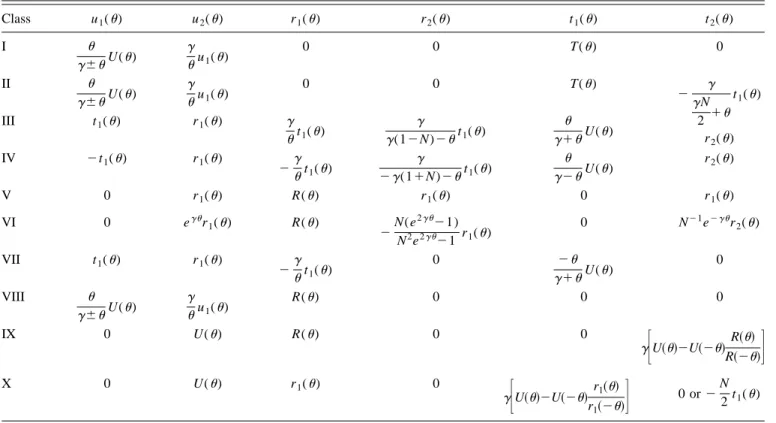
We list the complete solutions of SU(N)-invariant YBE without the crossing symmetry in Table I. U(u) satisfy U(u)U(2u)51 due to the unitarity and similarly for R(u), and T(u). It is easy to show that the classes I–VI are exactly the nonrelativistic limits of the relativistic solutions by Berg et al. @10#, i.e., imposing the crossing symmetry of u1(u)5t1(ip2u), u2(u)5t2(ip2u), and r1(u)
5r2(ip2u), which fixes the parameterg to a certain value
for each classes. Class I describes a system without reflec-tion, pair creanreflec-tion, and pair annihilation. Thus it is a good candidate for a nonrelativistic quantum-mechanical system.
g is fixed to zero with the crossing symmety. Class II does not have reflecting amplitudes and g522pi/N with the crossing relation. It is related to the C PN21 model SU(N) chiral Gross-Neveu model. Class III includes the O(2N) (N.1) symmetric scattering matrices obtained by Zamolod-chikov and ZamolodZamolod-chikov@8#. The crossing symmetry fixes
g to ip/(12N). Class IV has a similar structure to class III withg52ip/(11N) in the relativistic limit. Classes V and VI are the other nontrivial solutions with a crossing relation. Classes IX and X do not allow any nontrivial solutions with a crossing relation. No models are associated with these classes yet.
Classes VII and VIII are the most interesting since they have vanishing r2 and t2. Since these two classes are
identi-TABLE I. Complete solutions of nonrelativistic SU(N) invariant Yang-Baxter equations.
Class u1(u) u2(u) r1(u) r2(u) t1(u) t2(u) I u g6uU(u) guu1(u) 0 0 T(u) 0 II u g6uU(u) guu1(u) 0 0 T(u) 2gNg 2 1u t1(u) III t1(u) r1(u) g ut1(u) g g(12N)2ut1(u) u g1uU(u) r2(u) IV 2t1(u) r1(u) 2gut1(u) g 2g(11N)2ut1(u) u g2uU(u) r2(u) V 0 r1(u) R(u) r1(u) 0 r1(u) VI 0 egur1(u) R(u) 2N(e 2gu21) N2e2gu21 r1(u) 0 N21e2gur2(u) VII t1(u) r1(u) 2gut1(u) 0 2u g1uU(u) 0 VIII u g6uU(u) guu1(u) R(u) 0 0 0 IX 0 U(u) R(u) 0 0 g
F
U~u!2U~2u! R~u! R~2u!G
X 0 U(u) r1(u) 0 gF
U~u!2U~2u!r1~u! r1~2u!G
0 or2N 2t1(u)cal under the interchange of t1 with r1, we will concentrate
on Class VII only and will discuss how it can be related to the multicomponent CSM.
We begin with the multicomponent CSM where the Hamiltonian is given by H52
(
i n ]2 ]xi21(
i, j l~l1Pi j! sinh2~xi2xj! , ~3!where Pi j denotes the exchange operator of the colors of
~anti-!particles at xi and xj. This model has been shown
to be integrable by several authors @11,12#. Since Pi j2 5I, we can define the eigenstates of Pi j as u6
&
5(1/
A
2)(usisj&
6usjsi&
) such that Pi ju6&
56u6&
.To obtain the two-body S matrix, we consider the scatter-ing eigenstates of the Schro¨dinger equation @2(d2/dx2)1$l(l11)/sinh2x%#c
k(x)5k 2c
k(x). Due to the
underlying SU(1,1) structure of the scattering problem@13#,
ck(x) is proportional to (sinhx)l112F1@(l111ik)/
2,(l112ik)/2,l13/2;2sinh2x], where 2F1 is the
hyper-geometric function. The asymptotic states for x→` are
ck~x!→C
S
eikxG~ik!G~2l12! G~l111ik!G~l11! 1e2ikx G~2ik!G~2l12!
G~l112ik!G~l11!
D
~4! and the two-body scattering matrices areS1~k!5 G~ik!G~11l2ik! G~2ik!G~11l1ik!, S2~k!5 G~ik!G~l2ik!
G~2ik!G~l1ik!, ~5!
for Pi j561, respectively @14,15#.
Now returning to the usisj
&
basis, one can obtainparticle-particle scattering amplitudes straightforwardly as follows: Ss isj sjsi[u 15 1 2~S11S2!, Ss isj sisj[u 25 1 2~S12S2!, ~6!
for siÞsj. Note that Ss
isi
sisi5u
11u2 if si5sj. Similarly,
the scattering amplitudes of particles and antiparticles where
siÞs¯j become Ss is¯j sis¯j[r 15 1 2~S11S2!, Ss is¯j s¯jsi[t 15 1 2~S12S2!, ~7!
wheres¯j stands for the color of an antiparticle.~See Fig. 1 for schematic definitions of the amplitudes.!
The scattering amplitudes of the same color have to be dealt with some care. The most general eigenstates of Pi jare
now of the form u6
&
5(1/A
2)(uA&
6uB&
), where uA&
5N(i51N
aiusi¯si
&
anduB&
5N(i51 Naius¯isi
&
for somecoeffi-cients ai’s andN5((i51 N
ai2)21/2. The scattering amplitudes S6in the basis ofu6
&
can be related to those in the basis of usis¯i&
as follows:1
2~S11S2!5r11Mr2, 21~S12S2!5t11Mt2, ~8!
where M5N2(i, jNaiaj. Comparing Eq.~5! with ~6!, we find r25t250. With S6 given in Eq. ~3!, the scattering ampli-tudes of the SU(N)-invariant CSM yield
u15t15 2ik l1ik G~ik!G~l2ik! G~2ik!G~l1ik!, u25r15 l l1ik G~ik!G~l2ik! G~2ik!G~l1ik!, r25t250. ~9!
Indeed these amplitudes belong to class VII of the YBE. In this paper, we used the YBE with the unitarity as a unified tool to derive the S matrices of nonrelativistic many-particle systems as well as those of relativistic field theories. Additional constraints select out the corresponding solutions. For the relativistic cases, the crossing symmetry is required due to the CPT invariance. For the nonrelativistic cases, on the other hand, a natural assumption of the vanishing ampli-tudes of creation and annihilation is necessary. An interest-ing result is that we derived the S matrices of the multicom-ponent CSM where the potentials between two particles are all 1/sinh2x types irrespective of the species from the SU(N)-invariant YBE. We want to point out that there exists a more general exactly solvable potential ~Po¨schl-Teller! @13# which contains both 1/sinh2x and 1/cosh2x @16#. It has
been also known that the O(2)-invariant scattering theory ~the sine-Gordon model! is related to the nonrelativistic Hamiltonian system with the 1/sinh2x potential for ~anti-!particle-~anti-!particle scattering @8# and the 1/cosh2x
for particle-antiparticle @7#. It would be interesting to con-sider the case where particle-antiparticle scattering potential is different from particle-particle potential with particles car-rying colors. We would like to emphasize the approach to the multicomponent CSM and the generalized Haldane-Shastry model@3,4,17# based on the factorizable S-matrix theory can be promising. We hope our approach can be generalized to other integrable Hamiltonian systems.
We would like to thank T. Deguchi, P. Fendley, N. Kawakami, C. Lee, V. Pasquier, C. Rim, and R. Sasaki for helpful discussion. This work is supported in part by the Korea Science and Engineering Foundation under Contracts No. 95-0701-04-01-3 ~C.A. and K.L.! and 961-0201-006-2 ~C.A.!, and the Ministry of Education under Contracts No. BSRI-96-2428 ~C.A.!, 2428 ~K.L.!, and BSRI-96-2442 ~S.N.!. S.N. also acknowledges the Korea-Japan Ex-change program of KOSEF-JSPS. We also acknowledge the partial support of the Center for Theoretical Physics at Seoul National University.
@1# P. Calogero, J. Math. Phys. 10, 2191 ~1969!. @2# B. Sutherland, Phys. Rev. A 5, 1372 ~1972!. @3# F.D.M. Haldane, Phys. Rev. Lett. 60, 635 ~1988!. @4# B.S. Shastry, Phys. Rev. Lett. 60, 639 ~1988!.
@5# B.D. Simons, P.A. Lee, and B.L. Altshuler, Phys. Rev. Lett.
72, 64~1994!.
@6# F.D.M. Haldane, Phys. Rev. Lett. 67, 937 ~1991!. @7# V. Korepin, JETP Lett. 23, 201 ~1976!.
@8# A.B. Zamolodchikov and Al.B. Zamolodchikov, Ann. Phys. ~N.Y.! 120, 253 ~1980!.
@9# A. Kapustin and S. Skorik, Phys. Lett. A 196, 47 ~1994!. @10# B. Berg, M. Karowski, P. Weisz, and V. Kurak, Nucl. Phys.
B134, 125~1978!.
@11# A.P. Polychronakos, Phys. Rev. Lett. 69, 703 ~1992!. @12# Z.N.C. Ha and F.D.M. Haldane, Phys. Rev. B 46, 9359
~1992!.
@13# Y. Alhassid, F. Gu¨rsey, and F. Iachello, Ann. Phys. ~N.Y.!
148, 346~1983!.
@14# M.A. Olshanetsky and A.M. Perelomov, Phys. Rep. 94, 313 ~1983!.
@15# B. Sutherland and B.S. Shastry, Phys. Rev. Lett. 71, 5 ~1993!.
@16# B. Sutherland and R.A. Ro¨mer, Phys. Rev. Lett. 71, 2789 ~1993!.
@17# N. Kawakami, Phys. Rev. B 46, 1005 ~1992!.