Food Sci. Biotechnol. Vol. 18, No. 6, pp. 1528 ~ 1531 (2009)
1528
ⓒ The Korean Society of Food Science and Technology
Hypolipidemic and Antioxidative Properties of Tocotrienol-rich
Fraction (TRF) Supplementation in High Fat-fed Rats
Youngmin Choi and Junsoo Lee*
Department of Food Science and Technology, Chungbuk National University, Cheongju, Chungbuk 361-763, Korea
Abstract In this study, we investigated a dose-dependent hypolipidemic and antioxidant effects of tocotrienol-rich fraction
(TRF) from grape seeds. After induction of hyperlipidemia for 4 weeks, rats were supplemented with different dose (5, 25, and 50 mg/kg BW/day) of TRF for 1 week. Oral administration of TRF (50 mg/kg BW/day) decreased the plasma triglyceride (TG, 162.6 mg/dL), total cholesterol (TC, 83.7 mg/dL), low density lipoprotein-cholesterol (LDL-C, 20.3 mg/dL), malondialdehyde contents (MDA, 3.3 nmol/dL), and atherogenic index (AI, 2.0) compare to high-fat diet group. These data suggest that TRF supplementation has significant health benefits through the modulation of physiological functions that include various atherogenic lipid profiles and antioxidative status in hyperlipidemia.
Keywords: tocotrienol rich fraction, grape seed, hypolipidemic, antioxidant, high fat-fed rat Introduction
It is known that hypercholesterolemia is an important risk factor for development and progression of cardiovascular disease (CVD) such as atherosclerosis and myocardial infarction (1,2). Elevated plasma concentration of cholesterol, especially low density lipoprotein-cholesterol (LDL-C), is recognized as a leading cause in the development of atherosclerosis (3). According to the oxidation hypothesis, LDL-C accumulates in the extracellular subendothelial space of arteries and is oxidized to form oxidative LDL-C, which is highly atherogenic and toxic to vascular cells (4,5). Therefore, the inhibition of oxidative stress under hypercholesterolemia is considered to be an important therapeutic approach.
Indeed, vitamin E was reported to prevent LDL-C oxidation and to delay the development of atherosclerotic plaques in vivo, suggesting the effectiveness of antioxidant for the treatment and prevention of atherosclerosis (6,7). Several investigators reported that tocotrienols and/or tocotrienol-rich fraction (TRF) from palm and rice bran have been demonstrated to possess cholesterol lowering properties in humans and various experimental animals in the last few years (7-10). The hypocholesterolemic effect of tocotrienols may be attributable to posttranscriptional suppression of 3-hydroxy-3-methylglutaryl-CoA reductase (HMG-CoA reductase), and a concomitant upregulation of the LDL receptor (9,11). Alternatively, stimulation of hepatic apoB degradation by γ-tocotrienol resulting in a reduced
secretion of apoB-containing lipoproteins, such as LDL-C, may also contribute to the hypocholesterolemic properties of tocotrienols (12). Experiments in vitro and in vivo
indicate that γ-tocotrienol and analogues of γ-tocotrienol
may be more potent inhibitors of HMG-CoA reductase than other tocotrienols (13). Moreover, it has been
proposed that α-tocotrienol has a higher antioxidant
potential than α-tocopherol due to a more uniform
distribution in membrane bilayers and higher recycling efficiency from radicals (14).
The present study was designed to evaluate the effect of TRF purified from grape seed on the cholesterol metabolism and antioxidative status in rats fed a hyperlipidemic diet. Materials and Methods
TRF from grape seeds Purification of tocotrienol-rich fraction (TRF) from grape seeds (‘Campbell early’) was carried out using silica gel chromatography as described by Choi and Lee (15). The analysis of tocopherols and tocotrienols was performed on a LiChrosphere® Diol 100
column (250×4 mm, i.d., 5µm) using a mobile phase of
hexane/isopropanol (98.7:1.3, v/v) at a flow rate of 1.0 mL/ min. Peaks were detected by fluorescence using an excitation wavelength of 290 nm and an emission wavelength of 330 nm. TRF contains 0.27% α-tocopherol, 0.20% γ-tocopherol,
3.27% α-tocotrienol, and 6.79% γ-tocotrienol (16). Animal experiment This study was conducted in conformity with the policies and procedures detailed in guidelines of the National Institution of Toxicology Research of the Korea Food & Drug Administration for the care and use of laboratory animals. Thirty male Sprague-Dawley rats were purchased from Bio Genomics, Inc. (Seoul, Korea). Prior to the experiment, the rats were given rodent chow (LabDiet®; PMI Nutrition International, St.
Louis, MO, USA) containing 20.0% protein, 4.5% fat, 6.3% fiber, 50.2% carbohydrate, and water ad libitum. For the induction of hyperlipidemia, 24 rats were given an atherogenic diet purchased from Research Diets, Inc. (D12492, New Brunswick, NJ, USA) for 5 weeks (Table 1). Six control rats were given normal rodent chow. After the induction of hyperlipidemia, the rats were divided into 4 groups of 6 rats each and received 5, 25, or 50 mg TRF/ kg BW/day for 1 week through oral administration (0 mg TRF rats were given vitamin E-stripped corn oil). At the
*Corresponding author: Tel: +82-43-261-2566; Fax: +82-43-271-4412 E-mail: [email protected]
Received June 30, 2009; Revised August 25, 2009; Accepted September 3, 2009
Hypolipidemic and Antioxidant Properties of TRF 1529
end of the treatment, rats in all groups were anaesthetized and blood drawn by cardiac puncture and heparinized. Immediately after blood collection the liver were removed and washed with phosphate buffered saline (PBS). For the hepatic antioxidant status, 1 g of liver tissue was homogenized in 10 mL PBS and centrifuged for 10,000×g for 15 min. The supernatant was removed and stored at
−70oC for analysis.
Lipid profiles and antioxidant status assay in liver and plasma Plasma triglyceride (TG) and total cholesterol (TC), high density lipoprotein cholesterol (HDL-C), and LDL-C were determined using enzymatic assays on an automated chemistry analyzer (Hitachi 7080; Hitachi, Tokyo, Japan). The amount of plasma very low density lipoprotein cholesterol (VLDL-C) was calculated by subtracting HDL-C and LDL-C from TC. The atherogenic index (AI) was calculated as (TC−HDL-C)/HDL-C.
The total antioxidant activity (TAA) and catalase (CAT) activity in plasma and liver supernatant were determined according to the method of Choi and Lee (15) and Fossati
et al. (17), respectively. As a marker of the lipid peroxidation
product, the hepatic and plasma malondialdehyde (MDA) contents were measured using an extinction coefficient of 1.56×10⁵/M·cm (18).
Statistical analysis The results were reported as mean± standard deviation (SD). The significance of differences among treatment means were determined by one-way analysis of variance (ANOVA) using SAS version 8.1 (SAS Institute, Cary, NC, USA) with a significance level of 0.05.
Results and Discussion
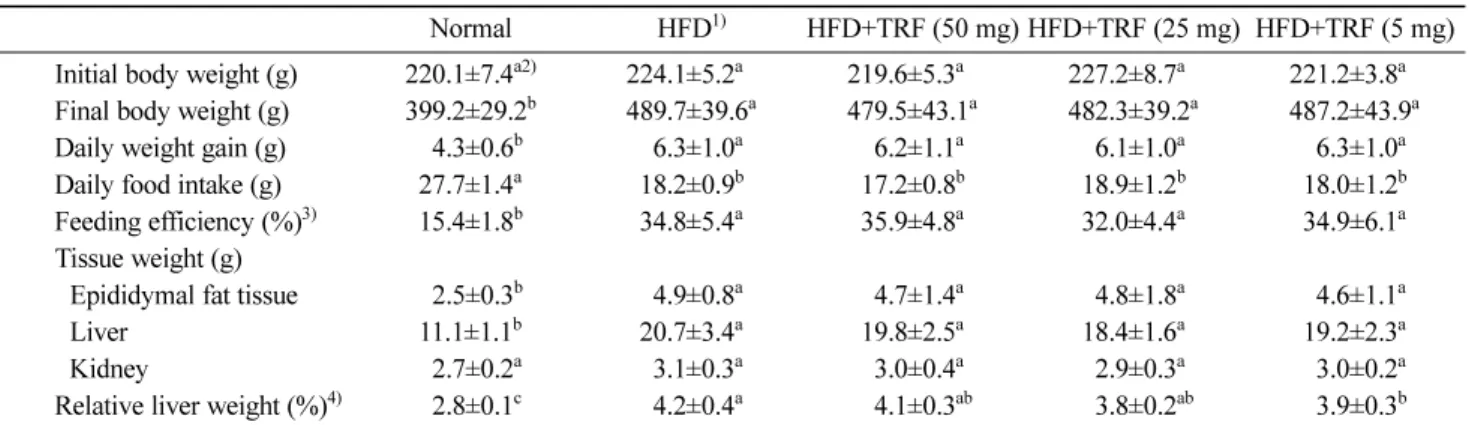
Body weight, food intake, and tissue weights Table 2 depicts the effect of tocotrienol-rich fraction (TRF) from grape seeds on body weight, food intake, and tissue weights of hyperlipidemic rats. The high fat diet caused a significant increase in the body, and tissue weight (g) and relative liver weight (%) of high fat diet (HFD) rats as compared with the normal diet animals. However, TRF supplementations (5, 25, and 50 mg/kg BW/day) did not affect the body and tissue weight gain during this study.
Effects of TRF on plasma lipid profiles in hyperlipidemic rats There is a growing body of evidence that oxidative modification of LDL-C may play a significant role in the development of atherosclerotic lesions (4,5). In this study, we investigated the dose-dependent hypolipidemic and antioxidant effects of TRF, a mixture of tocols purified from grape seeds, in experimentally induced hyperlipidemic rats.
The plasma lipid levels at the end of the experiment are shown in Table 3. After 5 weeks of treatment the TG, TC, and LDL-C concentrations and AI of rats fed a HFD-C showed significant increase as compared with the rats fed normal diet. However a decrease of HDL-C concentration of rats in HFD group was observed. Rats that received an oral administration of TRF (5, 25, and 50 mg/kg BW/day) for 1 week had lower concentration of TG and LDL-C and AI than those of rats that received HFD. Moreover, the concentration of HDL-C of rats treated with 50 mg TRF increased as compared with those of rats in HFD group. Hepatic TC and TG were significantly lower in the 50 and 25 mg TRF groups compared to the HFD group.
The decrease in plasma cholesterol levels was consistent
Table 1. Composition of normal and high fat diets (g%)
Ingredients1) Normal diet High fat diet
Proteins 20.0 26.2 Carbohydrates 50.2 26.3 Fats 04.5 034.92) Minerals 07.3 05.9 Vitamins 01.5 01.5 Fiber 06.3 06.5
1)Rodent diets were purchased from PMI Nutrition International
(LabDiet®) and Research Diets Inc (D12492) for normal and high
fat groups, respectively.
2)Fats consist of 9.2% soybean oil and 90.8% lard and the lard
con-tains 0.95 mg cholesterol/g.
Table 2. Changes in body and tissue weights, food intake, and feeding efficiency of rats fed different diets
Normal HFD1) HFD+TRF (50 mg) HFD+TRF (25 mg) HFD+TRF (5 mg)
Initial body weight (g) 220.1±7.4a2) 224.1±5.2a 219.6±5.3a 227.2±8.7a 221.2±3.8a
Final body weight (g) 399.2±29.2b 489.7±39.6a 479.5±43.1a 482.3±39.2a 487.2±43.9a
Daily weight gain (g) 004.3±0.6b 006.3±1.0a 006.2±1.1a 006.1±1.0a 006.3±1.0a
Daily food intake (g) 027.7±1.4a 018.2±0.9b 017.2±0.8b 018.9±1.2b 018.0±1.2b
Feeding efficiency (%)3) 015.4±1.8b 034.8±5.4a 035.9±4.8a 032.0±4.4a 034.9±6.1a
Tissue weight (g)
Epididymal fat tissue 002.5±0.3b 004.9±0.8a 004.7±1.4a 004.8±1.8a 004.6±1.1a
Liver 011.1±1.1b 020.7±3.4a 019.8±2.5a 018.4±1.6a 019.2±2.3a
Kidney 002.7±0.2a 003.1±0.3a 003.0±0.4a 002.9±0.3a 003.0±0.2a
Relative liver weight (%)4) 002.8±0.1c 004.2±0.4a 004.1±0.3ab 003.8±0.2ab 003.9±0.3b
1)HFD, high fat diet.
2)Values are mean±SD from 6 rats (n=6); Different letters in the same row indicate significant difference (by ANOVA and Duncan’s test, p<0.05).
3)(daily weight gain/daily food intake)×100% 4)(liver weight/final body weight)×100%
1530 Y. Choi and J. Lee
with the results reported in animals and humans (8,9). Qureshi et al. (19) suggested that the cholesterol-lowering
effect of tocotrienols from rice bran oil were even more encouraging than the effects of tocotrienols from palm oil due to the novel tocotrienols. The hypocholesterolemic properties of TRF may be explained by the mevalonate-suppressive action of constituent isoprenoid end products of plant secondary metabolism. Tocotrienols in HepG2 cells post-transcriptionally down-regulate enzymatic activity of HMG-CoA reductase, a key rate-controlling enzyme in the biosynthetic pathway of isoprenoids and cholesterol (20). Khor et al. (9) have also shown that tocotrienols
isolated from palm oil inhibit liver HMG CoA reductase activity in the guinea pig in a dose-dependent manner. Moreover, TRF used in this study contains a high portion of γ-tocotrienol. Experiments in vitro and in vivo indicate
that γ-tocotrienol may be more potent inhibitors of
HMG-CoA reductase than other tocotrienols (13). Alternatively, stimulation of hepatic apoB degradation by γ-tocotrienol
resulting in a reduced secretion of apoB-containing lipoproteins, such as LDL-C, may also contribute to the hypocholesterolemic properties of tocotrienols (12).
Effects of TRF on antioxidant status in hyperlipidemic rats The hepatic (410.6 unit/g tissue) and plasma (41.2 unit/mL) CAT activity of rats in HFD group was significantly lower than those of the normal diet group (911.1 unit/g tissue and 50 unit/mL, respectively) (Table 3). The oral administration of TRF recovered plasma CAT activity as compared with HFD group. Moreover, the MDA levels showed a significant increase in liver (27.9 nmol/g tissue) and plasma (8.4 nmol/mL) of the animals fed on HFD when compared to the normal diet group (17.0 unit/g tissue and 2.8unit/mL, respectively). The administration of TRF in HFD animals significantly decreased the MDA concentration as a dose-dependent manner.
The oxidative modification of lipids, particularly oxidation
of LDL-C, has been reported as one of the possible mechanisms leading to cardiovascular disease (21). The anti-atherogenic action of antioxidants is commonly linked to the inhibition of lipoprotein oxidation. The data from our study clearly indicate that the hyperlipidemic rats also showed an increase in the levels of lipid peroxides and this data was consistent with the earlier reports (22,23). Our study demonstrates that, in addition to lowering cholesterol, TRF also helps in inhibiting lipid peroxidation in hyperlipidemic rats. The antioxidant activity of tocopherols and tocotrienols is originated from their ability to donate phenolic hydrogens to lipid peroxy radicals (24). Several investigators reported that tocotrienols have greater antioxidant activity and protect more efficiently against some free radical-related diseases than tocopherols (14,24, 25). The present results suggest that TRF supplementation has significant health benefits through the modulation of physiological functions that include various atherogenic lipid profiles and antioxidant status in hyperlipidemia. Therefore, TRF may be a good source of nutrition and may provide good health benefits in hyperlipidemia and related complications.
Acknowledgments
This work has been supported by the Research Center for Bioresource and Health (RCBH) of ITEP & MOCIE and also supported by MAF/ARPC through the Grape Research Project Group.
References
1. Aygustin J, Dwyer J. Coronary heart disease: Dietary approaches to reducing risk. Top. Clin. Nutr. 10: 1-3 (1999)
2. Wald NJ, Law MR. Serum cholesterol and ischemic heart disease. Atherosclerosis 118: 1-5 (1995)
3. Krieger M. The “best” of cholesterols, the “worst” of cholesterols: A tale of two receptors. P. Natl. Acad. Sci. USA 95: 4077-4080 Table 3. Effects of TRF supplements on plasma lipid profiles and plasma and hepatic antioxidant status in high fat-fed rats
Normal HFD1) HFD+TRF (50 mg) HFD+TRF (25 mg) HFD+TRF (5 mg)
Plasma lipid profiles2)
TG (mg/dL) 060.3±14.1c3) 208.9±54.6a 162.6±19.0b 174.5±65.1ab 175.9±33.2ab
TC (mg/dL) 080.3±15.5b 099.9±17.0a 083.7±15.6ab 084.5±9.9ab 089.2±11.4ab
HDL-C (mg/dL) 029.8±3.0a 025.4±3.5b 027.9±3.8ab 025.3±1.2b 024.9±2.5b
LDL-C (mg/dL) 013.3±2.0b 026.7±6.5a 020.3±4.3ab 021.9±4.9ab 025.6±5.6a
AI 001.7±0.3c 003.0±0.8a 002.0±0.4bc 002.3±0.4b 002.6±0.4ab
Plasma antioxidant status4)
TAA (mgTEAC/mL) 002.1±0.1a 002.1±0.2a 002.1±0.1a 002.0+0.1a 002.2±0.1a
MDA (nmol/mL) 002.8±0.6b 008.4±3.1a 003.3±1.1b 006.5±2.4a 006.4±1.9a
CAT (unit/mL) 050.2±7.0a 041.2±6.5b 046.6±10.2ab 044.4±8.0ab 047.1±2.1ab
Hepatic antioxidant status
TAA (mgTEAC/g tissue) 005.8±0.3a 002.7±0.7d 004.1±0.3bc 004.2±0.2b 003.4±0.7b
MDA (nmol/g tissue) 017.0±1.5c 027.9±5.6a 018.7±2.5bc 017.3±3.9bc 022.7±6.1ab
CAT (Unit/g tissue) 911.1±100.8a 410.6+24.5b 459.7±14.8b 451.8±12.9b 434.5±21.4b
1)HFD, high fat diet.
2)TC, total cholesterol; TG, triglyceride; HDL-C, high density lipoprotein-cholesterol; LDL-C, low density lipoprotein-cholesterol; AI,
athero-genic index, (TC−HDL-C)/HDL-C.
3)Values are mean±SD from 6 rats; Different letters in the same row indicate significant difference (by ANOVA and Duncan’s test, p<0.05). 4)TAA, total antioxidant activity; MDA, malondialdehyde; CAT, catalase.
Hypolipidemic and Antioxidant Properties of TRF 1531
(1998)
4. Witztum JL, Steinberg D. Role of oxidized low density lipoprotein in atherogenesis. J. Clin. Invest. 88: 1785-1792 (1991)
5. Morel DW, Hessler JR, Chisolm GM. Low density lipoprotein cytotoxicity induced by free radical peroxidation of lipid. J. Lipid Res. 24: 1070-1076 (1983)
6. Porkkala-Sarataho E, Salonen JT, Nyyssönen K, Kaikkonen J, Salonen R, Ristonmaa U, Diczfalusy U, Brigelius-Flohe R, Loft S, Poulsen HE. Long-term effects of vitamin E, vitamin C, and combined supplementation on urinary 7-hydro-8-oxo-2'-deoxyguanosine, serum cholesterol oxidation products, and oxidation resistance of lipids in nondepleted men. Arterioscl. Throm. Vas. 20: 2087-2093 (2000)
7. Minhajuddin M, Beg ZH, Iqbal J. Hypolipidemic and antioxidant properties of tocotrienol-rich fraction isolated from rice bran oil in experimentally induced hyperlipidemic rats. Food Chem. Toxicol. 43: 747-753 (2005)
8. Qureshi AA, Qureshi N, Wright JJK, Shen Z, Kramer G, Gapor A, Chong YH, DeWitt G, Ong ASH, Peterson DM, Bradlow BA. Lowering of serum cholesterol in hypercholesterolemic humans by tocotrienols (Palmvitee). Am. J. Clin. Nutr. 53: 1021S-1026S (1991) 9. Khor HT, Chieng DY, Ong KK. Tocotrienols inhibit HMG-CoA reductase activity in the guinea pig. Nutr. Res.15: 537-544 (1995) 10. Qureshi AA, Mo H, Packer L, Peterson DM. Isolation and
identification of novel tocotrienols from rice bran with hypocholesterolemic, antioxidant, and antitumor properties. J. Agr. Food Chem. 48: 3130-3140 (2000)
11. Parker RA, Pearce BC, Clark RW, Gordon DA, Wright JJ. Tocotrienols regulate cholesterol production in mammalian cells by posttranscriptional suppression of 3-hydroxy-3-methylglutaryl-coenzyme A reductase. J. Biol. Chem. 268: 11230-11238 (1993) 12. Theriault A, Wang Q, Gapor A, Adeli K. Effects of
gamma-tocotrienol on apoB synthesis, degradation, and secretion in HepG2 cells. Arterioscl. Throm. Vas. 19: 704-712 (1999)
13. Pearce BC, Parker RA, Deason ME, Dischino DD, Gillespie E, Qureshi AA, Volk K, Wright JJ. Hypocholesterolaemic and antioxidant activities of benzopyran and tetrahydronaphthalene analogues of the tocotrienols. J. Med. Chem. 37: 526-541 (1994) 14. Serbinova EA, Kagan V, Han D, Packer L. Free radical recycling
and intramembrane mobility in the antioxidant properties of α
-tocopherol and α-tocotrienol. Free Radical Bio. Med. 10: 263-275 (1991)
15. Choi Y, Lee J. Antioxidant and antiproliferative properties of a tocotrienol-rich fraction from grape seeds. Food Chem. 114: 1386-1390 (2009)
16. Lee SM, Lee J. Tocopherol and tocotrienol contents of vegetable oils, margarines, butters, and peanut butters consumed in the Korean diet. Food Sci. Biotechnol. 15: 183-188 (2006)
17. Fossati P, Prencipe L, Berti G. Use of 3,5-dichloro-2-hydroxy-benzenesulfonic acid/4-aminophenazone chromogenic system in direct enzyme assay of uric acid in serum and urine. Clin. Biochem. 26: 227-231 (1980)
18. Buege JA, Aust SD. Microsomal lipid peroxidation. Method Enzymol. 52: 302-310 (1978)
19. Qureshi AA, Bradlow BA, Salser WA, Brace LD. Novel tocotrienols of rice bran modulate cardiovascular disease risk parameters of hypercholesterolemic humans. J. Nutr. Biochem. 8: 290-298 (1997)
20. Pearce BC, Parker RA, Deason ME, Qureshi AA, Wright JJ. Hypocholesterolaemic activity of synthetic and natural tocotrienols. J. Med. Chem. 35: 3595-3606 (1992)
21. Steinberg D, Parthasarathy S, Carew TE, Khoo JC, Witztum JL. Beyond cholesterol: Modifications of low-density lipoprotein that increase its atherogenicity. New Engl. J. Med. 320: 915-924 (1989) 22. Augusti KT, Narayanan A, Pillai LS, Ebrahim RS, Sivadasan R, Sindhu KR, Subha I, Abdeen S, Nair SS. Beneficial effects of garlic (Allium sativum Linn) on rats fed with diets containing cholesterol and either of the oil seeds, coconuts, or groundnuts. Indian J. Exp. Biol. 39: 660-667 (2001)
23. Tanaka M, Nakaya S, Kumai T, Watanabe M, Matsumoto N, Kobayashi S. Impaired testicular function in rats with diet-induced hypercholesterolemia and/or streptozotocin-induced diabetes mellitus. Endocr. Res. 27: 109-117 (2001)
24. Kamal-Eldin A, Appelqvist LA. The chemistry and antioxidant properties of tocopherols and tocotrienols. Lipids 31: 671-701 (1996)
25. Komiyama K, Iizuka K, Yamaoka M, Watanabe H, Tsuchiya N, Umezawa I. Studies on the biological activity of tocotrienols. Chem. Pharm. Bull. 37: 1369-1371 (1989)