92
Symposia
S9-3
Hydrogenases and Hydrogen Production
in Thermococcus onnurineus NA1
Jung-Hyun Lee*, Sung Gyun Kang,Seung Seob Bae, Jae Kyu Lim, Yun Jae Kim, Sang-Jin Kim, and Hyun Sook Lee
Marine Biotechnology Research Center, Korea Ocean Research & Development Institute, Ansan, P.O. Box 29, Seoul 425-600
Thermococcus onnurineus NA1 was isolated from a deep-sea hydrothermal vent region and was studied to
understand the adaptation mechanism of microorganisms in the highly variable hydrothermal vent environment. Previously, the genomic analysis of T. onnurineus NA1, sulfur-reducing hyperthermophilic archaea, revealed the mixotrophic potential of organotrophy and carboxydotrophy, followed by experimental demonstration, implicating a survival mechanism to be advantageous in the extreme condition [1], demonstrating a good example that the genomic analysis is a powerful tool to unveil the novel physiological features.
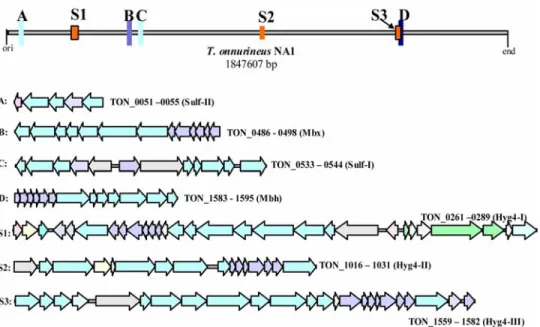
Furthermore, T. onnurineus NA1 retained high copies of hydrogenase clusters in the genome in association with oxidoreductases, including CO dehydrogenase and formate dehydrogenases (Fig. 1). Among those hydrogenases, three unique hydrogenase gene clusters (Hyg4-I, Hyg4-II and Hyg4-III) was extensively analyzed in comparison with two membrane-bound hydrogenases (Mbh and Mbx).
93 www.msk.or.kr The five hydrogenases (mbh, mbx, Hyg4-I, Hyg4-II, and Hyg4-III) were found to belong to energy- conserving hydrogenase, showing similarities to hydrogenase 4 (Hyg4) type subunits from Pyrococcus abyssi and T. litoralis. Furthermore, the gene products of the gene clusters shared similarities with subunits of complex I as well. These multimeric membrane-bound hydrogenase complexes seems to comprise transmembrane subunits homologous to complex I subunits involving in proton pumping and energy coupling, and appear to be able to couple the oxidation of a carbonyl group (originating from formate, acetate, or carbon monoxide) with the reduction of protons to H2 [2]. The hydrogenase gene clusters were found to be associated with genes
encoding auxiliary proteins involved in hydrogenase maturation, regulation, substrate transport, and Na+/H+ antiporter, studies on whose functions are under progress. Post-genomic analysis (transcriptome, proteome, metabolome) has been accomplished to elucidate the metabolic roles of these hydrogenases and accessory proteins and regulation of their biosynthesis and activity.
Based on the genomic information, we found that T. onnurineus NA1 could produce hydrogen using various electron donors. We make efforts to improve hydrogen production in T. onnurineus NA1 focusing on optimization of culture conditions and metabolic pathway redirection. The understanding of roles and mechanisms of hydrogenases and the engineering of hydrogenases will be very promising in hydrogen production because they could play as bioelectrocatalysts for hydrogen fuel.
References
[1] Lee HS, Kang SG, Bae SS, Lim JK, Cho Y, Kim YJ, Jeon JH, Cha SS, Kwon KK, Kim HT, Park CJ, Lee HW, Kim SI, Chun J, Colwell RR, Kim SJ, Lee JH (2008) The complete genome sequence of
Thermococcus onnurineus NA1 reveals a mixed heterotrophic and carboxydotrophic metabolism. J Bacteriol 190:7491-7499.
[2] Hedderich R (2004) Energy-converting [NiFe] hydrogenases from archaea and extremophiles: ancestors of complex I. J Bioenerg Biomembr 36:65-75.