© Korean Powder Metallurgy Institute 1082 -1. Introduction
Hydroxyapatite (HAP, Ca10(PO4)6(OH)2) is one of the most effective bioceramic material for bone substitution and reconstruction due to its similarities with the mineral constituents of human bones and teeth [1]. It also has been considered for orthopedic applications due to its favorable osteoconductive and bioactive properties [2,3]. The applications of bulk HAp compacts for nanostructured material implants are hindered by the low mechanical properties of sintered HAp [4], especially the fracture toughness, which is low compared to that of the natural bone. However, at high temperature sintering, HAp decomposes into α and β-TCP and also causes grain coarsening that imparts low mechanical properties to the sintered body. The spark plasma sintering (SPS) technique is recently gaining attention due to its favorable sintering characterstics such as rapid and low temperature sintering. On the other hand, CNT has been considered as a biocompatible material with some excellent properties like high stiffness and tensile strength [5]. CNT reinforced materials were studied where it exhibited superior performance compared to the monolithic materials [6,7]. In-situ synthesis of CNT/HAp composites and fabrication of biocompatible HAp coating on CNT was reported previously [8,9]. In this study, the CNT reinforced HAp composites were fabricated using the SPS process depending on sintering temperature and materials properties were investigated.
2. Experimental and Results
Spherical shaped nano HAp particles were synthesized using the microwave assisted synthesis process. Stoichiometric amount of Ca(OH)2 and H3PO4 was mixed in
1 liter of deionized water. The stirred mixture was heated in a microwave oven for 25 mins at PH and then washed twice and dried. The CNT (L-MWNT-1030, 10-30nm diameter, Shenzhen Nanotech Port Co. China) was dispersed in deionized water by ultrasonication for 3 hrs using sodium dodecyle sulphate (SDS) surfactant (CNT: SDS mass ratio=1:1 at 0.1% concentration). After sonication, the supernatant suspension was collected and the amorphous HAp powder was mixed with CNT dispersion to make 2.5 vol% of CNT loading and was ball milled for 20 hrs using ZrO2 balls. The powder was dried and then heat treated at 800 ºC for 30 mins in a nitrogen atmosphere to remove the SDS. The powders were sintered by SPS at 5 Pa pressure at 1000 ºC, 1100 ºC and 1200 ºC in an Ar atmosphere under a mechanical load of 30 MPa for 5 mins. The crystal structure and microstructure analysis of the powder and the bulk body was characterized by XRD (DMAX-250, Rigaku, Japan), FE-SEM (JSM-635F, JEOL, Japan) and TEM (JEM2010, JEOL, Japan) techniques.
Fig. 1 shows the SEM image of the CNT dispersed HAp powder. It shows that the CNT was considerably debundled and dispersed although significant extents of CNT bundles were still evident as shown inset.
Fig. 1. SEM image of HAp/CNT mixture powders.
2006 POWDER METALLURGY World Congress
PC03-W-17
500nm
Fabrication of CNT-Reinforced HAp Composites by Spark Plasma Sintering
Swapan Kumar Sarkar1, a, Min-Ho Youn1, b, Ik-Hyun Oh2, c and Byong-Taek Lee1, d 1
School of Advanced Materials Engineering, Kongju National University, 182, Shinkwan-dong, Kongju City, Chungnam 314-701, S Korea
2
Materials & Parts Team, KITECH, 971-35, Wolchul-dong, Buk-gu, Gwangju, 500-460, S Korea a
[email protected], [email protected], [email protected], [email protected] Abstract
Carbon nanotube (CNT) reinforced hydroxyapatite (HAp) composites were fabricated by using the spark plasma sintering process with surfactant modified CNT and HAp nano powder. Without the dependency on sintering temperature, the main crystal phase existed with the HAp phase although a few contents of β-TCP (Tri calcium phosphate) phase were detected. The maximum fracture toughness, (1.27 MPa.m1/2) was obtained in the sample sintered at 1100 oC and on the fracture
surface a typical intergranular fracture mode, as well as the pull-out pmhenomenon of CNT, was observed.
© Korean Powder Metallurgy Institute 1083
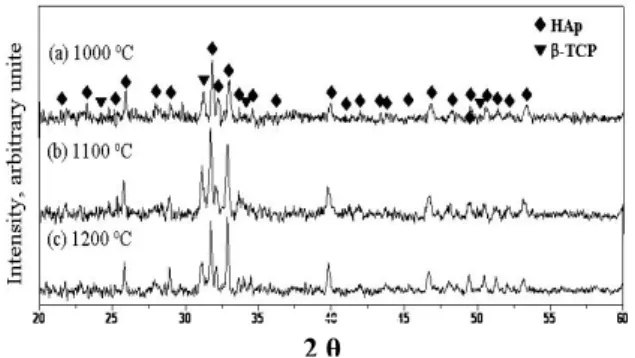
-Fig.2 is the XRD profiles for the SPSed samples sintered at 1000ºC (a), 1100ºC (b) and 1200 ºC (c). Without the dependency of sintering temperature, small amounts of β-TCP phase appeared due to the decomposition of the HAp during the SPS process. In general, HAp phase can be transformed to β-TCP phase during the pressureless sintering process and especially in vacuum. The electrical pulses may also enhance the decomposition process.
Fig. 2. XRD profiles for SPSed HAp/CNT composites sintered at different temperatures.
Fig. 3 SEM image of the fracture surface of the composite sintered at 1100 oC.
Fig.3 shows the SEM images of the fracture surfaces of the SPSed samples sintered at 1100 ºC. It is clearly seen that the size of HAp grains increased as the sintering temperature increased. The average grain size at 1000 ºC, 1100 ºC and 1200 ºC in the sintered body was changed to 0.5 um, 0.7 um and 1 um in diameter, respectively. In the sample sintered at 1000 ºC, residual pores were observed on the fracture surface and appeared with mostly flat morphology, which indicates that the fracture mode was mainly of transgranular type. But in the sample sintered at 1100 ºC, the fracture surface showed a dense structure without any cracks or shrinkage cavities. Moreover, the fracture surface showed a intergranular fracture. Some straight and long CNTs were observed on the fracture surface. The result indicates that when the cracks were propagated into the sintered body, the pull-out phenomenon occurred to absorb the energy of crack propagation. On the
other hand, at 1200 ºC, the main fracture mode was changed to transganular type fracture. The pull-out of CNT did not occur both in 1000 ºC and 1200 ºC. In all the composites CNT bundles were observed. This was a factor why the mechanical roperties did not improve considerably despite the superior reinforcing properties of CNT.
Table 1 shows the material properties of SPSed HAp-CNT composites depending on the sintering temperature. the maximum fracture toughness was observed in the sample sintered at 1100 ºC and the value was about 1.27 MPa.m1/2 which is higher compared to monolithic HAp (0.98±0.2 MPa.m1/2 ) prepared at the same SPS conditions.
3. Summary
CNT reinforced HAp composites were fabricated by the SPS process. Without the dependency on sintering temperature, a few amount of β-TCP was formed by HAp decomposition during the SPS process. Dense microstructure with improved fracture characteristics was observed when the SPS temperature was at 1100 ºC. Also, the CNT pull-out phenomenon and perfect intergranular fracture were observed in the sample sintered at 1100 ºC.
4. Acknowledgement
The work was supported by the NRL preject of the Korean Ministry of Science and Technololy.
5. References
1. E.O. Martz, V.K. Goel, M.H. Pope, J.B. Park: J Biomed. Mater. Res. Vol. 38 (1997).
2. R.R. Rao, H. N. Roopo, T.S. Kannan: J Mater Sci: Mater Med Vol. 8 (1997).
3. A.C. Tas, F. Korkusuz, M. Timucin, N. Akkas: J Mater Sci: Mater Med Vol.8 (1997).
4. J.W. Choi, Y.M. Kong, H.E. Kim, I.S. Lee: J Am Ceram Soc Vol. 81(7) (1998).
5. S.K. Smart, A.I. Cassady, G.Q. Lu, D.J. Martin: Carbon Vol. 44 (2006).
6. G.D. Zhan, J.D. Kuntz, J. Wan, A. . Mukherjee: Nature Materials Vol. 2 (2003).
7. S.I. Cha, K.T. Kim, S.N. Arshad, C.B. Mo and S.H. Hong: Adv. Mater. Vol. 17 (2005).
8. L. Zhao, L. Gao: Carbon. Vol. 42 (2004).
9. B. Zhao, H. Hu, S.K. Mandal, R.C. Haddon: Chem. Mater. Vol. 17 (2005).