© Korean Powder Metallurgy Institute 846 -1. Introduction
Mg alloy matrix composites are considered as advanced materials due to their light weight, high specific strength, high modulus, low coefficient of thermal expansion, as well as good creep resistance. The conventional casting processes for fabricating Mg alloy matrix composites have to employ very high temperatures which could trigger undesired interfacial reactions owing to the high reactivity of Mg. Therefore, it is of great importance to develop new processes and new Mg alloy matrix composites.
There are already many works in the literature which reported that the hot-forging process is able to improve the mechanical property because of the grain refinement induced by recrystallization during hot-forging. And there is also a possibility that NiTi alloys can be used as good reinforcing phases for Mg alloy because of their peculiar performances. To our knowledge, however, in the previous publications we can hardly find papers on Mg alloy matrix composite reinforced by continuous NiTi shape memory alloys fiber fabricated using hot-forging technique.
In this paper, a Mg alloy matrix composite reinforced with NiTi continuous fibers was fabricated using hot-pressing and hot-forging followed by hot treatment. The influence of hot-forging on the Mg matrix and interface was investigated as well.
2. Experimental and Results
The chemical composition of the Mg alloy ingot, used as the matrix, is listed in TABLE 1. The Mg alloy ingot with a
density of 2.02g/cm3 was machined into cuttings with sizes
of 0.3~0.6mm. Then the cuttings were ball-milled into powders using a planetary ball miller, with a ball-powder ratio of 20:1, a rotational speed of 400r/min, and a milling time of 10h.
Table 1. Chemical composition of Mg alloy matrix
Element Al Zn Cu Re Mg
Content(wt.%) 16.0 5.0 5.0 3.0 Balance The ball-milled powders of Mg alloy with 5 wt.% contents of Ti-50.7at.%Ni fibers (φ=0.1mm) pretreated by acid-washing were hot-pressed together. The fibers in a row were sandwiched between two layers of the cuttings or powders. The heating rate was 15℃/min. The work piece was kept at 200℃ for 30min, heated to hot-pressing temperature 420℃ and holding for 1h, and environment-cooled to room temperature. In the course of hot-pressing, the applied pressure increased gradually to 375MPa. The prepared composite was put in the hot-forging facility and heated. When heated to a temperature of 320℃, the composite was forged to about 50% thickness of the initial sample at 375MPa pressure.
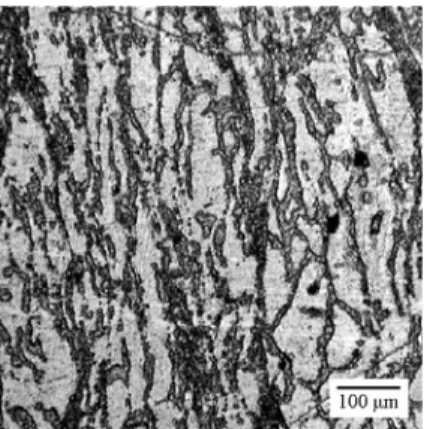
It can be seen from Fig.1 that the grains were elongated perpendicular to the direction of compression, the grain boundaries became illegible and looked like fiber-shape stripe, being the typical microstructure of deformed grains by hot-forging. Fig.2 give the microstructures of the hot-forged samples hot treatment. Only a few big deformed grains could be foun. It is obvious that grains were refined due to the recrystallization during the process of hot 2006 POWDER METALLURGY
World Congress
C03-01-2
Effect of Hot-forging on NiTi Shape Memory Alloy Fibers Reinforced
Mg Alloy Composite
Qi Guo1,a, Gang Li1,b, Renjian Tang1,c, and Biao Yan1,d 1
School of Materials Science and Engineering, Tongji University, 200092 Shanghai, China
a
[email protected], [email protected], [email protected], [email protected]
Abstract
The composite used in this paper was prepared by hot-pressing ball-milled Mg alloy powders, in which NiTi shape memory alloy fibers in a row were sandwiched. The microstructure and property were examined. It is shown that the composite consisted of a homogenous matrix with uniformly distributed NiTi shape memory alloy fibers, recrystallization took place in the Mg alloy matrix which was subjected to plastic deformatio; an adequate bonding formed between the matrix and fibers; the density and tensile strength of the composite increased after the hot-forging; the hot-forging process is capable of improving properties of the composite.
© Korean Powder Metallurgy Institute 847
-treatment. And the study of the TEM pictures of the hot treatment samples shows the process of recrystallization.
Fig. 1. The microstructures by OM for the hot-forging samples before hot treatment.
Fig. 2. The microstructures by OM for the hot-forging samples after hot treated sample.
The interface of NiTi fiber and the matrix after hot-forging was clear, remarkable interfacial reaction product or reaction layer was not observed at the interface. One of the reasons may be that NiTi fiber was pretreated by acid-washing, no harmful matter easy to react with Mg is remained; another reason is the melting point of NiTi alloy is high and the fabricating temperature used here is low, which is insufficient for severe interfacial reactions to take place.
Table 2. Properties of the composite before and after hot-forging
Porosity(Vol.%) Strength (MPa) Tensile Elongation(%) After Before After Before After Before
0.50 1.98 247.0 140.4 7.5 2.1
We compare the mechanical performance of the samples before and after hot-forging in TABLE 2. It can be said that the NiTi shape memory alloy fibers reinforced Mg alloy composite prepared by hot-forging and appropriate hot treatment has excellent mechanical performance.
3. Summary
1) After heat-treatment, recrystallization took place in the Mg alloy matrix which was subjected to plastic deformation during hot-forging.
2) No remarkable damage of the fibers was observed after the hot-forging and subsequent hot treatment, an adequate bonding was formed between the matrix and fibers.
3) The density of the composite increased after the hot-forging; its tensile strength increased greatly due to the grain refinement resulted from recrystallization.
In sum, the hot-forging process was capable of improving properties of the NiTi shape memory alloy fibers reinforced Mg matrix composite.
4. References
1 J. Yang, R. Schaller. Mechanical spectroscopy of Mg reinforced with Al2O3 short fibers and C nanotubes. Mater. Sci. Eng. A370,512-5(2004)
2 C. G. Kang , P. K. Seo. Forging process analysis with arbitrary shape die in semi-solid material with high solid fraction. International Journal of Mechanical Sciences, Volume 45, Issue 12, December 2003, P.1949-1974 3 K. Mizuuchi, K. Inoue, K. Hamada, M. Sugioka, M. Itami,
M. Fukusumi, M. Kawahara. Processing of TiNi SMA fiber reinforced AZ31 Mg alloy matrix composite by pulse current hot pressing. Mater. Sci. Eng. A367,343-9(2004)
4 C. Suryanarayana, E. Ivanov, V.V. Boldyrev. The science and technology of mechanical alloying. Mater. Sci. Eng. A304/306,151-158(2001)
5 B. L. Mrdike, P. Lukáč. Interfaces in magnesium-based composites. Sur. Inter. Ana. 31,682-91(2001)
6 M. Bram, A. Ahmad-Khanlou, A. Hechmann, B. Fuchs, H.P. Buchkremer, D. Stöver. Powder metallurgical fabrication processes for TiNi shape memory alloy parts. Mater. Sci. Eng. A337,254-63(2002)
7 Biao Yan, Gang Li. Mg alloy matrix composite reinforced with TiNi continuous fiber prepared by ball-milling/ hot-pressing. Composites Part A: Applied Science and Manufacturing, Volume 36, Issue 11, November 2005, P. 1590-1594