2012년도 한국멀티미디어학회 춘계학술발표대회 논문집 제15권1호
180
-Geographic Neighbor Based Approach for Group
Authentication in VANETs
1)Wen Huaqing*, Kyung-Hyune Rhee** *Dept. of Information Security, Graduate School,
Pukyong National Uninversity
**Dept. of IT Convergence and Application Engineering,
Pukyong National University e-mail : {wenhuaqing, khrhee}@pknu.ac.kr 1. Motivation
Recently, studies on security and privacy for Vehicular Ad Hoc Networks(VANETs) mainly depend on public key based digital signatures including group signature schemes[1,2,3]. However, the signature is expensive and the computation overhead of each vehicle will become intolerable when the density of vehicles is high. If there are 20-50 vehicles within the communication range and message interval is 100ms according to DSRC[4], the receiver needs to verify around 200-500 messages/s which will lead to a high computation burden to the receiver and finally cause high loss ratio and time delay[3]. It is contrary to quick transmission and authentication for safety-related message in cooperative driving.
2. Our Approach
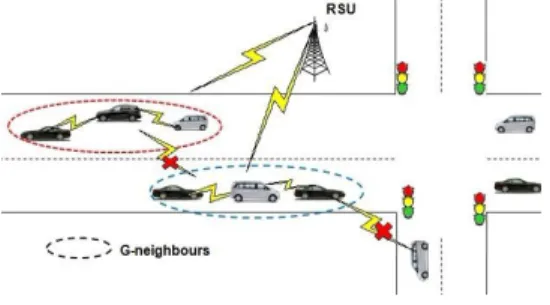
In order to resolve the problematic situation mentioned above, we consider geographical proximity neighbors(G-neighbours), instead of one-hop neighbors within wireless broadcast range, to refine the group of vehicles which have the same driving characteristics on the road.
Figure 1. Geographic neighbour formation In urban VANET scenario, because of the movement of vehicle is restricted to road constitution, vehicles driving to same direction on the same road segments can form a stable group. Each vehicle stay in same unidirectional group and geographical proximity can be defined as G-neighbours circled by the line in This research was supported by Basic Science Research Program through the National Research Foundation of Korea(NRF) funded by the Ministry of Education, Science and Technology (2011-0012849)
Figure 1. We take the following characteristics into consideration to form a G-neighbor group in our approach.
(1) Existing in each one-way road segment between two intersections.
(2) Vehicles have the same turning direction.
(3) Vehicles passes across an intersection during a green light.
3. Conclusion and Future Work
In this paper, we proposed a group authentication approach considering geographical neighbors to reduce the message authentication overhead caused by periodic broadcast of safety-related messages unnecessarily within wireless communication range in VANETs. When the traffic density becomes heavy, we expect that our approach can provide a stable and efficient system to address an urban-scale problem. Based on the G-neighbor approach, we are planing to design dynamic vehicular group management protocol depending on the change of vehicles driving conditions before and after passing through an intersection in urban VANET scenario. Moreover, we have a plan to conduct simulations for verifying the validity of the proposed protocol.
References
[1] Y. Park, S. Chul, C.-D. Jung, R.-H. Rhee, An Efficient Anonymous Authentication Protocol for Secure Vehicular Communications, Journal of Information Science and Engineering, Vol.26, No.3, pp.785-800, 2010. [2] M. Raya and J.-P. Hubaux, “Securing vehicular ad hoc networks”, Journal of Computer Security, Vol. 15, No. 1, pp.39-68, 2007.
[3] A. Studer, C. Chen, A. Perrig, F. Bai, B. Bellur, and A. Iyer. “Flooding-Resilient Broadcast Authentication for VANETs,” 17th annual international conference on Mobile computing and networking. pp.193-204, 2011. [4] Dedicated Short Range Communications (DSRC). [Online].Available: http://grouper.ieee.org/groups/scc32/ dsrc/index.html