E D U C AT I O N A N D I M A G I N Gjgh_6614415
Hepatobiliary and Pancreatic: Focal steatohepatitis
mimicking a metastasis
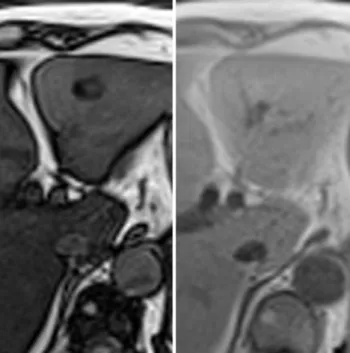
A woman, aged 65, was admitted to hospital for review of cancer management. Ten years previously, she had undergone a radical mastectomy for breast cancer. Bone metastases had been diag-nosed 8 months prior to admission and treated with palliative radiotherapy and tamoxifen. Blood tests revealed a minor eleva-tion of aspartate aminotransferase (133 u/l) and alanine ami-notransferase (103 u/l). Serum levels of various tumor markers were within the reference range and she had negative serological tests for hepatitis B and C. An abdominal computed tomography scan showed a nodular lesion in segment 3 of the liver that showed a target-like appearance with a low-attenuation rim (Figure 1). With magnetic resonance imaging (MRI), there was a drop in signal in the peripheral area of the lesion on the opposed-phase T1-weighted image (Figure 2, left) but not on the in-phase T1-weighted image (Figure 2, right). The patient underwent a per-cutaneous biopsy with ultrasound control. Histological evaluation revealed macrovesicular and microvesicular steatosis, ballooning degeneration with Mallory bodies and perisinusoidal fibrosis con-sistent with focal steatohepatitis.
Over recent years, there has been increasing interest in the effect of cancer therapy on the non-tumor bearing liver. These changes are more common with chemotherapy but have also been described with drugs such as tamoxifen. The most frequent change
is that of a diffuse fatty liver. However, fatty change can also be focal and may mimic a metastasis as in the above patient. These areas of focal steatosis are mostly found in segments 3 and 4. This distribution has been attributed to small areas in the liver that lack portal venous inflow. However, lack of portal venous inflow has also been used to explain areas of “fat-sparing”. After cessation of chemotherapy, diffuse fatty change is at least partially reversible in the majority of patients but the natural history of focal fatty change remains unclear. Images in the above patient illustrate the helpful role of CT and MRI in the differentiation of focal steatosis from liver metastases. With focal steatosis, there is a low attenuation area on unenhanced CT while, with MRI, opposed-phase T1-weighted images show signal loss when compared with the in-phase images. In contrast, there is no signal loss with opposed-phase T1 images in patients with typical metastases.
Contributed by
JS Choi* & M-J Kim*†
*Department of Radiology, Research Institute of Radiological Science, Severance Hospital and†Institute of Gastroenterology
and Brain Korea 21 Project, Yonsei University College of Medicine, Seoul, Korea
Figure 1 Figure 2
doi:10.1111/j.1440-1746.2010.06614.x
415 Journal of Gastroenterology and Hepatology 26 (2011) 415