저작자표시-비영리-변경금지 2.0 대한민국 이용자는 아래의 조건을 따르는 경우에 한하여 자유롭게 l 이 저작물을 복제, 배포, 전송, 전시, 공연 및 방송할 수 있습니다. 다음과 같은 조건을 따라야 합니다: l 귀하는, 이 저작물의 재이용이나 배포의 경우, 이 저작물에 적용된 이용허락조건 을 명확하게 나타내어야 합니다. l 저작권자로부터 별도의 허가를 받으면 이러한 조건들은 적용되지 않습니다. 저작권법에 따른 이용자의 권리는 위의 내용에 의하여 영향을 받지 않습니다. 이것은 이용허락규약(Legal Code)을 이해하기 쉽게 요약한 것입니다. Disclaimer 저작자표시. 귀하는 원저작자를 표시하여야 합니다. 비영리. 귀하는 이 저작물을 영리 목적으로 이용할 수 없습니다. 변경금지. 귀하는 이 저작물을 개작, 변형 또는 가공할 수 없습니다.
Master’s Thesis
Molecular phylogeny and DNA barcoding of
Gracilariaceae (Gracilariales, Rhodophyta)
from Asia-Pacific region
Mi Yeon Yang
Department of Biology
GRADUATE SCHOOL
JEJU NATIONAL UNIVERSITY
Molecular phylogeny and DNA barcoding of
Gracilariaceae (Gracilariales, Rhodophyta)
from Asia-Pacific region
Mi Yeon Yang
(Supervised by Professor Myung Sook Kim)
A thesis submitted in partial fulfillment of the requirement for the degree of
Master of Science
December, 2012
This thesis has been examined and approved.
Chairperson of the Committee
Date
Department of Biology
GRADUATE SCHOOL
JEJU NATIONAL UNIVERSITY
아시아-태평양산 홍조류 꼬시래기과의
분자계통 및 DNA barcoding
지도교수 김 명 숙
양 미 연
이 논문을 이학 석사학위 논문으로 제출함
2012 년 2 월
양미연의 이학 석사학위 논문을 인준함
심사위원장 ○
印위 원 ○
印위 원 ○
印제주대학교 대학원
2012 년 2 월
- 1 -
CONTENTS
ABSTRACT ……… 3
LIST OF TABLE ………... 5
LIST OF FIGURES ………... 6
Ⅰ
.
INTRODUCTION ………..………. 7
Ⅱ
. MATERIALS AND METHODS
1. Taxon sampling ……….... 10
2. DNA extraction, amplification and sequencing ………...……… 10
3. Alignments and molecular analyses ……….……… 11
Ⅲ
. RESULTS
1. Characteristics of plastid rbcL gene ………...……. 21
2. Characteristics of mitochondrial COI gene ………. 21
3. Phylogenetic relationships within the Gracilariaceae ………. 22
4. DNA barcoding ………... 23
- 2 -
Ⅳ
. DISCUSSION
1. Phylogeny of Gracilariaceae inferred from rbcL gene ……….. 32
1.1 Gracilaria clade ……….… 32
1.2 Gracilariopsis clade ………... 35
1.3 Hydropuntia clade ………. 36
1.4 Gracilaria vermiculophylla clade ………. 38
2. DNA barcoding inferred from COI gene ……….. 39
Ⅴ
. CONCLUSIONS ………. 43
Ⅵ
. LITERATURE CITED ………...……... 44
ABSTRACT IN KOREAN ………...………... 52
- 3 -
ABSTRACT
The family Gracilariaceae has been well known as the economic agarophytes. Although they have been extensively investigated and well defined from both an anatomical and a
molecular point of view, the species boundary and classifications are very difficult because of the high morphological plasticity, the lack of diagnostic characteristics and great species diversity. The aim of the present study is to acquire a better understanding of the
phylogenetic relationships, species diversity and species boundaries of the Gracilariaceae. To clarify the phylogenetic relationships and species boundary, we performed molecular
analyses for 115 specimens collected from Asia-Pacific region. A total of 22 species
including five cryptic species from Asia-Pacific region has been identified using plastid rbcL and mitochondrial COI genes. The results of phylogenetic relationships inferred from rbcL gene have confirmed the monophyly of the genera, Gracilaria, Gracilariopsis and
Hydropuntia. The phylogenetic trees estimated by ML and MP have been divided into two
large clades; one is Gracilaria sensu lato including Hydropuntia and G. vermiculophylla clade, and the other is Gracilariopsis. The rbcL genetic divergence among genera in Gracilariaceae ranged from 1.1% to 14.6%. The DNA barcoding data based on COI gene permitted us to verify 7 Gracilaria, 2 Hydropuntia and 2 Gracilariopsis species from Asia-Pacific region. The intraspecific divergences of COI ranged from 0% to 1.5%, and
interspecific divergences ranged from 0% to 14.7%. All species included in this study formed strong clades independently, indicating that DNA barcoding can effectively identify Gracilariaceae species. Our wide geographic sampling allowed us to extend the geographic range of the number of the species. Gracilaria perplexa, previously known from Australia as type locality, is here reported for the first time from Okinawa, Japan. Hydropuntia fisheri,
- 4 -
previously known from Thailand and Vietnam, is reported for the first time from Malaysia.
Gracilariopsis heteroclada, previously known from Hainan in China and the Philippines, is
reported for the first time from the Malaysia. Gracilaria sp.1 and sp.3 have potential to be new species with distinct morphological characteristics.
- 5 -
LIST OF TABLE
Table 1. List of included specimens, collection localities and GenBank accession
numbers. ………13
Table 2. Oligonucleotide primers used for amplification and sequencing. ………….…… 19 Table 3. Thermal cycling conditions polymerase chain reaction for rbcL
and COI gene. ……… 20
Table 4. Comparisons of genetic information from rbcL and COI in the
Gracilariaceae. ………... 25
- 6 -
LIST OF FIGURES
Figure 1. Maximum likelihood tree for Gracilariaceae inferred from
the rbcL sequence ……….. 27
Figure 2. Maximum parsimony tree for Graiclariaceae inferred from
the rbcL sequence ……….. 28
Figure 3. Neighbor joining tree of COI barcode of 115 specimens
in Gracilariaceae ……… 29
Figure 4. Comparison of intraspecific divergence in COI among
Gracilariaceae species ……… 30
- 7 -
Ⅰ
. INTRODUCTION
The family Gracilariaceae Nägeli (1847) belongs to Gracilariales, an order of marine red algae described by Fredericq and Hommersand (1989). The Gracilairaceae is characterized as follows: 1) a female reproductive structure consisting of a two-celled carpogonial branches, 2) a supporting cell producing other two to three two-celled sterile filaments, 3) the fertilized carpogonium fusing with its supporting cell to form the fusion cell, 4) the cells of the sterile filaments fusing into the fusion cell, and 5) the gonimoblasts developing directly and primarily outward from the fusion cell (Fredericq and Hommersand, 1989; 1990b). The gracilarioid algae include some of the most valuable marine plants. They have been extensively investigated over the last 30 years, and many studies have provided comprehensive information on their life history, cultivation, taxonomy, and utilization (Bellorin et al., 2002; Rueness, 2005). However, high morphological plasticity, the lack of diagnostic characters and great species diversity in the Gracilariaceae, have made it difficult to define the species boundary of this group.
The Gracilariaceae is well defined from both an anatomical and a molecular point of view within Rhodophyta, but the intergeneric taxonomy had a somewhat more complex history (Bird 1995; Bellorin et al., 2002). Currently, the Gracilariaceae is composed of up to seven genera (Fredericq and Hommersand, 1990b), namely Gracilaria Greville (1830),
Gracilariopsis Dawson (1949), Hydropuntia Montagne (1842), Melanthalia Montagne
(1843), Curdiea Harvey (1855), Gracilariophila Setchell et Wilson in Wilson (1910), and
Congracilaria Yamamoto (1986). Studies on the phylogenetic relationships inferred from
molecular data have produced stable clades at the genus level, such as Gracilaria sensu
- 8 -
the family (Bellorin et al., 2002; Gurgel and Fredericq, 2004). Gracilaria and Gracilariopsis have been confirmed to be monophyletic groups whereas Hydropuntia has received less support. The distribution of Curdiea and Melanthalia, are limited to around southern Australia, Tasmania, and New Zealand. These previous studies approached to the phylogeny of the Gracilariaceae on a global scale or focused on a regional scale, such as southern Africa (Iyer et al., 2005). On the other hand, the phylogeny and species diversity of the
Gracilariaceae occurring in Asia-Pacific region still remained as a gap in our knowledge. Kim et al. (2008a) replaced G. parvispora instead of G. bursa-pastoris from Korea and Japan using rbcL sequence data, and Kim et al. (2006) determined phylogenetic affinities of flattened Gracilaria species from Korea. Lin (2008) and Hau and Lin (2006) described a new species of Gracilariopsis from Taiwan and Vietnam, respectively. These show that comprehensive study of Asia-Pacific region is needed for phylogenetic relationships of Gracilariaceae.
DNA sequence analysis is the most widely used molecular technique for inferring phylogenetic relationships at the species level within the Gracilariaceae (Iyer et al., 2005; Kim et al., 2008b; Bellorin et al., 2008). It is a useful taxonomic tool for distinguishing between organisms that are difficult to distinguish based on morphological characteristics alone. Sequence analyses from different DNA regions have been used for many studies: chloroplast-encoded rbcL gene (Gurgel and Fredericq, 2004; Gargiulo et al., 2006),
rbcL-rbcS intergenic spacer region (i.e. Rubisco spacer; Goff et al., 1994; Iyer et al., 2005;
Rueness, 2005), the mitochondrial cox2-cox3 spacer (Cohen et al., 2004; Terada and Shimada, 2005), the cox1 gene (Robba et al., 2006, Yang et al., 2008), and the nuclear internal transcribed spacers of the ribosomal cistron (i.e. ITS; Goff et al., 1994; Bellorin et
al., 2002). Although many genes have been used for phylogenetic inference, the
- 9 -
inferring species level phylogenetic relationships within the Gracilariaceae (Gurgel and Fredericq, 2004; Kim et al., 2006; Kim et al., 2008b). However, this concern for molecular identification tools among algal systematics has the lack of a standard marker for rapid identification of specimen.
DNA barcoding has become an important tool for the identification of gracilarioid species (Saunders, 2005; Kim et al., 2010). DNA barcoding makes possible to have a comprehensive species-specific sequence library for eukaryotes (Marshall, 2005), offering the opportunity for a standardized system of species identification based on the analysis of small fragments of DNA (Lara et al., 2010). A DNA barcode is easily sequenced due to the short,
standardized DNA region used, and provides a rapid and efficient tool for taxonomic and biodiversity research (Hajibabaei et al., 2007). To solve the difficulty of distinguishing among Gracilariaceae species based on morphology, the sequencing of a short, standard region of DNA barcoding, was proposed. Mitochondrial-encoded COI, a 660-base fragment at the 5’ end of cox1, is a fast-evolving gene that has recently proven valuable for barcoding red algae species (Clarkston and Saunders, 2010; MS Kim et al., 2010). Use of COI may therefore allow a better understanding of the species delimitation among marine red algae.
Molecular data is expected to develop a classification and phylogeny of the Gracilariaceae as important criterion. The aim of the present study is to acquire a better understanding of the phylogenetic relationships, species diversity and species boundaries of the Gracilariaceae. Based on two molecular markers as rbcL and COI, 22 species from Asia-Pacific region are ascertained with clarifying their taxonomic identities, and we provide genetic diversity within and among the members of the family Gracilariaceae.
- 10 -
Ⅱ
. MATERIALS AND METHODS
1. Taxon sampling
115 specimens corresponding to the family Gracilariaceae were collected or sent by collaborators from the Korea, Japan, China, Malaysia, Taiwan, Thailand, the Philippines and Australia. Specimens, collection sites, and GenBank accession numbers are listed in Table 1. We removed other small organisms attached from the thalli under a dissecting microscope. The cleaned thalli were air-dried and stored in silica gel dessicant for molecular analyses, and housed at the herbarium of Jeju National University (JNUB), Jeju, Korea.
2. DNA extraction, amplification and sequencing
Total genomic DNA was extracted from dried thalli in liquid nitrogen using the DNeasy Plant Mini Kit (QIAGEN, Hilden, Germany). All the isolation steps were carried out according to the instructions of the manufacturer with minor modification by incubating the disrupted samples with buffer AP1 for minimum 1 hour at 63℃. The extracted DNA was stored at -20°C and used to amplify rbcL and COI.
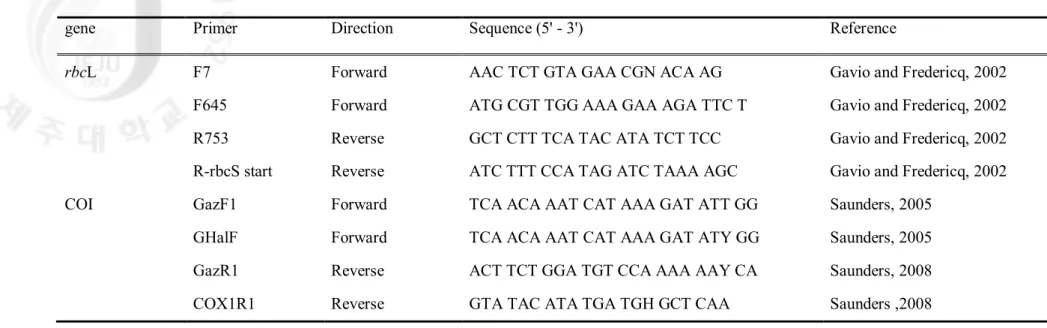
PCR amplification was performed on a total volume of 20 µl using AccuPower PCR Premix (Bioneer, Daejeon, Korea), and 1-10 ng of template DNA. For amplification and sequencing of the rbcL gene, the following specific primer pairs were used: rbcLF7-
rbcLR753 and rbcLF645-rbcS start (Gavio and Fredericq, 2002). PCR reaction of rbcL gene
was carried out with an initial denaturation at 96°C for 4 min, followed by 35 cycles of amplification (denaturation at 94°C for 1 min, annealing at 50°C for 1min and extension at 72°C for 2 min) with a final extension at 72°C for 7min. The COI region was amplified using the following primer pairs: GazF1-GazR1 (Saunders, 2005) and GHalF-COX1R1
- 11 -
(Saunders, 2008). PCR reaction of COI was carried out with an initial denaturation at 96°C for 4 min, followed by 40 cycles of amplification (denaturation at 94°C for 30s, annealing at 45°C for 30s and extension at 72°C for 1min) with a final extension 72°C for 7min. All PCR amplifications were carried out using Swift MaxPro thermal cyclers (ESCO, Singapore). The PCR products were purified using the AccuPrep PCR Purification Kit (Bioneer, Daejeon, Korea) and then sequenced commercially (Macrogen, Seoul, Korea).
3. Alignments and molecular analyses
Analyses of rbcL and COI region sequences of the forward and reverse strands were determined for all PCR products using an ABI PRISM™ 377 DNA Sequencer (Applied Biosystems, Foster City, CA, USA). Both electropherogram outputs from each sample were edited using Chromas version 1.45 (Queensland, Australia). Total rbcL and COI sequences were organized using the multiple-sequence editing program BioEdit (Hall, 1999) and aligned visually. To assess the level of variation in the sequences of rbcL and COI,
uncorrected (p) pair-wise genetic distances were estimated with PAUP* v4.0b10 (Swofford, 2002).
To confirm the taxonomic position of Gracilariaceae, Maximum likelihood (ML) and Maximum parsimony (MP) analysis were performed using PAUP 4.0 (Swofford, 2002). Total rbcL sequences including 51 sequences from GenBank were aligned with other Gracilariaceae species, and two genera, Curdiea crassa [AY049427] and Melanthalia
obtusata [AY046431], were used as an outgroup.
For ML tree, we performed a likelihood ratio test using MODELTEST (ver. 3.7; Posada and Crandall 1988) to determine the best available model for our sequence data. We selected general time reversible (GTR) model with gamma correction for among-site variation (Γ) and the proportion of invariable sites (I). ML tree were estimated using a heuristic search
- 12 -
with 100 random-additional sequence replicates and TBR branch swapping. To test node stability, ML bootstrap analyses were performed with 100 replicates. MP tree were constructed using heuristic search algorithm with the following settings: 1000 random sequence additions, tree bisection-reconnection (TBR) branch swapping, MulTrees, all characters unordered and unweighted, and branches with a maximum length of zero collapsed to yield polytomies. Bootstrap values for the resulting nodes were assessed using 1000 bootstrapping replicates with ten random sequence additions, TBR and MulTrees.
Clustering trees on COI were performed in MEGA 4.0 (Tamura et al., 2007) using the Neighbor-joining (NJ) algorithm based on Kimura -2-parameter (K2P) distance method. To compare other data, we contained 13 COI sequences from GenBank. NJ tree was used to provide a visual display of COI variation within and between species.
- 14 -
Table 1. List of included specimens, collection localities and GenBank accession numbers
Species & voucher Location Date Collector GenBank
COI rbcL
Gracilaria arcuata Zanardini
YG008 Ikei island: Uruma: Okinawa: Japan 03/03/10 M.S. Kim and M.Y. Yang JQ026057 JQ026031
Gracilaria articulata C.F. Chang & B.M. Xia
YG007 Howaito beach: Uruma: Okinawa: Japan 03/03/10 M.S. Kim and M.Y. Yang JQ026054 JQ026032
Gracilaria blodgettii Harvey
G058 Matou: Sanya: Hainan: China 01/29/10 M.S. Kim JQ026055 JN605794
Gracilaria incurvata Okamura
JD100404-14 Jongdal: Jeju: Korea 04/04/10 E.G. Han HQ322060 MI02 Misaki: Miura: Kanagawa: Japan 04/29/10 J.C. Kang and H.W. Lee HQ322023 MI03 Misaki: Miura: Kanagawa: Japan 04/29/10 J.C. Kang and H.W. Lee HQ322017
MI56 Misaki: Miura: Kanagawa: Japan 04/30/10 J.C. Kang and H.W. Lee HQ322026 JQ026024 CN-G353 Hansuri: Jeju: Korea 05/05/04 M.S. Kim HQ322020
G134 Hansuri: Jeju: Korea 06/26/10 M.Y. Yang and E.G. Han HQ322019 CN-G352 Hansuri: Jeju: Korea 05/05/04 M.S. Kim HQ322021 HG100404-5 Hagwi: Jeju: Korea 04/14/10 J.C. Kang HQ322018
Gracilaria parvispora I.A.Abbott
G153 Hado: Jeju: Korea 08/08/10 M.S. Kim HQ322033 G154 Sinyang: Jeju: Korea 03/27/10 M.S. Kim HQ322032 GM51 Dukchonri: Geomundo: Yeosu: Korea 06/12/10 M.Y. Yang and E.G. Han HQ322030 G074 Hamduck: Jeju: Korea 07/21/10 M.Y. Yang HQ322034
- 15 -
JD100404-20 Jongdal: Jeju: Korea 04/04/10 E.G. Han HQ322038
GB0601 Daejung: Jeju: Korea 06/06/05 M.S. Kim HG322047 JQ026040 MI59 Misaki: Miura: Kanagawa: Japan 04/30/10 J.C. Kang and H.W. Lee HQ322037
MI61 Misaki: Miura: Kanagawa: Japan 04/30/10 J.C. Kang and H.W. Lee HQ322035 MI60 Misaki: Miura: Kanagawa: Japan 04/30/10 J.C. Kang and H.W. Lee HQ322036
Gracilaria salicornia (C.Agardh) E.Y.Dawson
G056 Xiaodonghai Bay: Sanya: Hainan: China 01/30/10 M.S. Kim JN790237 JN605796 G169 Morib: Malaysia 11/23/07 M.S. Kim JN790224
G0606 Samae Say villar Chouburi: Thailand 07/26/09 Jutarat W. JN790235 G182 Phuket: Tailand 05/05/08 M.S. Kim JN790220 G175 Phuket: Tailand 05/05/08 M.S. Kim JN790221 G410 Barangay Bulo: Zamboanga City: Philippines 04/10/10 P.J.L. Geraldino JN790231 G404 Sangali Bay: Zamboanga Ciry: Philippines 04/10/10 P.J.L. Geraldino JN790197 G089 Rizal Beach: Gubat Bay: Philippines 02/02/10 P.J.L. Geraldino JN790238 G090 Bulusan: Sorsogon: Philippines 02/02/10 P.J.L. Geraldino JN790239 YG010 Ikei Island: Uruma: Okinawa: Japan 03/03/10 M.S. Kim and M.Y. Yang JN790236
G361 Ikei Island: Uruma: Okinawa: Japan 03/03/10 M.S. Kim and M.Y. Yang JN790234 JQ026045
Gracilaria tenuistipitata C.F.Chang and B.M.Xia
G452 Baan Aow Saay: Kok Tay yoaw: Songkla: Thailand 07/17/09 Jutarat W. JQ026074 GF0601 Baan Aow Saay: Kok Tay yoaw: Songkla: Thailand 07/17/09 Jutarat W. JQ026069 G449 Baan Aow Saay: Kok Tay yoaw: Songkla: Thailand 07/17/09 Jutarat W. JQ026073 G200 Baan Aow Saay: Kok Tay yoaw: Songkla: Thailand 07/17/09 Jutarat W. JQ026072 GC0508 Phuket: Tailand 05/05/08 M.S. Kim JQ026071
- 16 -
G460 Middle Banks: Penang: Malaysia 12/10/07 E. Phiak JQ026075 G3019 Big Korean Island: Penang: Malaysia 12/10/07 E. Phiak JQ026070 G459 Middle Banks: Penang: Malaysia 12/10/07 E. Phiak JQ026076
G052 Hongsha river: Sanya: Hainan: China 01/31/10 M.S. Kim JQ026077 JN605793
Gracilaria textorii (Suringar) De Toni
PS100117-10 Pyosun: Jeju: Korea 01/17/10 M.S. Kim HQ322061 PS100317-2 Pyosun: Jeju: Korea 03/17/10 M.S. Kim HQ322051 JD100404-9 Jongdal: Jeju: Korea 04/04/10 E.G. Han HQ322062
GT0616 Chagwido: Jeju: Korea 06/14/09 M.S. Kim HQ322064 JQ026036 GT0615 Udo: Jeju: Korea 06/17/09 M.Y. Yang HQ322065
G095 Hyodon: Jeju: Korea 01/17/10 E.G. Han HQ322069 HG100404-14 Hagwi: Jeju: Korea 04/14/10 J.C. Kang HQ322063
MI53 Misaki: Miura: Kanagawa: Japan 04/30/10 J.C. Kang and H.W. Lee JQ026037
Gracilaria vermiculophylla (Ohmi) Papenfuss
G068 Molunde: Busan: Korea 11/15/09 M.S. Kim HQ322059 GM01 Godo: Geomundo: Yeosu: Korea 06/12/10 M.Y. Yang and E.G. Han HQ322053 G099 Geumneung: Jeju: Korea 01/15/10 M.Y. Yang HQ322048 G100 Sinyang: Jeju: Korea 01/18/10 J.C. Kang HQ322039 HW100415-47 Haengwon: Jeju: Korea 04/15/10 M.Y. Yang
SS100404-8 Sungsan: Jeju: Korea 04/04/10 E.G. Han HQ322049
GV1001 Woljung: Jeju: Korea 10/15/05 M.S. Kim JQ026039 YG012 Nokonosima: Fukuoca: Japan 03/04/10 M.S. Kim and M.Y. Yang HQ322041
- 17 -
CN-G212 Shimoda: Shizuoka: Japan 03/18/03 M.S. Kim HQ322086
G183 China 01/28/00 M.S. Kim JQ026079
Gracilaria sp.1
GT0310 Japan 03/29/07 M.S. Kim JQ026052 JQ026051
GI0301 Japan 03/29/07 M.S. Kim JQ026053 JQ026050
Gracilaria sp.2
G091 Bulusan: Sorsogon: Philippines 02/02/10 S.Y. Kim and P.J.L. Geraldino JQ026059 JQ026033 G092 Bulusan: Sorsogon: Philippines 02/02/10 S.Y. Kim and P.J.L. Geraldino JQ026060 JQ026034 G405 Brgy: Piblaum: Philippines 09/30/10 P.J.L. Geraldino JQ026058
Gracilaria sp.3
G3021 Batu Feringii: Penang: Malaysia 12/12/07 M.S. Kim JQ026068 JQ026035
Gracilaria sp.4
PH020 Tuburan: Cebu: Philippines 02/20/10 P.J.L. Geraldino JQ026056 JQ026048
Gracilaria sp.5
G083 Bulusan: Sorsogon: Philippines 02/02/10 S.Y. Kim and P.J.L. Geraldino JQ026078 JQ026027
Gracilariopsis heteroclada J.Zhang & B.M.Xia
G174 Big Korean Island: Penang: Malaysia 12/10/07 M.S. Kim JQ026096
G3018 Batu Pucat: Penang: Malaysia 12/10/07 M.S. Kim JQ026097 JQ026029 G057 Yulin harbour: Sanya: Hainan: China 01/30/10 M.S. Kim JQ026098 JQ026028 G335 Bantayan: Bantayan Island: Philippines 04/02/10 P.J.L. Geraldino JQ026099
Gracilariopsis chorda (Holmes) Ohmi
BY18 Biyangdo: Jeju: Korea 05/20/10 J.C. Kang HQ322090 G121 Jongdal: Jeju: Korea 05/29/10 M.Y. Yang and E.G. Han HQ322079
- 18 -
G3030 Jongdal: Jeju: Korea 01/24/08 M.S. Kim HQ322066
G3029 Ojori: Jeju: Korea 01/23/08 M.S. Kim HQ322050 JQ026038 CN-Gr6 Dangmokri: Wando: Korea 10/15/08 M.S. Kim HQ322081
CN-Gr8 Jangheung: Jeollanamdo: Korea 11/10/07 M.S. Kim HQ322080 CN-G214 Shimoda: Shizuoka: Japan 02/18/03 M.S. Kim HQ322084 CN-G213 Chiba: Chiba: Japan 02/20/03 M.S. Kim HQ322085 MI62 Misaki: Miura: Kanagawa: Japan 04/30/10 J.C. Kang and H.W. Lee HQ322073 MI42 Misaki: Miura: Kanagawa: Japan 04/30/10 J.C. Kang and H.W. Lee HQ322074 CN-G210 Daeryeon: China 10/27/02 M.S. Kim HQ322087
Hydropuntia changii (B.Xia & I.A.Abbott) M.J.Wynne
G081 Bulusan: Sorsogon: Philippines 11/15/09 S.Y. Kim and P.J.L. Geraldino JQ026061 JQ026026
Hydropuntia edulis (S.G.Gmelin) Gurgel & Fredericq
G054 Qingshui Bay: Sanya: Hainan: China 01/29/10 M.S. Kim JQ026081 JN605795 G320 Currimao: Ilocos Norte: Philippines 05/26/10 P.J.L. Geraldino JQ026082
G325 Bmbm: Oslob: Cebu: Philippines 04/10/10 P.J.L. Geraldino JQ026080 G411 Saugali Bay: Zamboanga Ciry: Philippines 04/10/10 P.J.L. Geraldino JQ026085
G323 Bmbm: Oslob: Cebu: Philippines 04/01/10 P.J.L. Geraldino JQ026086 JQ026047 G171 Phuket: Thailand 05/05/08 M.S. Kim JQ026087
G163 Phuket: Thailand 05/05/08 M.S. Kim JQ026088
GE0501 Phuket: Thailand 05/05/08 M.S. Kim JQ026089 JQ026046 G167 Big Korean Island: Penang: Malaysia 12/10/07 M.S. Kim JQ026084
- 19 -
Hydropuntia fisheri (B.M.Xia & I.A.Abbott) M.J.Wynne
GT0511 Ao Tabg Kare: Phuket: Thailand 05/04/08 M.S. Kim JQ026062
G168 Phuket: Thailand 05/05/08 M.S. Kim JQ026065 JQ026049 G164 Phuket: Thailand 05/05/08 M.S. Kim JQ026067
G181 Morib: Malaysia 11/23/07 M.S. Kim JQ026063 G173 Big Korean Island: Penang: Malaysia 12/10/07 M.S. Kim JQ026064 G165 Big Korean Island: Penang: Malaysia 12/10/07 M.S. Kim JQ026066
Hydropuntia multifurcata (Børgesen) M.J.Wynne
G3023 Big Korean Island: Penang: Malaysia 12/11/07 M.S. Kim JQ026092 JQ026041 G3024 Batu Feringii: Penang: Malaysia 12/12/07 M.S. Kim JQ026093 JQ026042 G3025 Batu Pucat: Penang: Malaysia 12/11/07 M.S. Kim JQ026091 JQ026044 G166 Batu Feringii: Penang: Malaysia 12/12/07 M.S. Kim JQ026094 JQ026043
Gracilaria perplexa Byrne, K., Zuccarello, G.C., West, J., Liao, M.-L.& Kraft, G.T.
YG009 Howaito beach: Uruma: Okinawa: Japan 03/03/10 M.S. Kim and M.Y. Yang JQ026090 JQ026030
Hydropuntia preissiana (Sonder) Gurgel & Fredericq
- 20 -
Table 2. Oligonucleotide primers used for amplification and sequencing
gene Primer Direction Sequence (5' - 3') Reference
rbcL F7 Forward AAC TCT GTA GAA CGN ACA AG Gavio and Fredericq, 2002
F645 Forward ATG CGT TGG AAA GAA AGA TTC T Gavio and Fredericq, 2002 R753 Reverse GCT CTT TCA TAC ATA TCT TCC Gavio and Fredericq, 2002 R-rbcS start Reverse ATC TTT CCA TAG ATC TAAA AGC Gavio and Fredericq, 2002 COI GazF1 Forward TCA ACA AAT CAT AAA GAT ATT GG Saunders, 2005
GHalF Forward TCA ACA AAT CAT AAA GAT ATY GG Saunders, 2005 GazR1 Reverse ACT TCT GGA TGT CCA AAA AAY CA Saunders, 2008 COX1R1 Reverse GTA TAC ATA TGA TGH GCT CAA Saunders ,2008
21
Table 3. Thermal cycling conditions of polymerase chain reaction for rbcL and COI gene step Temperature Time Cycles
rbcL Initial denaturation 96℃ 4 min 1
Denaturation 94℃ 1 min 35 Annealing 50℃ 1 min
Extension 72℃ 2 min
Final extension 72℃ 7 min 1 COI Initial denaturation 96℃ 4 min 1 Denaturation 94℃ 30 sec 40 Annealing 45℃ 30 sec
Extension 72℃ 1 min
- 22 -
Ⅲ
. RESULTS
1. Characteristics of plastid rbcL gene
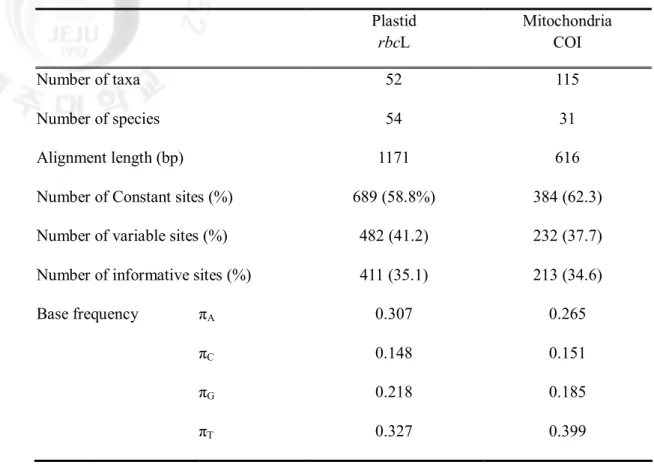
The 1,171 nucleotides of the rbcL gene were determined for 73 taxa including 51 GenBank sequences. No insertion or deletion mutations were found in the rbcL sequences, permitting unambiguous alignment of all sequences. Of these, 482 positions (41.2%) were variable and 411 (35.1%) were parsimoniously informative. The data file had an unequal frequency of bases (A=30.7%, C=14.8%, G=21.8%, T=32.7%). The sequence divergence ranged from 1.1% to 14.6% among Gracilariaceae species.
Comparisons of informative signal between rbcL and COI sequences revealed a slightly greater in rbcL (35.1%, n=51 taxa) than in COI (34.6% n=115 taxa). The overall genetic variation of rbcL gene in Gracilariaceae displayed that our rbcL sequences were more variation (Table 4). The range of genetic variation within genera, slightly expanded in all group.
2. Characteristics of mitochondrial COI gene
The 616 nucleotides of the COI gene were determined for 115 taxa including 13 GenBank sequences. No insertion or deletion mutations were found in the COI sequences, permitting unambiguous alignment of all sequences. Of these, 232 positions (37.7%) were variable and 213 (34.6%) were parsimoniously informative. The data file had an unequal frequency of bases (A=26.5%, C=15.1%, G=18.5%, T=39.9%). The sequence divergence ranged from 2.8% to 14.7% among Gracilariaceae species. The ranges of COI sequence variation within group have wider range than rbcL, although COI data are comparatively included small number of species.
- 23 -
3. Phylogenetic relationships within the Gracilariaceae
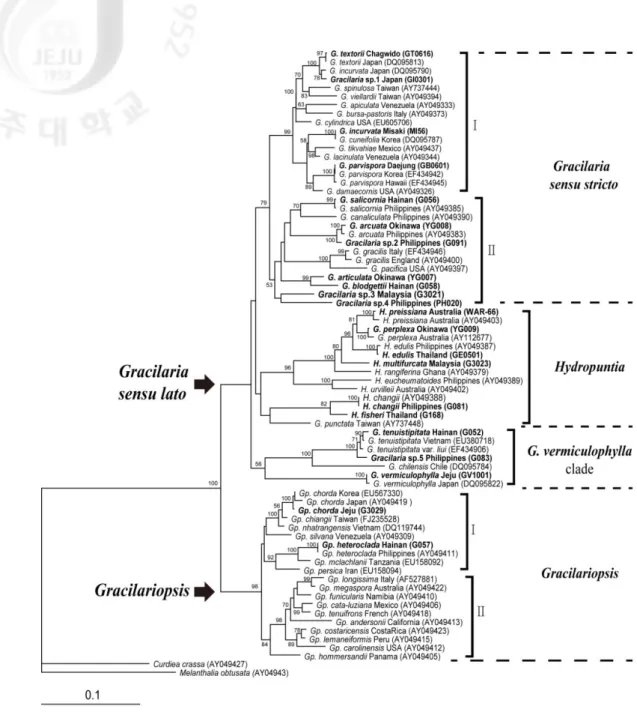
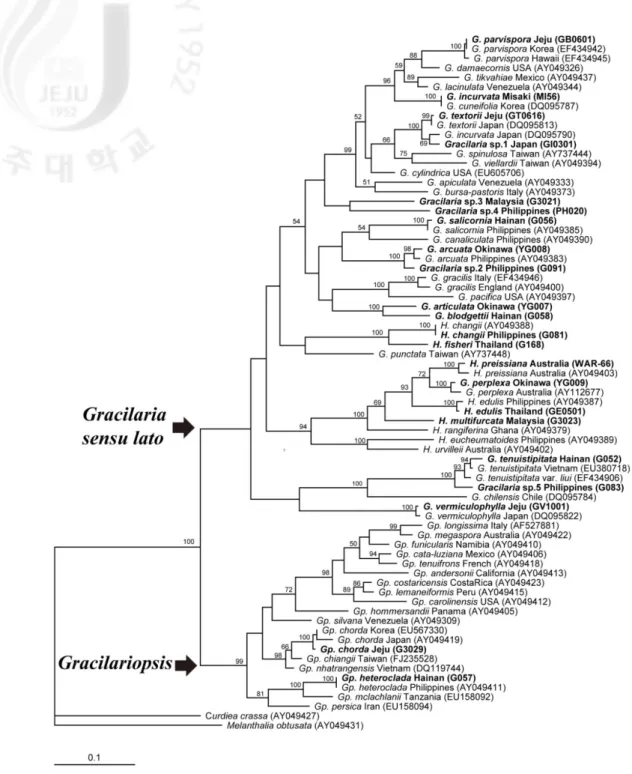
The family Gracilariaceae formed a well defined monophyletic group with 100% bootstrap support for both ML and MP analysis using rbcL gene. The maximum likelihood (ML) tree (Fig. 1) was compared with the maximum parsimony (MP) tree (Fig. 2). Both phylogenetic analyses were identified as two major assemblages: Gracilaria sensu lato clade and
Gracilariopsis clade. Gracilariopsis was early diverged with strong bootstrap supports in
ML (98%) and MP (99%) trees. Gracilaria sensu lato formed a sinagle assemblage without bootstrap support composed three large groups, treated here as Gracilaria sensu stricto,
Hydropuntia and G. vermiculophylla clade. Hydropuntia represent an independent clade in
ML tree but no bootstrap support. This monophyly does not hold in MP tree, due to H.
changii, H. fisheri and G. punctata grouping with other clade. G. vermiculophylla clade are
sustainedly monophyly with low and lacking bootstrap support in ML and MP tree.
Most specimens are grouped together as conspecific with verified rbcL sequences supported strong bootstrap, while several specimens are formed their independent clade. Clade
composed four Gracilaria species, G. articulata, G. blodgettii, Gracilaria sp.3 and sp.4, are newly derived and clustered basally within Gracilaria sensu stricto in ML Tree (Fig. 1).
Gracilaria sp.1 and sp.3 are proposed as new species with distinct morphology to comparing
any other species. Gracilaria sp.2 is closely related G. arcuata with strong bootstrap support (100%). H. multifurcata clustered with the clade containing H. edulis, and we provide published sequences for this species for the first time. H. fisheri closely related to H. changii with similar morphology, but clearly distinct in the rbcL tree. Gracilaria sp.5 is included in
- 24 -
4. DNA barcoding
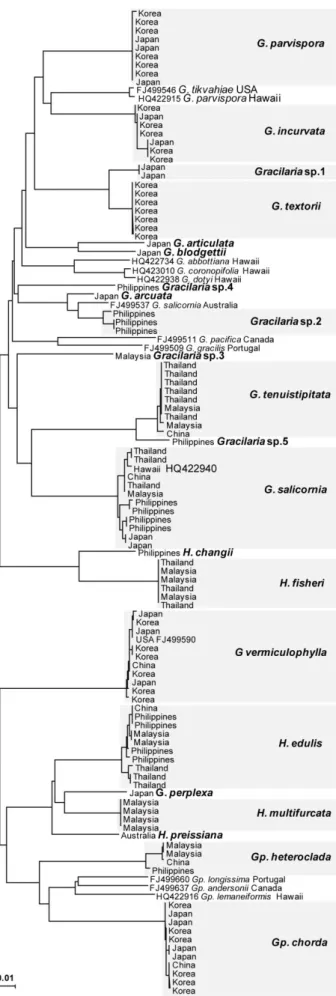
NJ tree using K2P model (Fig. 3) showed the genetic distance for all specimens based on the COI DNA barcoding. DNA barcoding approach separated 22 species including five
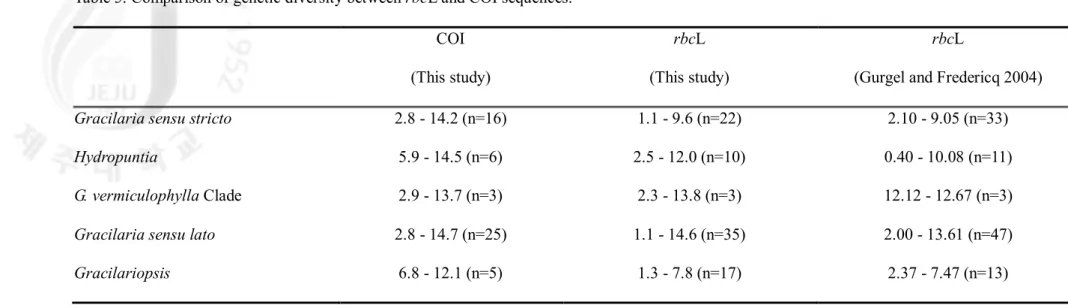
unidentified species from Asia-Pacific region with 11 sequences from GenBank. COI sequences of the conspecific members were either totally identical or very similar to each other, and formed distinct separate clusters. Among sequences acquired from in this study, 13 species represented by more than two individuals but 9 species are one individual only. We deal with intraspecific divergence for these 13 species except 9 species. The range of interspecific divergence across all taxa in Gracilaiaceae was 2.8-16.9%. The maximum genetic divergence (16.9%) produced between G. pacifica and Gp. longissima. Species comparisons within genera are summarized in Table 5. Low interspecific divergence levels were observed in two pairs, between G. textorii and Gracilaria sp.1 (2.8%), and between G.
tenuistipitata and Gracilaria sp.5 (2.9%). The minimal sequence divergences of two pairs
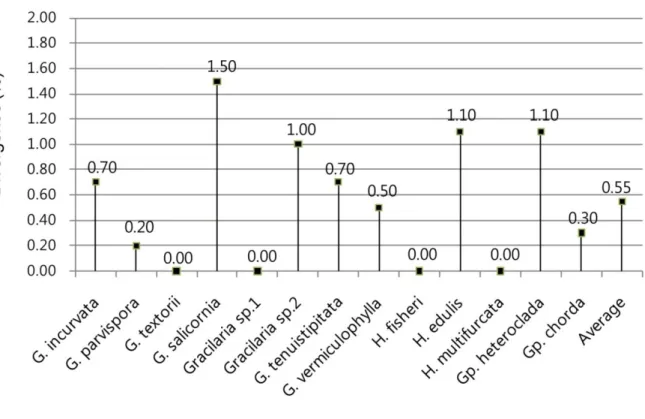
are also showed in rbcL tree. The range of intraspecific divergence within Gracilariaceae was 0-1.5%. Each conspecific intra-divergence was shown in Figure 4. In four species as G.
textorii, Gracilaria sp.1, H. fisheri, and H. multifurcata, conspecific members are all
identical. Gracilaria salicornia from six countries has the maximum intraspecific divergence among all species.
5. New geographical records and cryptic species
Our wide geographic sampling allowed us to extend and clarify the geographic range of a number of the species. Gracilaria perplexa, previously known from Australia as type locality, is here reported for the first time from Okinawa, Japan. In addition, Hydropuntia fisheri, previously known from Thailand and Vietnam, is reported for the first time from Malaysia.
- 25 -
Finally, Gracilariopsis heteroclada, previously known from Hainan in China and the Philippines, is reported for the first time from the Malaysia.
Comparisons of sequences within the study area as well as comparisons with published sequences revealed five cryptic species in this group. Two species of them, Gracilaria sp.1 and sp.3, have potential to be new species with morphological characters. More information of which, we shall mention below in discussion.
- 26 -
Table 4. Comparison of genetic information from rbcL and COI in the Gracilariaeae. Plastid rbcL Mitochondria COI Number of taxa 52 115 Number of species 54 31 Alignment length (bp) 1171 616 Number of Constant sites (%) 689 (58.8%) 384 (62.3) Number of variable sites (%) 482 (41.2) 232 (37.7) Number of informative sites (%) 411 (35.1) 213 (34.6) Base frequency πA 0.307 0.265
πC 0.148 0.151
πG 0.218 0.185
- 28 -
Table 5. Comparison of genetic diversity between rbcL and COI sequences.
COI rbcL rbcL
(This study) (This study) (Gurgel and Fredericq 2004)
Gracilaria sensu stricto 2.8 - 14.2 (n=16) 1.1 - 9.6 (n=22) 2.10 - 9.05 (n=33)
Hydropuntia 5.9 - 14.5 (n=6) 2.5 - 12.0 (n=10) 0.40 - 10.08 (n=11)
G. vermiculophylla Clade 2.9 - 13.7 (n=3) 2.3 - 13.8 (n=3) 12.12 - 12.67 (n=3)
Gracilaria sensu lato 2.8 - 14.7 (n=25) 1.1 - 14.6 (n=35) 2.00 - 13.61 (n=47)
Gracilariopsis 6.8 - 12.1 (n=5) 1.3 - 7.8 (n=17) 2.37 - 7.47 (n=13)
- 29 -
Fig. 1. Maximum likelihood tree for Gracilariaceae inferred from the rbcL sequences
The supporting values shown above the branches are from 100 bootstrap values. GenBank accession numbers of the rbcL gene sequences are reported in brackets; sequences generated in the present study are indicated in bold.
- 30 -
Fig. 2. Maximum parsimony tree for Gracilariaceae inferred from the rbcL
sequences. The supporting values shown above the branches are 1000 bootstrap values.
GenBank accession numbers of the rbcL gene sequences are reported in brackets; sequences generated in the present study are indicated in bold.
- 31 -
Fig. 3. Neighbor joining tree of COI barcode of 115 specimens in Gracilariaceae. Species
collected in the present study highlighted.
- 32 -
Fig. 4. Comparioson of intraspecific divergence in COI among Gracilariaceae species. Range in values is shown.
- 33 -
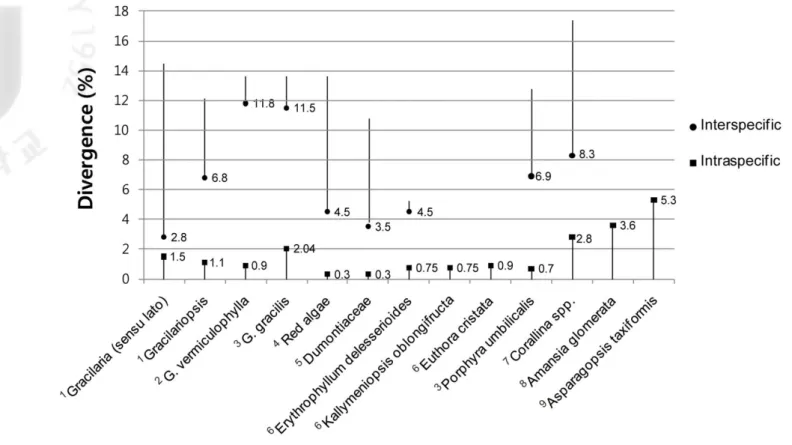
Fig. 5. Inter- and intraspecific divergences in several red algae. Range in values is shown.
References and molecular markers: 1this study (COI), 2Yang et al. 2008 (cox1), 3Robba et al. 2006 (cox1), 4Saunders 2005 (COI), 5Saunders 2008 (COI),
- 34 -
Ⅳ
. DISCUSSION
1. Phylogeny of Gracilariaceae inferred from rbcL gene 1.1 Gracilaria clade
Gracilaria is a species-rich genus and one of the most taxonomically difficult genera in
the Rhodophyta. In this study, 11 species from the Asia-Pacific region were resolved based on rbcL gene sequence data (Fig. 1).
Subgroup I: The phylogenetic relationships among deeper nodes within the most
derived Gracilaria lineage were composed of four Asian Gracilaria species with high bootstrap support in ML and MP (99/99) analyses. In this lineage, three flat Gracilaria species, namely, G. incurvata, G. textorii, and Gracilaria sp.1 from Japan, and one compressed species, G. parvispora, were included. In Pacific Asia, three of the flat species (G. cuneifolia, G. incurvata, and G. textorii) were very similar in having
proliferous thalli and shallow spermatangial conceptacles, and were difficult to identify because of variation in frond morphology and inconsistent branching patterns (Yamamoto, 1978). Kim et al. (2006) provided molecular evidence of G. textorii and G. cuneifolia from Korea and Japan using the plastid-coding rbcL and psbA genes. Their molecular phylogenetic analyses revealed the entities in each species, each of which has a considerable amount of gene sequence diversity. In addition, both the rbcL and psbA sequences clearly separated Japanese G. incurvata samples from G. textorii. We recently collected G. incurvata from the type locality in Misaki, Kanagawa Prefecture, Japan, and analyzed this species’ rbcL sequence. The data suggested that G. incurvata from Misaki and a previously published G. cuneifolia from Korea were identical. Our numerous specimens collected from intertidal and subtidal regions of Korea were also identical.
- 35 -
Although G. incurvata is very similar to G. textorii and G. cuneifolia, it is distinguished by narrower blades, incurved apices, and twisted branches. G. textorii has a relatively high divergence (5.9–6.0%) from G. incurvata regardless of their similar morphologies, and is sister to Gracilaria sp.1 from Japan. This raises questions about Gracilaria sp.1.
Sequence divergence between G. textorii and Gracilaria sp.1 was 1.1–1.3%, ambiguous values in terms of separating Gracilariaceae species. Nevertheless, the 100% bootstrap value and obvious differences in morphology convinced us that this represented a new species. Gracilaria sp. 1 from Japan is characterized by cylindrical stipes, and produces a round to elliptical lobe with roundish apices and smooth margins. At present, it does not fit any reported Japanese Gracilaria species; therefore, study of its anatomical and reproductive features is needed before giving it a formal taxonomic status. On the other hand, G. parvispora was substituted for G. bursa-pastoris from Korea and Japan by Kim
et al. (2008a). We showed that G. parvispora is monophyletic with a Hawaiian sample in
this study. This species has compressed thalli and is restricted to the Pacific, and is sister to G. damaecornis from the USA, with 2.9% divergence.
Subgroup II: This clade is composed of six terete species from the Asia-Pacific
region: G. arcuata, G. articulata, G. blodgettii, G. salicornia, Gracilaria sp. 2, and
Gracilaria sp. 4, and one flat unknown species from Malaysia, Gracilaria sp. 3. Many
species included in this clade, and G. salicornia has been confused with several related species (Millar and Xia, 1997; Xia, 1986). G. salicornia, G. articulata, and G. blodgettii have cylindrical and constricted thalli as common morphological features. A degree of thalli constriction and phenotypic plasticity renders species delimitation based solely on morphological grounds problematic (Xia, 1986). In a tree derived from rbcL sequence data, however, these species are related, but taxonomically distinct (Fig. 1 and 2). The presence of G. blodgettii in Asian countries has been questioned by Fredericq and Norris
- 36 -
(1992), but Terada and Yamamoto (2000) confirmed that the species is found in Japan. Our molecular evidence also supported the existence of G. blodgettii in Hainan, China. G.
blodgettii is distinguished from G. articulata and G. salicornia by its acute apices (Terada
and Shimada, 2005). Although G. salicornia and G. articulata have blunt apices with club-shaped branches in common, G. salicornia is distinguished by short branches and enlarged branch apices; intercalary articulations are present only in G. articulata. Our G.
salicornia specimens are group together with published rbcL sequences with 100%
bootstrap values. And this species is sister to G. canaliculata from the Philippines, with 6.1–6.3% divergence. G. arcuata does not share a pattern of thallus constriction with other species. This species is distinguished by its tapering branches that curve toward the apex (Ohno et al., 1999). G. arcuata is sister to Gracilaria sp. 2 from the Philippines with 100% bootstrap support. These two species have different morphology but little genetic divergence (1.1–1.2%). Genetic divergence between G. arcuata and Gracilaria sp. 2 is more remarkable according to COI data (Fig. 3). The distinct characteristics of this unknown species are the arcuate, irregularly secund to subdichotomous branches that are curved to the main axes. Gracilaria sp. 4, also collected from the Philippines, is
morphologically very similar to G. canaliculata. However, this species is far from G.
canaliculata in the rbcL tree, and so requires additional anatomical observation. In this
clade, on the other hand, one flat species from Malaysia (Gracilaria sp. 3) was included. We identified this specimen as G. textorii at first; however, it is more related to cylindrical species from Asia, and is sister to Gracilaria sp. 4 with 5.7% divergence. Four species located in the base of subgroup II are newly derived and their classification as species was confirmed by the molecular evidence in this study. Unknown species should now be the focus of research in order to elucidate the species and phylogeny of this group.
- 37 -
1.2 Gracilariopsis clade
The genus Gracilariopsis was separated from members of Gracilaria based on the characteristics of the reproductive organs; i.e., tubular nutritive cells are absent in the cystocarp and spermatangial cells are produced from superficial cortical cells (Fredericq and Hommersand, 1990a). This genus has repeatedly been confirmed as valid by
molecular data (Gurgel and Fredericq, 2004; Iyer et al., 2005; Kim et al., 2008). While 20 species are currently recognized globally (Guiry and Guiry, 2011), three (Gp. nganii Pham-Hoàng Hô, Gp. phanthietensis Pham-Hoàng Hô, and Gp. rhodotricha E.Y.
Dawson) of these are ambiguous. The existence of Gp. nganii and Gp. phanthietensis has not been reported since their first collection, and Gp. rhodotricha was unsuitable for inclusion in the genus Gracilariopsis because the spermatangia originate in deep pockets, unlike the superficial spermatangia in Gracilariopsis (Hau and Lin, 2006). Gracilariopsis species have a highly conserved morphology - cylindrical thalli - that render the
definition of species boundaries problematic. A phylogenetic tree based on rbcL data (Fig. 1 and 2) allows the members of Gracilariopsis to be easily distinguished, with 1.3–7.8% differences among 17 species globally. This also confirmed monophyly with strong bootstrap support (ML 98/MP 99).
The Gracilariopsis clade is divided into two subgroups.
Subgroup I: Subgroup I is composed of Asian Gracilariopsis specimens, with the
exception of two species from Venezuela and Tanzania. In this study, the two
Gracilariopsis species were resolved as Gp. chorda and Gp. heteroclada. Many Asian
species are mostly endemic, or have a very narrow distribution. Gp. chorda is the first member of the genus reported in Asia, and is distributed in Korea, Japan, China, and Taiwan. Gp. chorda groups together with 100% bootstrap values and is sister to Gp.
- 38 -
Yinngehai, Hainan Island, China, based on its mix of long and short spine-like branches (Chang and Xia, 1988), and is distributed in Vietnam and the Philippines. This species resembles Gp. chorda, but differs in terms of its small medullar cells, thicker cell walls, and a non-constricted cystocarp base (Chang and Xia, 1988). The specimens we collected from the type locality are identical to those from the Philippines with 100% bootstrap values. Molecular data confirmed the occurrence of Gp. heteroclada in Hainan as the type locality, and in the Philippines and Malaysia. Its geographical distribution now includes Malaysia. Gp. heteroclada is sister to Gp. mclachlanii from Tanzania, with 2.9% divergence.
Subgroup II: This group has moderate bootstrap support (84%) in ML tree, and
includes the type species of genus Gracilariopsis, Gp. andersonii. Dawson (1949) designated Gp. sjoestedtii as the type species, now synonymized to Gp. andersonii. Gp.
lemaneiformis was shown not to have a worldwide distribution but to be restricted to the
vicinity of Peru in South America. This species is most likely identical to Gp.
costaricensis from Costa Rica (Gurgel and Fredericq, 2004). There was only 0.8%
divergence between Gp. lemaneiformis and Gp. costaricensis, and the range of variation in rbcL is 1.3–7.8%, with the exception of two species.
1.3 Hydropuntia clade
This clade includes six Hydropuintia species from the Asia-Pacific region.
Hydropuntia Montagne was originally grouped with H. urvillei, based on their elaborate
compound spermatangial conceptacles (Wynne, 1989). Hydropuntia has been validated by Fredericq and Norris (1992) on the basis of its “indirect” production of gonimoblast, basally directed, nutritive filaments; more rigidly programmed pericarp and cystocarp cavity development; and ramified, spreading, fusion cells. Gurgel and Fredericq (2004)
- 39 -
confirmed the independence of the genus Hydropuntia in Gracilariaceae using rbcL sequence evidence. The generic status of Hydropuntia, however, is still in doubt when both morphological and molecular data are considered (Bellorin et al., 2002; Gargiulo et
al., 2006). In our ML tree derived from rbcL data (Fig. 1), Hydropuntia are monophyletic
and represent an independent clade with a type species but no bootstrap support. This monophyly does not hold in an MP tree (Fig. 2), due to three species grouping with the
Gracilaria sensu stiricto clade.
The type species of Hydropuntia (H. urvillei) is found in the clade, and sister to H.
eucheumatoides from the Philippines with 5.3% divergence. H. edulis, a widely
distributed species, was collected from the Philippines, Malaysia, Thailand, Taiwan, and Hainan, China, in this study. This species is closely related to two Australian species, H.
preissiana and G. perplexa. H. preissiana was originally reported from Southwestern
Australia in 2004. We collected this species from Rottnest Island, Western Australia, and it exhibits only 0.8% divergence from the published sequence. Specimens have a compressed thallus with many small branchlets arising from the blade margins. Another species is G. perplexa, reported only in Australia. Byrne et al. (2002) mentioned that this species has an ambiguous morphology making it difficult to distinguish from several other Australian species; however, they confirmed a new species of G. perplexa using RuBisCo and cox2-3 spacers. Our rbcL data also demonstrated its distinctiveness, using a specimen we collected in Okinawa, Japan. Japan is the only region reported outside the type locality. Also, we suggest that G. perplexa should be transferred to Hydropuntia due to its Hydropuntia-type spermatangial conceptacles (Byrne et al., 2002) and molecular data. Sequence data using RbcL (this study) and RuBisCo and cox2-3 spacers (Byrne et
al., 2002) indicated that G. perplexa is sister to H. preissiana. H. preissiana and G. perplexa have 2.5–3.0% interspecific divergence in rbcL data and moderate bootstrap
- 40 -
values (ML 81/MP 72). In terms of the morphological characteristics of these species, G.
perplexa is easily distinguished from H. preissiana by its terete thallus with acute tips. H. multifurcata was originally reported from Mauritius, Africa. We collected four
samples of this species in Penang, Malaysia, each of which exhibited a compressed and multiaxial thallus. This species has Hydropuntia-type spermatangial conceptacles (Terada
et al., 2004). We confirmed this species’ inclusion in Hydropuntia based on molecular
data.
Two cylindrical species were derived in this study, H. changii and H. fisheri. H.
changii from the Philippines was identical to published rbcL data, and characterized by a
slightly constricted branch base and tapering apices. This species is sister to H. fisheri with 3.9% divergence and an 82% ML bootstrap value. H. fisheri was collected in Thailand and Malaysia in this study. To the best of our knowledge, this is the first report of H. fisheri in Malaysia. H. fisheri is characterized by an abruptly constricted branch base and inflated branches.
1.4 Gracilaria vermiculophylla clade
This clade is composed of G. tenuistipitata, G. vermicuolophylla, and G. chilensis, which were proposed to make up a new genus by Gurgel and Fredericq (2004). In the present study, this clade was monophyletic and independent in both ML and MP (Fig. 1 and 2), however, had a low bootstrap value (56%) in the ML analysis.
G. tenuistipitata was collected in Thailand, Malaysia, and Hainan, China, in this study.
The G. tenuistipitata clade was resolved with 71% and 93% bootstrap support in the ML and MP analysis, respectively. This species is closely related to Gracilaria sp. 5 from the Philippines with 2.3% rbcL divergence and 2.9–3.1% divergence in COI data. These two
- 41 -
species are similar in morphology, although the genetic divergence is sufficient to separate them into distinct species.
G. vermiculophylla was also resolved with strong support (100%) in both ML and MP.
We collected this species from Korea, Japan, and China.
2. DNA barcoding inferred from COI gene
The utility of a DNA barcoding system based on the COI mitochondrial gene for identification and discovery of species has been tested in several red algal groups
(Clarkston and Saunders, 2010; Gall and Saunders, 2010; Sherwood et al., 2011). In fact, this technique may be useful for identifying cryptic species in which diagnostic
morphological characteristics are lacking or difficult to analyze (Sherwood et al., 2008). We aligned specimens of 17 species of Gracilaria, 5 of Gracilariopsis, and 6 of
Hydropuntia for the COI barcoding data set. COI barcoding successfully differentiated
the Gracilariaceae to the species level. The within-species divergence values ranged between 0% and 1.5% in all, whereas between-species divergences were greater than 2.8%. Intraspecific variation was slightly higher for G. salicornia (1.5%), Gracilaria sp. 4 (1.0%), H. edulis (1.1%), and Gp. heteroclada (1.1%) than is typically reported in red algae. In terms of G. salicornia and H. edulis, intraspecific divergence is likely due to the specimens being collected from 6–7 different nations, because the greatest divergence values occurred between Thailand and the Philippines in both species. However,
Gracilaria sp. 2 and Gp. heteroclada exhibited high intraspecific divergence despite
being collected from only one and three countries, respectively. Also, these four species, having high intraspecific variation, have specimens from the Philippines in common. More research is required before this divergence can be attributed to phenomena such as
- 42 -
incipient speciation and introgression. Intraspecific divergence is absent from G. textorii,
Gracilaria sp. 1, H. fisheri, and H. multifurcata. On the other hand, the interspecific
divergence between G. textorii and Gracilaria sp. 1 in COI was 2.8%; these species are closely related and showed the lowest rbcL value (1.1%). Moreover, G. tenuistipitata is closely related to Gracilaria sp. 5, with 2.9–3.1% interspecific divergence in COI. These interspecific divergence values are a little lower than those of other red algae (Saunders, 2005; Robba et al., 2006; Saunders, 2008; Walker et al., 2009).
A critical feature of any region used as a ‘barcode’ in species identification is that the intraspecific variation must be significantly lower than the interspecific variation; a so-called ‘barcoding gap’ must exist (Hebert et al., 2003; Moritz and Cicero, 2004). The genetic diversity and differentiation of several mitochondrial genes are compared in Figure 5, and demonstrate the barcoding gap. Analysis of the intraspecific divergence in the Gracilariaceae with respect to other Gracilaria taxa revealed intermediate values (0– 1.5%), but G. gracilis had a relatively high intraspecific divergence (2.04%). Usually DNA barcoding of Gracilariaceae species uses an empirical 0–2% intraspecific
divergence; however, this threshold was far exceeded in other red algal species including
Asparagopsis taxiformis (5.3%) and Amansia glomerata (3.6%) (Sherwood, 2008;
Sherwood et al., 2011). Sherwood et al. (2011) suggested that these two species may represent species complexes, a possibility that would require detailed anatomical study. Intraspecific divergence of Corallina spp. (2.8%), which occurred in specimens between Ireland and England, also exceeded the threshold of the Gracilariaceae. With the
exception of the three taxa mentioned above, the intraspecific divergence of Gracilariaceae is somewhat higher than that of other red algae, while minimum interspecific divergence is lower. Therefore, the barcoding gap of Gracilariaceae is narrower than that of other taxa.
- 43 -
The COI-5P exhibits high variability, especially in the third codon, making it effective for discriminating between even closely related species (Hebert et al., 2003). Due to this high interspecific divergence, the COI marker has successfully been used to establish species identity in several red algal species, which are difficult to identify (Saunders, 2005; Teasdale and Klein, 2010). Hebert et al. (2004) proposed a standard sequence threshold of ten times the mean intraspecific variation for the group. If applied to the
Gracilaria sensu lato species examined in this study, the average intraspecific variation
would be 0.52% with a 5.2% threshold. Because the minimum interspecific divergence in this study was 2.8% based on the COI gene, it does not correspond to a standard sequence threshold in Gracilaria sensu lato. If applied to the Gracilariopsis genus, it has 0.7% average intraspecific variation with a 6.8% threshold. However, Gracilariopsis represents far fewer species than Gracilaria sensu lato; therefore, a change in the interspecific variation may occur if more species are added to this group. In terms of results, we have five times the species sequence threshold of the mean intraspecific variation for
Gracilariaceae. Previous barcoding studies have indicated that interspecific divergences of 3.5–18% should be sufficient for distinguishing among red algal species (Saunders, 2008; Robba et al., 2006; Clarkston and Saunders, 2010; Walker et al., 2009). In the present work, we identified a barcoding gap based on COI, and DNA barcode values greater than 2.8% corresponded to unequivocally distinct species. At lower values (1–2%), divergent mitotypes may or may not correspond to distinct species, and additional
investigation is then required to assess the status of the populations under study (Saunders, 2005; Lane et al., 2007). Meyer and Paulay (2005), Meirer et al. (2006), and Wiemers and Fiedler (2007) all question the notion of barcoding gaps, suggesting that such “gaps” are in fact an artifact of insufficient sampling across taxa. In this study, closely related Gracilariaceae species lessened the purported barcoding gap; therefore, an extension to
- 44 -
this study with additional red algae species is warranted to resolve this issue. However, Lukhtanov et al. (2009) discussed how the inclusion of geographically separated populations influenced DNA barcoding. They indicated that although expanded geographical coverage did substantially increase intraspecific variation, reducing the barcoding gap between species, this did not decrease species identification using NJ clustering. In our COI data (Fig. 3), all species were independently monophyletic and possessed distinct clusters, indicating that this DNA barcoding method can effectively identify these Gracilariaceae species.
- 45 -
Ⅴ
. CONCLUSIONS
Our phylogenetic reconstruction of Gracilariaceae confirmed the previously recognized subgeneric classification, but highlighted several species-level cases. We derived a total of 22 Gracilariaceae species from the Asia-Pacific region and elucidated their phylogenetic relationships and clarified the classifications of previously unclear entities. RbcL and COI sequences were sufficiently differentiated at the species level in Gracilariaceae. With these two molecular datasets we have contributed to the assessment of species boundaries in Gracilariaceae. Using rbcL data, morphologically distinct and well-defined species usually have more than 2% interspecific rbcL sequence divergence. Lower interspecific divergence occasionally exists between closely related species; therefore, before final conclusions can be made regarding the taxonomy of this group, it is necessary to perform a comprehensive investigation that includes phylogenetic analysis of several taxa. The COI barcoding used here allowed the clear distinction of the different species in this group, and COI sequences exhibited a barcoding gap. Intraspecific
diversity plays a fundamental role in delimiting species boundaries. Generally, COI barcoding of Gracilariaceae species showed 0–2% intraspecific divergence, which is the standard threshold for separation of species. Thus, studies of intraspecific divergence that include additional sampling should be conducted to define the species boundaries. For large-scale phylogeny and species identification, a consensus regarding the most suitable gene is essential. To better understand the evolutionary relationships within this group, an extension to this study with additional species is necessary.
- 46 -
Ⅵ
. LITERATURE CITED
Bellorin, A.M., M.C. Oliveira and E.C. Oliveira. 2002. Phylogeny and systematics of the marine algal family Gracilariaceae (Gracilariales, Rhodophyta) based on small subunit rDNA and ITS sequences of Atlantic and Pacific species. J. Phycol., 38: 551-563.
Bellorin, A.M., A. Buriyo, J. Sohrabipour, M.C. Oliveira and E.C. Oliveira. 2008.
Gracilariopsis mclachlanii sp. nov. and Gracilariopsis persica sp. nov. of the
Gracilariaceae (Gracilariales, Rhodophyceae) from the Indian Ocean. Journal of
Phycology, 44: 1022–1032.
Bird, C.J. 1995. A review of recent taxonomic concepts and developments in the Gracilariaceae (Rhodophyta). Journal of Applied Phycology, 7: 255-267.
Byrne, K., G.C. Zuccarello, J. West, M.L. Liao and G.T. Kraft. 2002. Gracilaria species (Gracilariaceae, Rhodophyta) from southeastern Australia, including a new species,
Gracilaria perplexa sp. nov.: Morphology, molecular relationships and agar content. Phycological Research, 50(4): 295-312.
Chang, C.F. and B.M. Xia. 1988. On two new Gracilaria (Gigartinales, Rhodophyta) from South China. In: Taxonomy of economic seaweeds with reference to some Pacific
and Caribbean species (Abbott, I.A. Eds) Vol.2, pp. 127-129. California Sea Grant
College Program.
Clarkston, B.E. and G.W. Saunders. 2010. A comparison of two DNA barcode markers for species discrimination in the red algal family Kallymeniaceae (Gigartinales,
Florideophyceae), with a description of Euthora timburtonii sp. nov. Botany, 88: 119-131.
- 47 -
Cohen, S., S. Faugeron, E.A. Martines, J.A. Correa, F. Viard, C. Destombe and M. Valero. 2004. Molecular identification of two sibling species under the name Gracilaria
chilensis (Rhodophyta, Gracilariales). J. Phycol., 40: 742-747.
Dawson, E.Y. 1949. Studies of northeast Pacific Gracialriaceae. Allan Hancock
Foundation Publ., Occ. Pap., 7:1-105, 25pls.
Fredericq, S. and J.N. Norris. 1992. Studies on cylindrical species of western Atlantic
Gracilaria (Gracilariales, Rhodophyta): G. cylindrica Børgesen and G. blodgettii
Harvey. In: Taxonomy of Economic Seaweeds. (Abbott, I.A. Eds) Vol.2, pp. 211-231. La Jolla, California: California Sea Grant College.
Fredericq, S. and M.H. Hommersand. 1989. Proposal of the Gracilariales ord. nov. (Rhodophyta) based on an analysis of the reproductive development of Gracilaria
verrucosa. Journal of Phycology, 25: 213-227.
Fredericq, S. and M.H. Hommersand. 1990a. Comparative morphology and taxonomic status of Gracilariopsis (Gracilariales, Rhodophyta). J. Phycol., 25: 228-241. Fredericq, S. and M.H. Hommersand. 1990b. Diagnoses and key to the genera of the
Gracilariaceae (Gracilariales, Rhodophyta). Hydrobiologia, 204/205: 172-178. Gall, L.L. and G.W. Saunders. 2010. DNA barcoding is a powerful tool to uncover algal
diversity: a case study of the Phyllophoraceae (Gigartinales, Rhodophyta) in the Canadian flora. J. Phycol., 46: 374-386.
Gargiulo, G M., M. Morabito, G. Genoves and F.D. Masi. 2006. Molecular systematic and phylogenetics of Gracilariacean species from the Mediterranean Sea. J. Phycol., 18: 297–504.
Gavio, B and S. Fredericq. 2002. Grateloupia turuturu (Halymeniaceae, Rhodophyta) is the correct name of the non-native species in the Atlantic known as Grateloupia
- 48 -
Goff, L.J., D.A. Moon, A.W. Coleman. 1994. Molecular delineation of species and species relationships in the red algal agarophytes Gracilariopsis and Gracilaria (Gracilariales). J. phycol., 30: 521-537.
Greville, R.K. 1830. Algae britannicae, or descriptions of the marine and other inarticulated plants of the British islands, belonging to the order Algae; with plates illustrative of the genera. pp. [i*-iii*], [i]-lxxxviii, [1]-218, pl. 1-19.
Guiry, M.D. and G.M. Guiry. 2011. AlgaeBase. World-wide electronic publication, National University of Ireland, Galway. http://www.algaebase.org; searched on 08 December 2011.
Gurgel, C.F.D. and S. Fredericq. 2004. Systematics of the Gracilariaceae (Gracilariales, Rhodophyta): a critical assessment based on rbcL sequence analysis. J. Phycol., 40: 138-159.
Hajibabaei, M., G.A.C. Singer, P.D.N. Hebert and D.A. Hickey. 2007. DNA barcoding: how it complements taxonomy, molecular phylogenetics and population genetics.
Trends in Genetics, 23: 167–172.
Hall, T.A. 1999. BioEdit: a user-friendly biological sequence alignment editor and analysis program for Windows 95/98/NT. Nucl Acids Symp Ser, 41: 95-98.
Harvey, W.H. 1855. Short characters of some new genera and species of algae discovered on the coast of the colony of Victoria, Australia. Ann. Mag. Nat. Hist. (Lond.), 5: 332-6.
Hau, L.N. and S.M. Lin. 2006. Gracilariopsis nhatrangensis (Gracilariaceae,
Rhodophyta), a new marine red alga from Nhatrang, southern Vietnam. Botanical
studies, 47: 329 –337.
Hebert, P.D N., A. Cywinska, B.L. Ball and J.R. DeWaard. 2003. Biological identification through DNA barcodes. Proc. R. Soc. Lond. B. Biol. Sci., 270(1512): 313-321.
- 49 -
Hebert P.D.N., M.Y. Stoeckle, T.S. Zemlak and C.M. Francis. 2004. Identification of birds through DNA barcodes. PLoS. Biol., 2: 1657-1663.
Iyer, R., E.M. Tronchin, J.J. Bolton and V.E. Coyne. 2005. Molecular systematics of the Gracilariaceae (Gracilariales, Rhodophyta) with emphasis on Southern Africa. J.
Phycol., 41: 672-684.
Kim, M.S, E.C. Yang and S.M. Boo. 2006. Taxonomy and phylogeny of flattened species of Gracilaria (Gracilariceae, Rhodophyta) from Korea based on morphology and protein-coding plastid rbcL and psbA sequences. Phycologia, 45: 520-528.
Kim, M.S., M. Kim, R. Terada, E.C. Yang and S.M. Boo. 2008a. Gracilaria parvispora is the correct name of the species known as G. bursa-pastoris in Korea and Japan. Taxon, 57(1): 231-237.
Kim, M.S., E.C. Yang, S.Y. Kim, I.K. Hwan.g and S.M. Boo. 2008b. Reinstatement of
Gracilariopsis chorda (Gracilariaceae, Rhodophyta) based on plastid rbcL and
mitochondrial cox1 sequences. Algae, 23: 209-217.
Kim, M.S., M.Y. Yang and G.Y. Cho. 2010. Applying DNA barcoding to Korean Gracilariaceae (Rhdophyta). Cryptogamie, Algologie, 31: 387-401.
Lane, C.E., S.C. Lindstrom and G.W. Saunders. 2007. A molecular assessment of northeast Pacific Alaria species (Laminariales, Phaeophyceae) with reference to the utility of DNA barcoding . Molecular Phylogenetics and Evolution, 44: 634-648. Lara, A., J.L.P. De Leon, R.Rodriguez, D. Casane, G. Cote, L. Bernatchez and E.
Garcia-Machado. 2010. DNA barcoding of Cuban freshwater fishes: evidence for cryptic species and taxonomic conflicts. Molecular Ecology Resources, 10: 421-430.
Lin, S.M. 2008. Morphological and phylogenetic studies of Gracilariopsis chiangii, new species (Gracilariaceae, Rhodophyta), an alga presently known as Gracilaria chorda in Taiwan. The Raffles Bulletin of Zoology Supplement, 19: 19-26.
- 50 -
Lukhtanov, V.A., A. Sourakov, E.V. Zakharov and P.D.N. Hebert. 2009. DNA barcoding central Asian butterflies: increasing geographical dimension does not significantly reduce the success of species identification. Molecular Ecology Resources, 9: 1302-1310.
Marshall, E. 2005. Taxonomy, Will DNA barcodes breathe life into classification?
Science, 307: 1037.
Meier, R., K. Shiyang, G. Vaidya and P.K.L. Ng. 2006. DNA barcoding and taxonomy in Diptera: a tale of high intraspecific variability and low identification success. Syst.
Biol., 55:715-728.
Meyer, C.P. and G. Paulay. 2005. DNA barcoding: error rates based on comprehensive sampling. PLoS. Biol., 3:422.
Millar, A.J.K. and B.M. Xia. 1997. Studies on terete species of Australian Gracilaria. In:
Taxonomy of Economic Seaweeds. (Abbott, I.A. Eds) Vol.6, pp. 103-109. La Jolla,
California: California Sea Grant College System.
Montagne, C. 1842. Prodromus generum specierumque phycearum novarum, in itinere ad polum antarcticum... collectarum…. Paris. 16 pp.
Montagne, C. 1843. Quatrième centurie de plantes cellulaires exotiques nouvelles. Décades VII, IX et X. Ann. Sci. Nat. Bot. Seconde Sér. 20: 352-379, pls 15-16. Moritz C., C. Cicero. 2004. DNA barcoding: promise and pitfalls. PLoS. Biol.,
2:1529-1531.
Nägeli, C. 1847. Die neuern Algensysteme und Versuch zur Begründung eines eigenen Systems der Algen und Florideen. Neue Denkschriften der Allgemeinen
Schweizerischen Gesellschaft für die Gesammten, 9(2): 1-275, pls I-X.
Ohno, M., R. Terada and H. Yamamoto. 1999. The species of Gracilaria from Vietnam. In: Taxonomy of Economic Seaweeds with reference to some Pacific species, Vol. VII.