Fast Crack Detection using Ultrasound Lock-in Thermography
JaiWan Cho, HyunKyu Jung, SeungHo Jung, and SeungHo KimNuclear Robotics Lab. Korea Atomic Energy Research Institute, [email protected] P.O. Box 105, Yusong, Daejon, KOREA, 305-353
1. Introduction
Active thermography is being used since several years for remote non-destructive testing. It provides thermal images for remote detection and imaging of damages. Also, it is based on propagation and reflection of thermal waves which are launched from the surface into the inspected component by absorption of modulated radiation. For energy deposition, it use external heat sources (e.g., halogen lamp or convective heating) or internal heat generation (e.g., microwaves, eddy current, or elastic wave). Among the external heat sources, the ultrasound is generally used for energy deposition because of defect selective heating up. The heat source generating a thermal wave is provided by the defect itself due to the attenuation of amplitude modulated ultrasound. A defect causes locally enhanced losses and consequently selective heating up. Therefore amplitude modulation of the injected ultrasonic wave turns a defect into a thermal wave transmitter whose signal is detected at the surface by thermal infrared camera. This way ultrasound lock-in thermography(ULT) allows for selective defect detection which enhances the probability of defect detection in the presence of complicated intact structures.
In this paper the applicability of ULT for fast defect detection is described. Examples are presented showing the detection of crack in thick SUS material. Measurements were performed on various kinds of typical defects in nuclear materials (both metal and non-metal). The obtained thermal image reveals area of crack in row of thick SUS material.
2. Crack Detection
In this section the ULT technique used to detect crack of thick SUS material is described. The ULT experimental setup includes a high power (1.5kW) ultrasonic sonotrode, thermal infrared camera, power amplifier, and image recording system.
2.1 Principle of Ultrasound Lock-in Thermography The lock-in thermography [1] have been used very early for remote monitoring of thermal features, e.g. cracks, delaminations [2], and other kinds of boundaries. As one can image square meters of airplanes within a few minutes [3], one has a powerful method for fast inspection of safety relevant structures with a depth range of several millimetres in polymer composites. The absorption of intensity modulated radiation
generates on the whole surface a thermal wave. It propagates into the interior where it is reflected at boundaries so that it goes back to the surface where it is superposed to the initial wave (see Figure 1). This way a defect is revealed by the local change of phase angle [4].
Fig 1. ULT principle: Modulated ultrasound excitation generates thermal waves in the defect itself, those are sensed at the surface (courtesy of G. Busse).
Defects differ from their surroundings by their mechanical weakness. They may cause stress concentrations, and under periodical load there may be friction in cracks and delaminations. When the acoustic waves are launched into the whole volume, they are reflected several times until they disappear preferably in a defect and generate heat. As defects may be areas where mechanical damping is enhanced, the ultrasound is converted into heat mainly in defects [5, 6]. Modulation of the elastic wave amplitude results in periodical heat generation so that the defect is turned into a local thermal wave transmitter. Its emission is detected via the lockin thermography tuned to the frequency of amplitude modulation.
2.2 Experiment
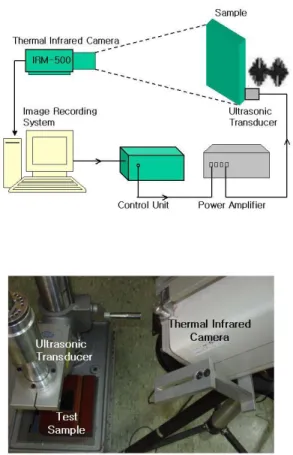
Figure 2 displays the resulting experimental arrangement. The ultrasonic transducer is attached to the component that is monitored by a thermal infrared camera. The ultrasonic wave frequency was typically around 20 kHz. The acoustical energy provided by the source was in most experiments 1.5 kW. And the duration of a measurement was typically 5 seconds. In the following we describe results that was obtained on material used for nuclear applications – thick SUS crack test sample, Aluminum, and Beryllium-Copper alloy . In order to unify the emmissivity of the material, the surface of sample is sprayed with black paints.
Transactions of the Korean Nuclear Society Autumn Meeting Busan, Korea, October 27-28, 2005
Fig 2. Experimental setup of lock-in thermography with ultrasonic excitation.
2.3 Results
Defects to be detected and monitored are e.g. cracks, corrosion, and loose parts. Using ULT, one can identify defects rapidly in a remote way. Fig. 3 shows that ULT can reveal crack since it is heated selectively by friction effect.
Fig 3. Detection of crack in thick SUS material (14T) with ULT ( Lock-in Frequency: 0.2Hz, Ultra sound Power: 1.5kW).
3. Conclusion
Ultrasound lockin thermography allows for selective detection of defects. The advantage of selective defect heating is that the energy generated by ultrasound is used in a very efficient way since it is not wasted for heating of intact areas. The fast crack detection makes ULT well suited for non-destructive inspection in the quality control of safety relevant structures, e.g. in nuclear applications.
REFERENCES
[1] A. Dillenz, T. Zweschper, G.Riegert, and G. Busse, Progress in phase angle thermography, Review of Scientific Instruments, Vol.74, No. 1, p. 417, 2003.
[2] G. Busse, Optoacoustic phase angle measurement for probing a metal, Appl. Phys. Lett. Vol. 35, p. 759, 1979. [3] D. Wu, A. Salerno, U. Malter, and G. Busse, Inspection of aircraft structural components using lock-in thermography, Quantitative Infrared Thermography, p. 251, 1997.
[4] Th. Zweschper, A. Dillenz, and G. Busse, Inspection of aerospace structures with ultrasound lock-in-Thermography,
http://www.ndt.net/article/wcndt00/papers/idn312/
[5] G. Lutz, Inspection of copper canisters for spent nuclear fuel by means of ultrasound, Technical Reports TR-04-03, 2004.
[6] A. Dillenz, G. Busse, and D. Wu, Ultrasound lockin thermography: feasibilities and limitations, Proc. SPIE Vol. 3827, p. 10, 1999.