Adsorptive removal of odour substances and NO and catalytic
esterification using empty fruit bunch derived biochar
Hyung Won Lee
1,*, Jae-Kon Kim
2,*, and Young-Kwon Park
1,♠1School of Environmental Engineering, University of Seoul, Seoul 02504, Korea
2Research Institute of Petroleum Technology, Korea Petroleum Quality & Distribution Authority, Cheongju 28115, Korea
Received 22 February 2018 Accepted 26 March 2018 ♠Corresponding Author E-mail: [email protected] Tel: +82-2-6490-2870 *Co-first authors Open Access pISSN: 1976-4251 eISSN: 2233-4998
Article Info
Copyright © Korean Carbon Society
http://carbonlett.org
Abstract
Empty fruit bunch (EFB) char was used to remove NOx and odorous substances. The
physi-cochemical properties of the EFB chars were altered by steam or KOH treatments. The Brunauer-Emmett-Teller surface area and porosity were measured to determine the proper-ties of the modified EFB chars. The deNOx and adsorption test for hydrogen sulphide and
acetaldehyde were performed to determine the feasibility of the modified EFB chars. The KOH-treated EFB (KEFB) char revealed higher deNOx efficiency than with commercial
activated carbon. The Cu-impregnated EFB char also had high deNOx efficiency at
tempera-tures higher than 150°C. The KEFB char showed the highest hydrogen sulphide and acetal-dehyde adsorption ability, followed by the steam-treated EFB char and untreated EFB char. Moreover, the product prepared by sulfonation of EFB char showed excellent performance for esterification of palm fatty acid distillate for biodiesel production.
Key words: char, adsorption, activation, catalyst, pyrolysis
1. Introduction
Pyrolysis is known to be an efficient method for biomass conversion [1-7].Among the products of pyrolysis, biochar is a material with great potential for use as adsorbent and catalyst for the removal of contaminants in air and water matrices [8-17]. The catalytic and adsorbent properties of biochar differ according to its surface area, pore properties and min-eral content.
Selective catalytic reduction (SCR) is considered a representative deNOx method and various catalysts have been used for SCR [18-26]. Recently, the use of biochar as catalyst support for the SCR process was suggested. Cha et al. [27] used biomass char produced from the pyrolysis of rice straw and sewage sludge as a supporting material for Mn impregnation and reported that Mn-impregnated char had high deNOx efficiency.
Jo et al. [28] activated biochar using KOH solution and found that the activated char showed higher deNOx efficiency due to the improved surface properties and surface area caused by the chemical treatment. Kong et al. [29] impregnated three types of metal oxides (V2O5, MnO and CuO) on KOH-treated char and assessed their ability for NO removal using
ammonia (NH3) at 160°C.
Odour substances emitted from food waste consist mainly of hydrogen sulphide (H2S),
NH3, organic acids and aldehydes [30]. They are also classified as harmful air pollutants
owing to their offensive odour and negative effects on the environment and human health. A range of methods, including such as absorption, adsorption, biological treatment and ozone oxidation, have been applied to the removal of these odorous substances [30]. In particular, the adsorption method is used more widely than other methods because of its simplicity, low operating cost and high efficiency.
Recently, biochar-catalyst prepared from saccharides and biomass by incomplete carbonization followed by sulfonation, has attracted much attention from researchers
DOI: http://dx.doi.org/
DOI:10.5714/CL.2018.28.081
This is an Open Access article distributed under the terms of the Creative Commons Attribution Non-Commercial License (http://creativecommons.org/licenses/ by-nc/3.0/) which permits unrestricted non-commercial use, distribution, and reproduction in any medium, provided the original work is properly cited.
A brief review on graphene applications in rechargeable lithium ion battery electrode materials
Sameen Akbar, Muhammad Rehan, Liu Haiyang, Iqra Rafique, and Hurria Akbar
KCS Korean Carbon Society
carbonlett.org
pISSN: 1976-4251 eISSN: 2233-4998
REVIEWS
density were also performed using the back-titration method to determine the compositional and surface properties (carboxylic, phenolic and sulfonic groups) of the sulfonated EFB char.
2.4. NO
x, H
2S and aldehyde removal efficiency
of SEFB and KEFB biochars
A NOx removal test was performed using a SUS tube reactor.
For this, 3 mg of experimental biochar was loaded inside the SUS tube with quartz wool at both ends of the biochar. Constant con-centrations of NO and NH3 gases (1000 ppm) were supplied to the
reactor at temperatures ranging from 50 to 300°C together along with a mixture of oxygen (10 %) and nitrogen gas (90 %). The total flow rate of the gas was 100 mL min–1 and the calculated space
velocity (WHSV) was 20,000 mL/gcat·h. The overall efficiency of
each biochar for NOx removal was calculated using Eq. 1. The inlet
and outlet concentration of NO was measured using a NOx analyser
(42i-HL, Thermo Fisher Scientific) connected online.
The efficiencies of the EFB biochars for removal of H2S and
aldehyde were tested in a Tedlar bag. For this, 10 ppm of H2S
and aldehyde were placed in a 10 L Tedlar bag together with 0.1 g of EFB biochar. The concentration of H2S or aldehyde
remain-ing after 5, 10, 30 and 60 min of adsorption was analysed usremain-ing a gas-detecting tube (Gestec).
2.5. Esterification performance of fatty acids
over Sul-EFB biochar
Catalytic esterification of free fatty acids over each bio-char was also evaluated in this study. For this, a mixture of palm fatty acid distillate (PFAD; supplied by SK Chemical Co., Ltd., Korea) and methanol (MeOH; MeOH to PFAD mo-lar ratio, 15:1) was stirred together with Sul-EFB biochar (5 wt% of initial oil) at 75°C for 24 h on a hot plate using a mag-netic stirrer (250 rpm). After reaction, the final biodiesel oil was obtained using vacuum filtration to eliminate the residual biochar and to evaporate the MeOH. The EN 14103 method was applied to quantify the fatty acids methyl esters (FA-MEs) in the final biodiesel sample after esterification using biochar. For this, a gas chromatography-flame ionization de-tector (GC-FID; Agilent Technology) with a capillary column (SP-2380, Supelco: 30 m length, 0.25 mm inner diameter, 0.2 μm film thickness) was used together with nonadecanoic acid methyl ester as an internal standard. The GC-FID measure-ments were repeated three times.
3. Results and Discussion
3.1. Biochar properties
As shown in Table 1, the original EFB biochar had essen-tially no pore structure and lower surface area than that of the activated biochar reported in previous studies [8,43]. The un-measurable surface area and pore volume of the untreated EFB char was increased by applying steam and KOH treatments. because of its low preparation cost and high catalytic
activ-ity [31-40]. Wang et al. [38] and Dehkhoda et al. [40] used hardwood biochar as support in the synthesis of solid acid catalysts, and the product exhibited high catalytic activity for the esterification reaction.
In this study, the feasibility of biochar as an alternative ma-terial to activated carbon for the removal of NOx and odour
substances was evaluated. Biochar was obtained from pyroly-sis of empty fruit bunch (EFB) and was activated by treatment with steam or KOH. The efficiencies of the steam-treated EFB (SEFB) and KOH-treated EFB (KEFB) chars as catalysts for deNOx were tested, as well as for adsorbents of hydrogen sul-phide (H2S) and aldehyde (CH3CHO). In an attempt to improve
the biochar properties, Cu was also added to the treated biochar and its catalytic and adsorbent activities were compared with those of the other treated biochars.
2. Experimental
2.1. SEFB and KEFB biochar
First, EFB was subjected to pyrolysis at 500°C to obtain biochar. For the steam treatment (SEFB), the biochar was heated to 700°C at 5°C/min and then maintained at 700°C for 1 h under a mixture of steam (1.62 mL h–1) and nitrogen
gas (50 mL min–1). For the KOH treatment of EFB char, a
mixture of KOH and biochar (1:1) was dissolved in distilled water and then dried in an oven at 105°C. After sufficient drying, the KEFB char was heated to 700°C at 5°C/min and was maintained at that temperature for 1 h under nitrogen gas (50 mL min–1). To remove the K+ ions remaining after the
KOH treatment, the biochar was neutralized with 5.0 M HCl and then washed with distilled water. After this, it was dried thoroughly in an oven at 105°C. For the copper treatment, 5, 10, or 20 wt% of Cu was used to impregnate 5 g portions of KEFB char to produce three variants of Cu-KEFB. After the incipient wetness impregnation, the Cu-impregnated KEFB (Cu-KEFB) biochar was dried at 110°C under air and heated at 350°C for 3 h under nitrogen gas.
2.2. Sulfonated EFB (Sul-EFB) biochar
For the sulphur treatment, EFB biochar was ground to pow-der and a 15 g sample was sulfonated using 50 mL concentrated sulphuric acid (95–98%). The sample was soaked for 1 h in a 500 mL flask, with temperature controlled at 90°C in an oil bath. After cooling to ambient temperature, the mixture was stirred in distilled water and filtered. Washing with hot distilled water followed by filtration was repeated to eliminate the residual sul-phate ions. After the final filtration, the sample was placed in an air drier for 24 h at 80°C.
2.3. Characterization
The N2 adsorption-desorption method (Sorptomatic
instru-ment, Thermo Ins) was applied to analyse the surface area, pore size and volume of the biochar according to a procedure reported elsewhere [41,42]. Elemental analysis and total acid
3.2. Biochar activity
3.2.1. NOx removal by KEFB biochars
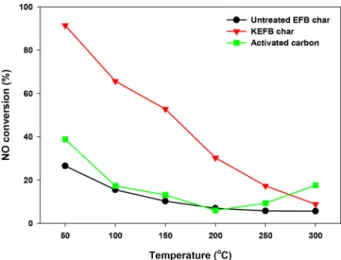
Fig. 1 shows the efficiency of the EFB biochars pre-pared in this study, for the removal of NOx. Although the
untreated EFB biochar exhibited NOx removal efficiency
lower than 30% at all temperatures, KEFB exhibited much higher NOx removal efficiency than those of untreated EFB
biochar and of commercial activated carbon. In particular, the NOx removal efficiency of KEFB was greater than 90%
at 50°C. The high efficiency of KEFB on NOx removal
at low temperature can be explained by the high physical NOx adsorption efficiency of KEFB [27,48]. The high NOx
removal efficiency of the KEFB biochar decreased when Cu-KEFB was used at 50°C (Fig. 2). The NOx removal efficiency of Cu-KEFB became higher than that of KEFB at temperatures higher than 150°C. The high NOx removal
efficiencies of Cu-KEFB at high temperatures can be ex-plained by the effective catalytic reaction promoted by the Cu on KEFB.
Although the Brunauer-Emmett-Teller (BET) surface area and pore volume of untreated EFB char were very low, they were increased by the steam and KOH treatments. This is because the steam treatment caused diffusion of heated steam into the biochar where it expanded openings [44] and the KOH treat-ment cleaned pores blocked by tar particles [45,46]. KEFB had a larger BET surface area (698 m2 g–1) and pore volume (0.24
cm3 g–1) than those of SEFB (328 m2 g–1, 0.10 cm3 g–1). This
suggests that chemical treatment using KOH is more effective for the development of biochar pores than is physical treatment using steam. Although the 5% Cu-EFB biochar had surface area similar to that of KEFB, its surface area decreased with increas-ing Cu content (up to 20%) due to the formation of large Cu particles in the pores [47].
As shown in Table 2, the surface area and pore volume of Sul-EFB was 2.10 m2 g–1 and 0.006 cm3 g–1, respectively. This
indicates that the sulfonation treatment of EFB biochar can make structural changes by causing the collapse and degrada-tion of carbon. The collapse and degradadegrada-tion of biochar car-bon indicated that activation/oxidation of biochar occurred during sulfonation [43]. The total acid density of Sul-EFB, as measured by the titration method, was 24.72 mmol g–1. This
suggests high accessibility of sulphuric acid into the carbon bulk of the EFB biochar and the successful formation of co-valent bonds between the carbon surface of the EFB biochar and sulfonic acid. The high S-content of Sul-EFB (2.05 % in Table 3), also indicates the cross-linking of sulfonic acid groups to the carbon layer.
Table 1.
Specific surface areas and total pore volumes of EFB biocharsBiochar Surface area (m2 g–1) Pore volume (cm3 g–1)
EFB ND ND SEFB 328 0.10 KEFB 700 0.24 5%-Cu/KEFB 699 0.30 10%-Cu/KEFB 624 0.27 20%-Cu/KEFB 606 0.26 ND, not detected.
Table 2.
Specific surface area, total pore volume and total acid-ity of Sul-EFB biocharBiochar Surface area(m2 g–1) Pore volume(cm3 g–1) Total acidity(mmol g–1)
Sul-EFB 2.10 0.006 24.72
Table 3.
Elemental analysis of EFB and Sul-EFB biocharSample C N O S
EFB 67.45 0.72 9.05
-Sul-EFB 49.27 0.87 34.53 2.05
Fig. 1.
NO removal-efficiencies of two EFB biochars and commercial activated carbon.4. Conclusions
Biochar treated with steam (SEFB) and KOH (KEFB) was used as either a catalyst or adsorbent for NOx, H2S and
alde-hyde removal. KEFB had higher NOx removal efficiency than
did untreated EFB biochar and activated carbon, particularly at low temperatures. This high NOx removal efficiency of KEFB
at low temperatures was decreased by Cu impregnation. On the other hand, the NOx removal efficiency of Cu-KEFB was higher
than that of the KEFB at temperatures higher than 150°C due to the catalytic activity of Cu. The H2S and aldehyde adsorption
efficiencies of the EFB biochar were also increased by the steam and KOH treatments. Both SEFB and KEFB revealed higher H2S and aldehyde removal efficiencies than with untreated EFB
biochar and activated carbon. In particular, KEFB showed much higher aldehyde removal efficiency than the other EFB biochars and activated carbon owing to its large surface area. Moreover, Sul-EFB, which was prepared by sulfonation of EFB biochar, showed excellent performance for esterification of PFAD for biodiesel production.
Conflict of Interest
No potential conflict of interest relevant to this article was reported.
Acknowledgements
This research was supported by the Nano-Material Tech-nology Development Program through a grant from the Na-tional Research Foundation of Korea (NRF), funded by the Ministry of Science, ICT and Future Planning (No. NRF-2015M3A7B4049714). Also, this research was supported by the Technology Development Program to Solve Climate Changes of the National Research Foundation (NRF) funded by the Minis-try of Science, ICT (2017M1A2A2086839).
References
[1] Zhao S, Liu M, Zhao L, Lu J. Effects of organic and inorganic met-al smet-alts on thermogravimetric pyrolysis of biomass components. Korean J Chem Eng, 34, 3077 (2017). https://doi.org/10.1007/ s11814-017-0209-8.
[2] Lee Y, Shafaghat H, Kim J, Jeon JK, Jung SC, Lee IG, Park YK. Upgrading of pyrolysis bio-oil using WO3/ZrO2 and Amberlyst
catalysts: evaluation of acid number and viscosity. Korean J Chem Eng, 34, 2180 (2017). https://doi.org/10.1007/s11814-017-0126-x. [3] Mamaeva A, Tahmasebi A, Yu J. The effects of mineral salt cata-lysts on selectivity of phenolic compounds in bio-oil during mi-crowave pyrolysis of peanut shell. Korean J Chem Eng, 34, 672 (2017). https://doi.org/10.1007/s11814-016-0291-3.
[4] Xue Y, Yan C, Zhao X, Huang S, Guo C. Ni/La2O3-ZrO2 catalyst
for hydrogen production from steam reforming of acetic acid as a model compound of bio-oil. Korean J Chem Eng, 34, 305 (2017). https://doi.org/10.1007/s11814-016-0277-1.
3.2.2. Adsorption of odour emitting substances
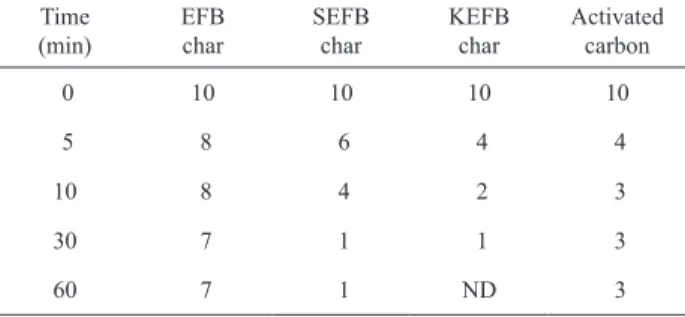
Tables 4 and 5 show the efficiencies of the adsorption of H2S and acetaldehyde by the EFB biochars and a commercial
activated carbon, respectively. Although the H2S and
acet-aldehyde adsorption efficiencies of the untreated EFB bio-char were low, those of SEFB and KEFB were higher than untreated EFB and activated carbon after 10 min adsorption time. In particular, KEFB showed higher aldehyde removal efficiency than did SEFB. This can be explained by the higher BET surface area of KEFB (Table 1), which provides greater adsorption capacity.
3.2.3. Esterification of FPAD over Sul-EFB
The effect of Sul-EFB on the esterification of FPAD is shown in Table 6. The contents (vol%) of FAMEs in the product die-sel oil obtained from esterification of PFAD over Sul-EFB was increased to 95.08 vol% by increasing reaction time to 15 h. This indicates that the successful esterification of PFAD could be enhanced by the catalytic effect of Sul-EFB.
Table 4.
Hydrogen sulphide concentration (ppm) in the Tedlar bag after adsorption by EFB biochars and activated carbonTime
(min) EFBchar SEFBchar KEFBchar Activated carbon
0 10 10 10 10
5 8 6 4 4
10 8 4 2 3
30 7 1 1 3
60 7 1 ND 3
Table 5.
Aldehyde concentration (ppm) in the Tedlar bag after adsorption by EFB biochars and activated carbonTime
(min) EFBchar SEFBchar KEFBchar Activated carbon
0 10 10 10 10
5 9 4 ND 7
10 9 4 ND 6
30 8 2 ND 6
60 8 2 ND 6
Table 6.
FAME content (vol%) from esterification catalysed by Sul-EFB Time (h) Catalyst-SO3H 1 19.24 3 43.24 6 52.78 9 72.50 12 84.47 15 95.08[20] Jiang Y, Wang X, Bao C, Huang S, Zhang X, Wang X. Poisoning effect of CaO on CeO2/TiO2 catalysts for selective catalytic
reduc-tion of NO with NH3. Korean J Chem Eng, 34, 1874 (2017). https://
doi.org/10.1007/s11814-017-0085-2.
[21] Zhang K, Xu L, Niu S, Lu C, Wang D, Zhang Q, Li J. Iron-man-ganese-magnesium mixed oxides catalysts for selective catalytic reduction of NOx with NH3. Korean J Chem Eng, 34, 1858 (2017).
https://doi.org/10.1007/s11814-017-0047-8.
[22] Son J, Yang H, Kim G, Hwang S, You H. Technology development for the reduction of NOx in flue gas from a burner-type vaporizer
and its application. Korean J Chem Eng, 34, 1619 (2017). https:// doi.org/10.1007/s11814-017-0029-x.
[23] Xu L, Niu S, Lu C, Wang D, Zhang K, Li J. NH3-SCR
perfor-mance and characterization over magnetic iron-magnesium mixed oxide catalysts. Korean J Chem Eng, 34, 1576 (2017). https://doi. org/10.1007/s11814-017-0044-y.
[24] Yu C, Si F, Ren S, Jiang X. Experimental and numerical predictions of ash particle erosion in SCR monolithic catalysts for coal-fired utility boilers. Korean J Chem Eng, 34, 1563 (2017). https://doi. org/10.1007/s11814-017-0001-9.
[25] Zhu L, Zhong Z, Yang H, Wang C, Wang L. DeNOx performance
and characteristic study for transition metals doped iron based catalysts. Korean J Chem Eng, 34, 1229 (2017). https://doi. org/10.1007/s11814-016-0369-y.
[26] Jeong JM, Park JH, Baek JH, Hwang RH, Jeon SG, Yi KB. Ef-fect of acid treatment of Fe-BEA zeolite on catalytic N2O
conver-sion. Korean J Chem Eng, 34, 81 (2017). https://doi.org/10.1007/ s11814-016-0239-7.
[27] Cha JS, Choi JC, Ko JH, Park YK, Park SH, Jeong KE, Kim SS, Jeon JK. The low-temperature SCR of NO over rice straw and sew-age sludge derived char. Chem Eng J, 156, 321 (2010). https://doi. org/10.1016/j.cej.2009.10.027.
[28] Jo YB, Cha JS, Ko JH, Shin MC, Park SH, Jeon JK, Kim SS, Park YK. NH3 selective catalytic reduction (SCR) of nitrogen oxides
(NOx) over activated sewage sludge char. Korean J Chem Eng, 28,
106 (2011). https://doi.org/10.1007/s11814-010-0283-7. [29] Kong M, Liu Q, Guo F, Jiang L, Yao L, Ren S, Yang J.
Physico-chemical properties of pine-derived bio-chars modified by metal oxides and their performance in the removal of NO. J Energy Inst, 91, 467 (2018). https://doi.org/10.1016/j.joei.2017.01.006. [30] Kang BS, Hong Y, Lee H, Kim YM, Kim SC, Jeon JK, Jung SC,
Park YK. Removal of food waste odor using nanoporous carbon adsorbents. J Nanosci Nanotechnol, 18, 1492 (2018). https://doi. org/10.1166/jnn.2018.14905.
[31] Abdullah SHYS, Hanapi NHM, Azid A, Umar R, Juahir H, Kha-toon H, Endut A. A review of biomass-derived heterogeneous catalyst for a sustainable biodiesel production. Renewable Sus-tainable Energy Rev, 70, 1040 (2017). https://doi.org/10.1016/j. rser.2016.12.008.
[32] Mardhiah HH, Ong HC, Masjuki HH, Lim S, Pang YL. Investiga-tion of carbon-based solid acid catalyst from Jatropha curcas bio-mass in biodiesel production. Energy Convers Manage, 144, 10 (2017). https://doi.org/10.1016/j.enconman.2017.04.038.
[33] Lee J, Kim KH, Kwon EE. Biochar as a catalyst. Renewable Sustainable Energy Rev, 77, 70 (2017). https://doi.org/10.1016/j. rser.2017.04.002.
[34] Lee J, Jung JM, Oh JI, Ok YS, Lee SR, Kwon EE. Evaluating the effectiveness of various biochars as porous media for biodiesel syn-thesis via pseudo-catalytic transesterification. Bioresour Technol, [5] Lee H, Kim YM, Lee IG, Jeon JK, Jung SC, Chung JD, Choi
WG, Park YK. Recent advances in the catalytic hydrodeoxygen-ation of bio-oil. Korean J Chem Eng, 33, 3299 (2016). https://doi. org/10.1007/s11814-016-0214-3.
[6] Shafaghat H, Rezaei PS, Ro D, Jae J, Kim BS, Jung SC, Sung BH, Park YK. In-situ catalytic pyrolysis of lignin in a bench-scale fixed bed pyrolyzer. J Ind Eng Chem, 54, 447 (2017). https://doi. org/10.1016/j.jiec.2017.06.026.
[7] Kim H, Shafaghat H, Kim J, Kang BS, Jeon JK, Jung SC, Lee IG, Park YK. Stabilization of bio-oil over a low cost dolomite cata-lyst. Korean J Chem Eng, 35, 922 (2018). https://doi.org/10.1007/ s11814-018-0002-3.
[8] Park SH, Cho HJ, Ryu C, Park YK. Removal of copper(II) in aque-ous solution using pyrolytic biochars derived from red macroalga Porphyra tenera. J Ind Eng Chem, 36, 314 (2016). https://doi. org/10.1016/j.jiec.2016.02.021.
[9] Zhu J, Gan L, Li B, Yang X. Synthesis and characteristics of lignin-derived solid acid catalysts for microcrystalline cellulose hydroly-sis. Korean J Chem Eng, 34, 110 (2017). https://doi.org/10.1007/ s11814-016-0220-5.
[10] Mehrvarz E, Ghoreyshi AA, Jahanshahi M. Adsorptive separation of CO2 and CH4 by the broom sorghum based activated carbon
functionalized by diethanolamine. Korean J Chem Eng, 34, 413 (2017). https://doi.org/10.1007/s11814-016-0268-2.
[11] Krishnaiah D, Joseph CG, Anisuzzaman SM, Daud WMAW, Sun-dang M, Leow YC. Removal of chlorinated phenol from aqueous solution utilizing activated carbon derived from papaya (Carica Papaya) seeds. Korean J Chem Eng, 34, 1377 (2017). https://doi. org/10.1007/s11814-016-0337-6.
[12] Cha JS, Park SH, Jung SC, Ryu C, Jeon JK, Shin MC, Park YK. Production and utilization of biochar: a review. J Ind Eng Chem, 40, 1 (2016). https://doi.org/10.1016/j.jiec.2016.06.002.
[13] Yap MW, Mubarak NM, Sahu JN, Abdullah EC. Microwave in-duced synthesis of magnetic biochar from agricultural biomass for removal of lead and cadmium from wastewater. J Ind Eng Chem, 45, 287 (2017). https://doi.org/10.1016/j.jiec.2016.09.036. [14] Wang H, Xia W, Lu P. Study on adsorption characteristics of
bio-char on heavy metals in soil. Korean J Chem Eng, 34, 1867 (2017). https://doi.org/10.1007/s11814-017-0048-7.
[15] Wan S, Wang S, Li Y, Gao B. Functionalizing biochar with Mg–Al and Mg–Fe layered double hydroxides for removal of phosphate from aqueous solutions. J Ind Eng Chem, 47, 246 (2017). https:// doi.org/10.1016/j.jiec.2016.11.039.
[16] Wang B, Liu S, Li F, Fan Z. Removal of nitrate from constructed wetland in winter in high-latitude areas with modified hydro-phyte biochars. Korean J Chem Eng, 34, 717 (2017). https://doi. org/10.1007/s11814-016-0308-y.
[17] Tran HN, You SJ, Chao HP. Insight into adsorption mechanism of cationic dye onto agricultural residues-derived hydrochars: negli-gible role of π-π interaction. Korean J Chem Eng, 34, 1708 (2017). https://doi.org/10.1007/s11814-017-0056-7.
[18] Fan Y, Ling W, Huang B, Dong L, Yu C, Xi H. The synergistic effects of cerium presence in the framework and the surface re-sistance to SO2 and H2O in NH3-SCR. J Ind Eng Chem, 56, 108
(2017). https://doi.org/10.1016/j.jiec.2017.07.003.
[19] Feng H, Wang C, Huang Y. Particle deposition behaviors of mono-lithic De-NOx catalysts for selective catalytic reduction (SCR).
Ko-rean J Chem Eng, 34, 2832 (2017). https://doi.org/10.1007/s11814-017-0195-x.
lites. Appl Chem Eng, 27, 407 (2016). https://doi.org/10.14478/ ace.2016.1051.
[43] Lima IM, Boateng AA, Klasson KT. Physicochemical and adsorp-tive properties of fast-pyrolysis bio-chars and their steam activated counterparts. J Chem Technol Biotechnol, 85, 1515 (2010). https:// doi.org/10.1002/jctb.2461.
[44] Jin H, Capareda S, Chang Z, Gao J, Xu Y, Zhang J. Biochar py-rolytically produced from municipal solid wastes for aqueous As(V) removal: adsorption property and its improvement with KOH activation. Bioresour Technol, 169, 622 (2014). https://doi. org/10.1016/j.biortech.2014.06.103.
[45] Jin H, Hanif MU, Capareda S, Chang Z, Huang H, Ai Y. Copper(II) removal potential from aqueous solution by pyrolysis biochar de-rived from anaerobically digested algae-dairy-manure and effect of KOH activation. J Environ Chem Eng, 4, 365 (2016). https://doi. org/10.1016/j.jece.2015.11.022.
[46] Shen B, Yao Y, Ma H, Liu T. Ceria modified MnOx/TiO2-pillared
clays catalysts for the selective catalytic reduction of NO with NH3 at low temperature. Chin J Catal, 32, 1803 (2011). https://doi.
org/10.1016/s1872-2067(10)60269-0.
[47] Kastner JR, Miller J, Geller DP, Locklin J, Keith LH, Johnson T. Catalytic esterification of fatty acids using solid acid catalysts gen-erated from biochar and activated carbon. Catal Today, 190, 122 (2012). https://doi.org/10.1016/j.cattod.2012.02.006.
[48] Toles CA, Marshall WE, Wartelle LH, Mcaloon A. Steam- or carbon dioxide-activated carbons from almond shells: physical, chemical and adsorptive properties and estimated cost of produc-tion. Bioresour Technol, 75, 197 (2000). https://doi.org/10.1016/ s0960-8524(00)00058-4.
231, 59 (2017). https://doi.org/10.1016/j.biortech.2017.01.067. [35] Madhu D, Chavan SB, Singh V, Singh B, Sharma YC. An
economi-cally viable synthesis of biodiesel from a crude Millettia pinnata oil of Jharkhand, India as feedstock and crab shell derived cata-lyst. Bioresour Technol, 214, 210 (2016). https://doi.org/10.1016/j. biortech.2016.04.055.
[36] Li M, Zheng Y, Chen Y, Zhu X. Biodiesel production from waste cooking oil using a heterogeneous catalyst from pyro-lyzed rice husk. Bioresour Technol, 154, 345 (2014). https://doi. org/10.1016/j.biortech.2013.12.070.
[37] Zhou Y, Niu S, Li J. Activity of the carbon-based heterogeneous acid catalyst derived from bamboo in esterification of oleic acid with ethanol. Energy Convers Manage, 114, 188 (2016). https:// doi.org/10.1016/j.enconman.2016.02.027.
[38] Wang S, Zhao C, Shan R, Wang Y, Yuan H. A novel peat biochar supported catalyst for the transesterification reaction. Energy Con-vers Manage, 139, 89 (2017).
[39] Li S, Gu Z, Bjornson BE, Muthukumarappan A. Biochar based sol-id acsol-id catalyst hydrolyze biomass. J Environ Chem Eng, 1, 1174 (2013). https://doi.org/10.1016/j.jece.2013.09.004.
[40] Dehkhoda AM, West HA, Ellis N. Biochar based solid acid cata-lyst for biodiesel production. Appl Catal A Gen, 382, 197 (2010). https://doi.org/10.1016/j.apcata.2010.04.051.
[41] Lee EH, Park R, Kim H, Park SH, Jung SC, Jeon JK, Kim SC, Park YK. Hydrodeoxygenation of guaiacol over Pt loaded zeolitic ma-terials. J Ind Eng Chem, 37, 18 (2016). https://doi.org/10.1016/j. jiec.2016.03.019.
[42] Kim YM, Kim BS, Chea KS, Jo TS, Kim S, Park YK. Ex-situ cata-lytic pyrolysis of Korean native oak tree over microporous