The National Cancer Screening Program for Breast Cancer in the Republic of Korea: Is it Cost-Effective?
RESEARCH ARTICLE
The National Cancer Screening Program for Breast Cancer
in the Republic of Korea: Is it Cost-Effective?
Moon Hae Kang
1,2, Eun-Cheol Park
2,3, Kui Son Choi
4, MiNa Suh
4, Jae Kwan
Jun
4, Eun Cho
5*
Abstract
This goal of this research was to evaluate the cost-effectiveness of the National Cancer Screening Program (NCSP) for breast cancer in the Republic of Korea from a government expenditure perspective. In 2002-2003 (baseline), a total of 8,724,860 women aged 40 years or over were invited to attend breast cancer screening by the NCSP. Those who attended were identified using the NCSP database, and women were divided into two groups, women who attended screening at baseline (screened group) and those who did not (non-screened group). Breast cancer diagnosis in both groups at baseline, and during 5-year follow-up was identified using the Korean Central Cancer Registry. The effectiveness of the NCSP for breast cancer was estimated by comparing 5-year survival and life years saved (LYS) between the screened and the unscreened groups, measured using mortality data from the Korean National Health Insurance Corporation and the National Health Statistical Office. Direct screening costs, indirect screening costs, and productivity costs were considered in different combinations in the model. When all three of these costs were considered together, the incremental cost to save one life year of a breast cancer patient was 42,305,000 Korean Won (KW) (1 USD=1,088 KW) for the screened group compared to the non-screened group. In sensitivity analyses, reducing the false-positive rate of the screening program by half was the most cost-effective (incremental cost-effectiveness ratio, ICER=30,110,852 KW/LYS) strategy. When the upper age limit for screening was set at 70 years, it became more cost-effective (ICER=39,641,823 KW/LYS) than when no upper age limit was set. The NCSP for breast cancer in Korea seems to be accepted as cost-effective as ICER estimates were around the Gross Domestic Product. However, cost-effectiveness could be further improved by increasing the sensitivity of breast cancer screening and by setting appropriate age limits.
Key words: Cost-effectiveness analysis - economic evaluation - breast cancer screening - mammography - Korea
1Graduate School of Yonsei University, 2Institute of Health Services Research, 3Department of Preventive Medicine and Public
Health, Yonsei University College of Medicine, Seoul, 4National Cancer Control Institute, National Cancer Center,
Gyeonggi-do, 5College of Pharmacy, Sookmyung Women’s University, Seoul, Korea *For correspondence: [email protected]
Asian Pacific J Cancer Prev, 14 (3), 2059-2065
Introduction
Breast cancer has become a leading cancer among women in the Republic of Korea, with an annual percent change of 6.6% in the incidence rate between 1999 and 2007 (Oh et al., 2011), and an annual increase in mortality of 4.3% from 1983-1993, and 2.4% from 1994-2007 (Jung et al., 2010). The incidence rate of breast cancer among women in Korea is markedly lower than that in the West (incidence rate is 1/4-1/8 that in the United States) (Park et al., 2009). Moreover, the highest incidence of breast cancer occurs among Korea women in their 40s, and decreases after age 50 (Park et al., 2009), whereas breast cancer incidence in the United States continues to increase with age. The National Cancer Screening
Program (NCSP) in Korea recommends biennial breast cancer screening by mammography for women aged 40 years or older (Ministry of Helalth and Welfare, 2002). In the United States and Canada, women aged 50-74 years are recommended to receive a mammography every 2-3 years (U.S. Preventive Service Task Force, 2009; Canadian Task Force on Preventive Health Care, 2011). In the United Kingdom, the National Health Service recommends that women aged 50-70 years receive a mammography every 3 years (National Cancer Screening Committe, 2010), and Japanese women are recommended to receive a mammography as from age 40 every 1-2 years (National Cancer Center, 2009). In 1996, the Korean government established the comprehensive ‘10-year Plan for Cancer Control’. The
NCSP, which is administered by the Ministry of Health and Welfare, was established in 1999 as part of this plan to provide screening for gastric, breast, and cervical cancer free of charge to Medical Aid Program recipients (Jung et al., 2010; Lee et al., 2011; Han et al., 2012; Park et al., 2012b). Since then, free screening services were expanded and in 2002-2003, all National Health Insurance beneficiaries could use the screening services of the NCSP (Lee et al., 2011; Park et al., 2011; 2012a). The reported breast cancer screening rate in Korea increased from 55.9% in 2004 to 79.5% in 2010 (Ministry of Helalth and Welfare and National Cancer Center, 2011). However the high number of false-positive screening results has kept the sensitivity of breast cancer screening very low, and therefore the cost-effectiveness of the NCSP for breast cancer remains unclear. Thus, we investigated the cost-effectiveness of the NSCP for breast cancer. Costs considered included direct, indirect and productivity costs related to breast cancer screening, and effectiveness outcomes included 5-year survival and life years saved (LYS).
Materials and Methods
Study population and data sources
The study population comprised women invited to attend breast cancer screening between 1 January 2002 and 31 December 2003 (baseline) by the NCSP for breast cancer, which targets all women aged 40 years or over. As Korean women are to undergo screening at even-numbered ages (i.e., 40, 42, etc.), the 2-year baseline screening period used in the present study should include all women in the target screening population. Women who attended breast cancer screening were identified using the NCSP database, and divided into two groups: women who attended screening at baseline (screened group) and those who did not (non-screened group). Breast cancer diagnosis in both groups at baseline, and during 5-year follow-up was identified using the Korean Central Cancer Registry (KCCR). Breast cancer mortality data was collected from the Korean National Health Insurance Corporation and the National Statistical Office. Cost data were obtained from the internal accounts of screening units, published studies, and national statistics.
Screening results
Screening results recorded as ‘breast cancer doubt’ or ‘breast cancer’, were regarded as positive. The false-positive rate was calculated as the portion of breast cancers recorded in the KCCR, minus true-positive screening results, divided by the total number of positive screening results.
Cost-effectiveness model
To determine cost-effectiveness, costs and effectiveness outcomes were compared between the screened and non-screened groups. Actual cost values were used in all cost-effectiveness analyses; no
hypothetical or derived cost values were employed. Both outcomes and costs were age-adjusted for the standard population of National Statistics Korea.
Costs
Three cost combinations were considered in the cost-effectiveness analysis model. COST Ⅰ included direct screening costs, i.e., screening costs and additional costs for further testing after false-positive screening results. Screening costs consisted of full-picture archiving communication system examination, film, and consultation fee. Additional costs for further testing after false-positive screening results included cost of ultrasound, biopsy, 20% of the mammotome costs, since it was assumed that mammotome examination was conducted in a selective manner, and consultation fee (Table 1).
COST Ⅱ included direct and indirect screening costs, i.e., costs in COST I plus transportation costs (two-way). The same transportation costs were also added to the additional costs for further testing after false-positive screening results. COST I and COST II applied to the screened group only, and did not include the non-screened group.
COST Ⅲ considered all costs in COST II plus productivity costs, defined as loss of salary due to screening participation. To determine productivity cost, annual average salary was used to calculate a daily wage in each age group. This was then multiplied by the average economic activity rate in each age group. For housewives, daily wages for housework were multiplied by a woman’s non-economic activity rate. We assumed productivity costs corresponding to about half of an average day for women to participate in breast cancer screening (Table 1). All costs were inflated to values for the year 2009 using consumer indexes. For the base cost-effectiveness analysis, COST Ⅲ was utilized.
Effectiveness
Five-year survival and LYS were used as effectiveness outcomes, and were compared between the screened and the unscreened groups. LYS was calculated for different survival scenarios as follows: it was considered that women who survived the 5-year follow-up period lived until their last year of life-expectancy. LYS for women, who died within 5 years of their cancer diagnosis, was calculated as the number of years between date of diagnosis and death. The same method was applied to the screened and non-screened groups. Both 5-year survival and LYS are presented per 100,000 women in each group for the same of comparability.
Sensitivity analyses
Uncertainty in cost-effectiveness analyses was examined by sensitivity analyses, in which four factors that were expected to have an effect on the result were varied: mammotome utilization, rate of false-positive screening results, productivity cost, and upper age limits
The National Cancer Screening Program for Breast Cancer in the Republic of Korea: Is it Cost-Effective?
for breast cancer screening.
Separate analyses were run supposing that: 1) mammotome utilization increased from 20% to 40%, 2) mammotome utilization increased to 50%, 3) false-positive screening results were decreased to half (positive rate: 8.77% rather than 17.54), or 4) false-positive screening results increased two-fold (35.07%), and 5) the average productivity costs increased by 10%. We also conducted a sensitivity analysis using upper age limits for breast cancer screening of 60, 65, 70, 75 and 80 years.
Results
Screening participation and cancer detection
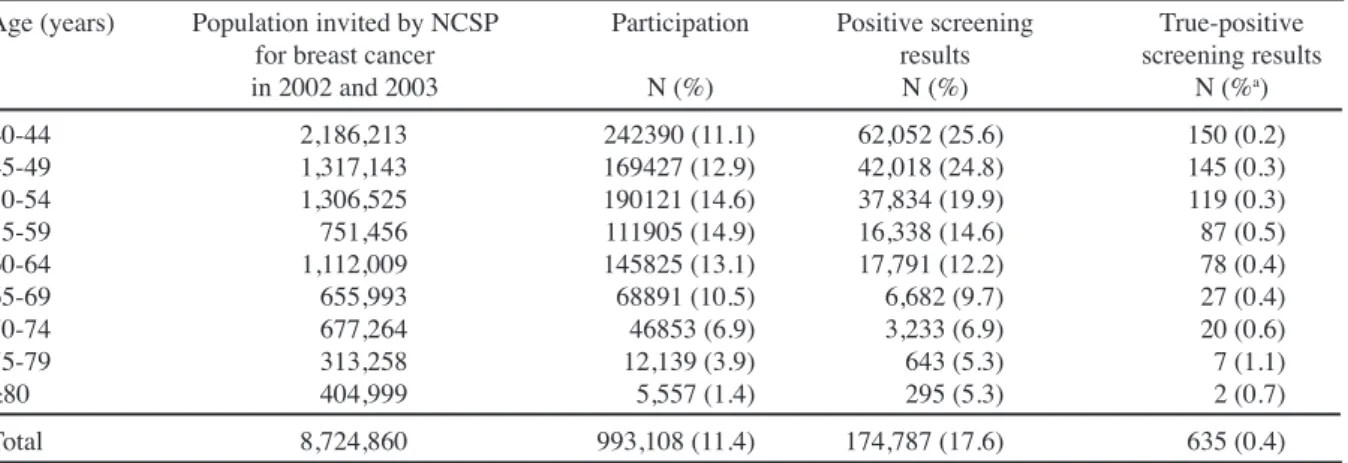
A total of 8,724,860 women aged 40 years or over were invited to attend breast cancer screening by the NCSP at baseline. Among them, 993,108 (11.38%) participated in screening at baseline (Table 2). Women
in their 50s showed the highest participation rate (over 14%), but after the age of 70 years, the participation rate fell below 10%.
Of those screened, 17.59% were referred to further testing due to positive screening results (‘breast cancer diagnosis’ or ‘breast cancer doubt’) (Table 2). Among screening participants in their 40s, about 25% had a positive screening result. The rate of positive screening results decreased with age in our study population. In the screening group, 635 women had a confirmed diagnosis of breast cancer, rendering a rate of true-positive results of 0.36% at baseline (Table 2).
The numbers of breast cancer cases identified during 5-year follow-up are reported in Table 3 for both the screened and non-screened groups. More women in the screened group were found to have breast cancer than in the non-screened group, but breast cancer incidence increased during 5-year follow-up for both groups (Table 3). In the first year of follow-up, 151 cases of breast
Table 1. Costs for the Screened Group Used in the Analysis of the National Cancer Screening Program
Cost type Amount (KW)
Direct screening cost (1) Cost of screening test
Full PACS & films (24,960 KWa) + Consultation (5,120 KWb) 30,080
(2) Costs of further testing due to false-positive screening result
Ultrasound/biopsy (262,000 KWb) + Mammotome 20%c (20%*1,150,000 KWb) +Consultation (16,880 KWb) + 511,704
specialty consultation fee 50% (50%*5,648 KWb,d)
Indirect screening cost
Transportation (one-way): 11,702e
Two-way travel cost: 11,702*2 23,404
Productivity cost
Attendee’s average productivity costs for half day
Equation: {(average daily wage * economic activity rate) + (wages for housework * non-economic activity rate)} * 1/2
Age 40-49 y: {80,911 KW*0.644 + 52,175 KW*1-0.644)}*1/2 35,341f
Age 50-59 y: {74,054 KW*0.541 + 47,017 KW*(1-0.541)}*1/2 30,827f
Age over 60 y: {60,811 KW*0.286 + 47,017 KW*(1-0.286)}*1/2 25,478f
*All unit costs were inflated to 2009 values; aSource: National Cancer Screening Program guidebook. 2002-2011. Division of Cancer Policy, Ministry of Health and Welfare; bSource: Data obtained from the Division of Medical Information and Technology, Yonsei University Health System, Seoul; cThe cost for mammotome was multiplied by 20% as it was assumed that about 20% of patients with false-positive screening results received retesting with mammotome. dThe cost for specialty consultation fee was multiplied by 50% for this analysis under the assumption that half of the participants with false-positive screening results received specialty consultation and the remaining half received retesting from a general physician. eSource: The Third Korea National Health and Nutrition Examination Survey (KNHANES Ⅲ), 2005. fSource: Statistics Korea, 2009-2011. Ministry of Employment and Labor, Employment Policy Office. Abbreviations: PACS, picture archiving communication system; y, years; KW, Korean Won
Table 2. Participation and Positive Screening Results, National Cancer Screening Program (NCSP) for
Breast Cancer in 2002-2003
Age (years) Population invited by NCSP Participation Positive screening True-positive
for breast cancer results screening results
in 2002 and 2003 N (%) N (%) N (%a) 40-44 2,186,213 242390 (11.1) 62,052 (25.6) 150 (0.2) 45-49 1,317,143 169427 (12.9) 42,018 (24.8) 145 (0.3) 50-54 1,306,525 190121 (14.6) 37,834 (19.9) 119 (0.3) 55-59 751,456 111905 (14.9) 16,338 (14.6) 87 (0.5) 60-64 1,112,009 145825 (13.1) 17,791 (12.2) 78 (0.4) 65-69 655,993 68891 (10.5) 6,682 (9.7) 27 (0.4) 70-74 677,264 46853 (6.9) 3,233 (6.9) 20 (0.6) 75-79 313,258 12,139 (3.9) 643 (5.3) 7 (1.1) ≥80 404,999 5,557 (1.4) 295 (5.3) 2 (0.7) Total 8,724,860 993,108 (11.4) 174,787 (17.6) 635 (0.4)
cancer were identified in the screened group, compared to 94 in the non-screened group (Table 3). The difference in cumulative incidence narrowed throughout follow-up, and by the 5th year, the age-adjusted breast cancer incidence rates were 0.46% and 0.45% for the screened and non-screened groups respectively (Table 3). On the other hand, the proportion of early-stage breast cancers diagnosed in 2002-2003 was larger in the screened group (40.0%) than the non-screened group (23.4%) (Table 4).
Cost-effectiveness analysis
Overall mortality due to breast cancer during 5-year follow-up was 1.77 times higher in the non-screened group than the screened group (39 vs. 22 per 100,000 women) (Table 4). Women in their 50s showed the highest mortality compared to other age groups in both the screened and non-screened groups. The incremental age-adjusted LYS for the screened group was 402 years, increasing by 1.41% compared to the non-screened group (Table 4).
COST I for breast cancer detection in the NCSP was 12,031,751 Korean Won (KW) (11,100 US Dollars, USD; exchange rate November 2012 1 USD=1,088 KW) (Table 5). Adding transportation cost to this (COST II) raised
the cost to 13,345,966 KW (12,300 USD). COST III also considered the productivity costs related to screening participation, and was 16,987,188 KW (15,600 USD), which was about 1.4 times higher than COST Ⅰ (Table 5).
To reduce the number of breast cancer mortalities over the 5-year follow-up by one, costs of between 707,453,000 KW and 998,827,000 KW (650,000 USD-918,000 USD) were required (Table 5) for the screened group compared to the non-screened group (Table 5). That is, to save one breast cancer patient among 100,000 women aged 40 years or over for 5 years, costs related to breast cancer screening was about 918,000 USD in South Korea. Regarding 5-year survival, women in their 60’s showed the highest cost-effectiveness (incremental cost-effectiveness ratio, ICER=844 million KW) in comparison with other age groups (Table 5). The ICER of 5-year survival with regard to COST Ⅲ was about 1.4 times higher than the ICER with Cost Ⅰ.
To increase LYS by one, the add cost (COST III) was as much as 42,305,000 KW (39,000 USD). The ICERs were similar across age groups (ICER: 32,532,000 KW-46,241,000 KW/LYS) except for the age group over 70 years, which showed an ICER of 109,077,000 KW, more than two-fold that of the other age groups (Table 5). The
Table 3. Cumulative Number of Breast Cancer Detection during 5-year Follow-up between Screened and Non-screened Groups (per 100,000 women)
Age 1st year 2nd year 3rd year 4th year 5th year
(years) Screened Non-Screened Screened Non-Screened Screened Non-Screened Screened Non-Screened Screened Non-Screened
N (%) N (%) N (%) N (%) N (%) N (%) N (%) N (%) N (%) N (%) 40-44 189 (0.2) 99 (0.1) 292 (0.3) 204 (0.2) 420 (0.4) 312 (0.3) 554 (0.6) 426 (0.4) 646 (0.7) 535 (0.5) 45-49 215 (0.2) 136 (0.1) 329 (0.3) 274 (0.3) 459 (0.5) 414 (0.4) 583 (0.6) 543 (0.5) 661 (0.7) 655 (0.7) 50-54 175 (0.2) 128 (0.1) 281 (0.3) 250 (0.3) 368 (0.4) 358 (0.4) 464 (0.5) 456 (0.5) 528 (0.5) 550 (0.6) 55-59 155 (0.2) 112 (0.1) 235 (0.2) 217 (0.2) 322 (0.3) 313 (0.3) 409 (0.4) 410 (0.4) 474 (0.5) 494 (0.5) 60-64 123 (0.1) 78 (0.1) 189 (0.2) 150 (0.2) 252 (0.3) 226 (0.2) 325 (0.3) 292 (0.3) 364 (0.4) 357 (0.4) 65-69 94 (0.1) 54 (0.1) 126 (0.1) 106 (0.1) 160 (0.2) 156 (0.2) 193 (0.2) 205 (0.2) 222 (0.2) 254 (0.3) 70-74 70 (0.1) 40 (0.04) 107 (0.1) 78 (0.1) 141 (0.1) 110 (0.1) 177 (0.2) 142 (0.1) 203 (0.2) 174 (0.2) 75-79 74 (0.1) 29 (0.03) 99 (0.1) 52 (0.1) 115 (0.1) 79 (0.1) 132 (0.1) 98 (0.1) 132 (0.1) 117 (0.1) ≥80 18 (0.02) 14 (0.01) 18 (0.02) 37 (0.04) 18 (0.02) 49 (0.1) 36 (0.04) 63 (0.1) 36 (0.04) 75 (0.1) Total 151 (0.2) 94 (0.09) 230 (0.2) 187 (0.2) 315 (0.3) 277 (0.3) 404 (0.4) 364 (0.4) 461 (0.5) 445 (0.5)
*The total frequency values were age-adjusted
Table 4. The Proportion of Early-stage Breast Cancer Detected in 2002-2003, 5-year Mortality and
Life-Years Saved (LYS) among the Screened and Non-screened Groups (per 100,000 women)
Age (years) Early-stage cancera 5-year mortalityb LYS differenceb
Screened Non-screened Screened Non-screened Screened - non-screened (%)
40-44 40.20% 25.40% 17 (0.02%) 28 (0.03%) 427 (1.04%) 45-49 39.30% 26.70% 26 (0.03%) 42 (0.04%) 525 (1.46%) 50-54 38.80% 23.00% 24 (0.02%) 45 (0.05%) 619 (1.94%) 55-59 36.30% 24.60% 31 (0.03%) 49 (0.05%) 414 (1.53%) 60-64 39.10% 23.20% 24 (0.02%) 42 (0.04%) 338 (1.47%) 65-69 33.80% 19.90% 13 (0.01%) 38 (0.04%) 375 (2.08%) 70-74 46.50% 21.40% 32 (0.03%) 33 (0.03%) 11 (0.08%) 75-79 58.30% 17.60% 8 (0.01%) 41 (0.04%) 254 (2.31%) ≥80 50.00% 15.90% 18 (0.02%) 38 (0.04%) 48 (0.60%) Totalc 40.00% 23.40% 22 (0.02%) 39 (0.04%) 402 (1.41%)
a% of early stage represents the proportion of in-situ and local stages over all breast cancer cases identified during the baseline years of 2002-2003; bOutcomes were observed for 5 years after baseline (2002-2003); cTotal values were age-adjusted; LYS, life-years saved
The National Cancer Screening Program for Breast Cancer in the Republic of Korea: Is it Cost-Effective?
age group 50-59 showed the lowest incremental costs per LYS, which was about 23% lower than the average (Table 5).
Sensitivity analyses
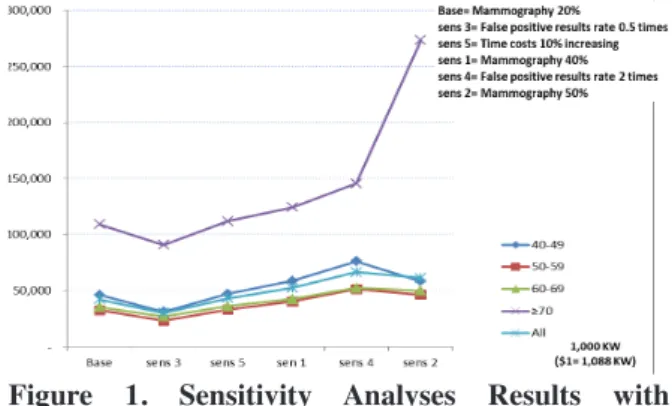
The results of sensitivity analyses in terms of ICERs regarding LYS during 5-year follow-up are shown in the Figure 1. Varying the rate of mammotome examination and false-positive screening results, produced different ICERs than the base model. When we assumed a false-positive rate that was two-fold the current one for mammography, the ICER (66.7 million KW/LYS) increased about by 36.6% compared to the ICER of the base model (Figure 1). As expected, the assumption of a lower false-positive rate lowered the ICER over the LYS (30.1 million KW/LYS) by 28.8% compared to the non-screened group. When the utilization of mammotome examination increased to two-fold and 2.5-fold respectively, the costs per LYS increased to 52.4 million KW (23.9%) and 61.3 million KW (44.9%), respectively (Figure 1).
When the ICER values were compared across age groups, 50-59 years was the most cost-effective age group in the base model, as well as in other sensitivity models. On the other hand, the age group over 70 years was the least cost-effective for NCSP for breast cancer in all sensitivity analyses (Figure 1).
When we considered upper age limit from 60 to no limit, as in the current program, the ICER ranged between 39.6 million KW and 42.3 million KW. Indeed, the NCSP for breast cancer showed the most cost-effectiveness when the upper age limit was set to age 70 years, with an ICER of 39.6 million KW/LYS, 0.9 times lower than the ICER of the current screening program .
Discussion
In this study, we used the databases of the NCSP and the KCCR to determine the incidence and outcomes of the NCSP for breast cancer. The ICER in Korean women aged 40 years or older, the target population of the NCSP for breast cancer, was found to be 42 million KW (USD 39,000) per LYS, which was a bit higher than the Gross Domestic Product (GDP) per capita in South Korea, which was approximately 27,168 USD in 2009 (The World Bank). However, in most developed countries where breast cancer screening programs exist, ICER estimates have been reported to be below the national GDP per capita. For example, the ICER of organized breast cancer screening in Switzerland, taking into account mammography and treatment costs, was 14,452 USD per LYS, which was 26% of the Swiss GDP per capita (de Gelder et al., 2009). In Norway and Finland, the screening and treatment costs per LYS of women were reported to be 10,747 USD and 18,955 USD respectively. In the United States, the additional cost to screen women aged 50-69 years was 37,000 USD per LYS, representing about 87% of their GDP per capita (Wong et al., 2010). In Japan, when consultation, treatment and terminal care cost were considered, the cost per LYS was 14,300 USD for mammography screening, which was 84% of the GDP per capita (Okubo et al., 1991). In contrast, the ICER estimates for screening Chinese women aged 40-69 years with mammogram, including productivity and treatment cost (ICER=64,400 USD/LYS) was 37 times higher than the GDP per capita (Wong et al., 2007).
The costs for an organized screening program are affected by participation rates, cancer detection rates and false-positive rates. The participation rate for breast cancer screening increased from 14.1% in 2002 to 34.9 % in 2008 in Korea (Oh et al., 2010), and the breast cancer incidence rate has also recently increased in Korea (Lee et al., 2009). As the participation and incidence rates of breast cancer in Korea continue to increase, so will the ICER of breast cancer screening.
Among the positive screening results, 635 actual cases of breast cancer were detected by the NCSP in 2002-2003, indicating a 0.36% true-positive rate and a high positive rate for these years. In Europe, false-positive mammography results are likely less common (Salz et al., 2011). False-positive screening results can negatively affect subsequent screening behavior, by deterring women from participating in screening, which could be a serious public health problem (Oh et al., 2011). Also, it has been reported that women who
Table 5. Incremental Cost-effectiveness Ratios (ICER) between the Screened and Non-screened Groups (per 100,000 women)
Age Cost 5-year ICERa LYS ICERb
group (1,000 KW) survival
All Cost I: 12,031,751 17 707,453 402 29,964 All Cost II: 13,345,966 17 784,727 402 33,237 All Cost III: 16,987,188 17 998,827 402 42,305
40-49 21,944,480 13 1,597,890 474 46,241
50-59 17,160,337 20 844,274 527 32,532
60-69 12,644,006 21 592,246 355 35,550
≥70 10,032,924 15 641,454 91 109,077
*The cost, 5-year survival, LYS and ICER values were all age-adjusted. All costs estimates were inflated to 2009 values. KW, Korean Won; LYS, life-years saved. a1,000 KW/survival, b1,000 KW/LYS
Figure 1. Sensitivity Analyses Results with Incremental Cost-effectiveness Ratios Regarding Life-years Saved in the Screened Group Compared to the Non-screened Group
previously experienced false-positive mammograms were more likely to report symptoms of anxiety and depression (Jatoi et al., 2006). Due to the high rates of false-positive screening results in Korea, many women needlessly received further testing, which led to more expensive costs. Cost-effectiveness was estimated from a government expenditure perspective in this study. If out-of-pocket costs for women with false-positive screening results were considered, the incremental costs per LYS for the screening group would be greater from a societal perspective.
The higher false-positive rate in this study might be caused by physicians who had lower mammography reading skills when the NCSP was expanded to cover the entire population in 2002-2003. Another possible reason could be the substantially higher breast density of Asian women than White women (El-Bastawissi et al., 2001). In a previous study, about 68.8% of Korean women in their 40s were found to have dense breasts (Jeon et al., 2011). Because dense breasts make mammograms more difficult to read, it might explain the higher false-positive rate in women aged 40-54 years in this study.
In the sensitivity analyses as well as the base analysis, women the age group of 70 or older showed the highest ICER compared to the other age groups, and this was most likely caused by the small sample size in this age group (participation rate: 4.63% in 2002-2003). One way toward a more cost-effective NCSP for breast cancer might be to restrict the target population by setting an upper age limit. According to our sensitivity analyses, setting an age limit of 70 would produce the most cost-effective outcomes, but beyond 70 years the ICER increases.
While women aged 40 years or over are the target population for the NCSP for breast cancer in Korea, Western countries, including the United States, Canada and the United Kingdom, recommend that women receive screening starting at age 50 years (Graham-Rowe, 2012). Extending the screening age to women under 40 would not improve the cost-effectiveness of the screening program, as younger women are more likely to have denser breasts, which would increase the risk of false-positive screening results (Graham-Rowe, 2012). However, considering that breast cancer has an earlier onset in Korean women, setting a lower age limit for breast cancer screening program might be a contradiction. Reducing false-positive screening results is the key for the NCSP to be cost-effective, and thus efforts to increase sensitivity, such as education for radiologists in reading mammograms, might be immediately needed.
While this research has examined the cost-effectiveness of breast cancer screening in Korea based on actual data rather than hypothetical estimates, there are several limitations in this study. First, while direct screening costs were identified in this study, medical costs for cancer treatment were not considered by cancer stage. Treatment costs for women with breast cancer
would have been the same in the screened and non-screened groups, but there were more early-stage cancers represented in screened group (Table 4). Therefore it is probable that the ICER including treatment costs would have been lower in the screening group.
Second, while the ICER estimates were standardized by age, other various characteristics associated with screening participation, such as area of residence area and education level, were not adjusted for in this group. Previous studies have shown that people with lower socioeconomic status were less likely to participate in screening programs (Song and Fletcher, 1998; Bobo et al., 2004; 2006). Thus, different health behaviors according to different socioeconomic backgrounds might be related to the health outcomes of screening program, and these effects could not be examined in this study.
Third, while quality-adjusted life years (QALYs) are usually considered as an integrated outcome measure, they were not considered in this study. Indeed, no study measuring QALY for Korean breast cancer patients has been found. Among previous studies conducted in other countries, only three used QALYs as an outcome measure for the cost-effectiveness of breast cancer screening (Stout et al., 2006; Schousboe et al., 2011; Wong et al., 2012). Indeed, the results obtained with LYS and QALYs were similar (Carles et al., 2011).
Finally, while our follow-up period was 5 years, a longer follow-up period might be needed to gain more stable and valid cost-effectiveness outcomes. For example, the cost-effectiveness of mammography screening for women aged 50-79 years in the United States was dominated when the observational period was 3 years (Wong et al., 2010). In contrast, it turned out to produce ICER of 34,000 USD/QALY when the observation period was lengthened to 11 years (Stout et al., 2006).
In conclusion, this study examined the cost-effectiveness of the NCSP for breast cancer in 2002- 2003 and showed an ICER per LYS of 42 million KW. This cost could be thought of as within the affordable range. However the high number of false-positive screening results might lead to an argument in the discussion about resource allocation for cancer in Korea. The present study serves as an important basis for interventions to improve the cost-effectiveness of breast cancer screening in Korea.
Acknowledgement
This study was supported by a grant from the National R&D Program for Cancer Control, Ministry of Health and Welfare, Republic of Korea (Grant Number: 1120410).
References
Bobo JK, Shapiro JA, Brustrom J (2006). Efforts to locate low-income women for a study on mammography
The National Cancer Screening Program for Breast Cancer in the Republic of Korea: Is it Cost-Effective?
rescreening: implications for public health practice.
Journal of Community Health, 31, 249-61.
Bobo JK, Shapiro JA, Schulman J, et al(2004). On-schedule mammography rescreening in the national breast and cervical cancer early detection program. Cancer
Epidemiology Biomarkers & Prevention, 13, 620-30.
Canadian Task Force on Preventive Health Care (2011). Screening for Breast Cancer. Summary of recommendations for clinicians and policy-makers. Available from: http:// canadiantaskforce.ca/guidelines/2011-breast-cancer/. Carles M, Vilaprinyo E, Cots F, et al (2011). Cost-effectiveness
of early detection of breast cancer in Catalonia (Spain).
BMC Cancer, 11, 192.
de Gelder R, Bulliard JL, de Wolf C, et al (2009). Cost-effectiveness of opportunistic versus organised mammography screening in Switzerland. Eur J Cancer,
45, 127-38.
El-Bastawissi AY, White E, Mandelson MT, et al(2001). Variation in mammographic breast density by race.
Annals of epidemiology, 11, 257-63.
Graham-Rowe D (2012). Risk analysis: A dense issue. Nature,
485, S60-S1.
Gram I, Lund E, Slenker S (1990). Quality of life following a false positive mammogram. British journal of cancer,
62, 1018.
Han MA, Jun JK, Choi KS, et al (2012). Satisfaction in the National Cancer Screening Program for breast cancer with and without clinical breast examination. Asian Pac
J Cancer Prev, 13, 63-7.
Jatoi I, Zhu K, Shah M, et al(2006). Psychological distress in US women who have experienced false-positive mammograms. Breast cancer research and treatment,
100, 191-200.
Jeon J-H, Kang J-H, Kim Y, et al (2011). Reproductive and Hormonal Factors Associated with Fatty or Dense Breast Patterns among Korean Women. Cancer Res Treat, 43, 42-8.
Jung KW, Shin HR, Kong HJ, et al (2010). Long-term trends in cancer mortality in Korea (1983-2007): a joinpoint regression analysis. Asian Pac J Cancer Prev, 11, 1451-7. Lee EH, Lee HY, Choi KS, et al (2011). Trends in Cancer
Screening Rates among Korean Men and Women: Results from the Korean National Cancer Screening Survey (KNCSS), 2004-2010. Cancer Res Treat, 43, 141-7. Lee SY, Jeong SH, Kim YN, et al (2009). Cost-effective
mammography screening in Korea: high incidence of breast cancer in young women. Cancer Sci, 100, 1105-11. Ministry of Helalth & Welfare (2002). National Cancer
Screening Program. Available from: http://www. mw.go.kr/front_policy/jc/sjc0104mn.jsp?PAR_MENU_ ID=06&MENU_ID=060406.
Ministry of Helalth & Welfare, National Cancer Center (2011). <Cancer Facts & Figures 2011.pdf>. Available from: http://www.cancer.go.kr/ncic/cics_g/cics_g02/cics_ g027/__icsFiles/afieldfile/2011/04/08/cancerfacts2011. pdf.
National Cancer Center (2009). Cancer Prevention and Screening. Available from: http://www.ncc.go.jp/en/ index.html.
National Cancer Screening Committe (2010). Breast Cancer Screening. Available from: http://www.nhs. uk/Conditions/Cancer-of-the-breast-female/Pages/ Screeningbreastcancer(female).aspx.
Oh D, Jung DW, Jun JK, et al (2011). On-schedule mammography rescreening in the National Cancer
Screening Program for breast cancer in Korea. Asian Pac
J Cancer Prev, 12, 2865-70.
Oh DK, Shim JI, Han M, et al (2010). Breast Cancer Screening in Korean Women: Report of the National Cancer Screening Program in 2008. J Breast Cancer AID - 10.4048/jbc.2010.13.3.299 [doi], 13, 299-304.
Okubo I, Glick H, Frumkin H, et al (1991). Cost-effectiveness analysis of mass screening for breast cancer in Japan.
Cancer, 67, 2021-9.
Park B, Choi KS, Lee YY, et al (2012a). Cancer screening status in Korea, 2011: results from the korean national cancer screening survey. Asian Pac J Cancer Prev, 13, 1187-91.
Park B, Choi KS, Lee YY, et al (2012b). Trends in Cancer Screening Rates among Korean Men and Women: Results from the Korean National Cancer Screening Survey (KNCSS), 2004-2011. Cancer Res Treat, 44, 113-20. Park MJ, Park EC, Choi KS, et al (2011). Sociodemographic
gradients in breast and cervical cancer screening in Korea: the Korean National Cancer Screening Survey (KNCSS) 2005-2009. BMC Cancer, 11, 257.
Park SK, Kang D, Kim Y, et al(2009). Epidemiologic characteristics of the breast cancer in Korea. Journal of
the Korean Medical Association, 52, 937-45.
Salz T, DeFrank JT, Brewer NT (2011). False positive mammograms in Europe: do they affect reattendance?
Breast cancer research and treatment, 127, 229-31.
Schousboe JT, Kerlikowske K, Loh A, et al (2011). Personalizing mammography by breast density and other risk factors for breast cancer: analysis of health benefits and cost-effectiveness. Ann Intern Med, 155, 10-20. Song L, Fletcher R (1998). Breast cancer rescreening in
low-income women. American journal of preventive medicine,
15, 128-33.
Stout NK, Rosenberg MA, Trentham-Dietz A, et al (2006). Retrospective cost-effectiveness analysis of screening mammography. J Natl Cancer Inst, 98, 774-82.
U.S. Preventive Service Task Force (2009). Recommendations on breast cancer screening. Available from: http://www. uspreventiveservicestaskforce.org/uspstf/uspsbrca.htm Wong IO, Kuntz KM, Cowling BJ, et al (2007). Cost
effectiveness of mammography screening for Chinese women. Cancer, 110, 885-95.
Wong IO, Kuntz KM, Cowling BJ, et al (2010). Cost-effectiveness analysis of mammography screening in Hong Kong Chinese using state-transition Markov modelling. Hong Kong Med J, 16 Suppl 3, 38-41.
Wong IO, Tsang JW, Cowling BJ, et al(2012). Optimizing resource allocation for breast cancer prevention and care among Hong Kong Chinese women. Cancer.