C A S E R E P O R T
Open Access
Successful antibiotic treatment of
pulmonary disease caused by
Mycobacterium abscessus subsp. abscessus
with C-to-T mutation at position 19 in
erm(41) gene: case report
Su-Young Kim
1†, Sung Jae Shin
2†, Byeong-Ho Jeong
1and Won-Jung Koh
1*Abstract
Background:
Mycobacterium abscessus complex (MABC) is the most drug resistant of the mycobacterial pathogens.
M. abscessus subsp. abscessus encodes a functional erythromycin ribosomal methylase gene, erm(41), causing inducible
macrolide resistance. However, some clinical isolates of
M. abscessus subsp. abscessus harboring nonfunctional erm(41)
were susceptible to macrolide, even after extended incubation of 14 days. Loss of function of the
erm(41) genes was
associated with a T-to-C substitution at position 28 of the gene (T28C), leading to an amino acid change from Trp to
Arg at codon 10. Pulmonary disease caused by
M. abscessus subsp. abscessus strains with an nonfunctional erm(41)
(C28 sequevar) may be responsive to macrolide-containing antibiotic regimens. Therefore, all
M. abscessus subsp.
abscessus strains with a functional erm(41) (T28 sequevar) were thought to be resistant to macrolide with extended
incubation. Here, we report the first case of pulmonary disease caused by a strain of
M. abscessus subsp. abscessus
which was susceptible to macrolide due to T19 sequevar of
erm(41) gene.
Case presentation: A 62-year-old Korean female was referred to our hospital due to chronic cough, sputum,
and hemoptysis lasting more than 5 months. The patient
’s sputum was positive for acid-fast bacilli staining and
nontuberculous mycobacteria (NTM) were isolated twice from sputum specimens. The isolate was identified as
M. abscessus subsp. abscessus. The isolate had a point mutation of C → T at position 19 (C19 → T) in the erm(41)
gene, instead of expected C28 sequevar of
erm(41), and had no rrl mutation. The isolate displayed a clarithromycin
susceptible phenotype with an Arg
→ Stop codon change in erm(41). The patient was successfully treated with a
macrolide-containing regimen.
Conclusion: This is the first case of pulmonary disease caused by a strain of
M. abscessus subsp. abscessus showing
clarithromycin susceptible phenotype due to T19 sequevar of the
erm(41) gene. The erm(41) gene is clinically important,
and non-functional
erm alleles may be an important issue for the management of MABC lung disease. The presence of
a non-functional
erm(41) allele in M. abscessus subsp. abscessus isolates may be associated with better outcomes.
Keywords: Nontuberculous mycobacteria,
Mycobacterium abscessus, Lung diseases, Clarithromycin, Drug resistance
* Correspondence:[email protected]
†Equal contributors
1Division of Pulmonary and Critical Care Medicine, Department of Medicine,
Samsung Medical Center, Sungkyunkwan University School of Medicine, Irwon-ro 81, Gangnam-gu, Seoul 06351, South Korea
Full list of author information is available at the end of the article
© 2016 Kim et al. Open Access This article is distributed under the terms of the Creative Commons Attribution 4.0 International License (http://creativecommons.org/licenses/by/4.0/), which permits unrestricted use, distribution, and reproduction in any medium, provided you give appropriate credit to the original author(s) and the source, provide a link to the Creative Commons license, and indicate if changes were made. The Creative Commons Public Domain Dedication waiver (http://creativecommons.org/publicdomain/zero/1.0/) applies to the data made available in this article, unless otherwise stated.
Background
The prevalence of lung diseases caused by nontuberculous
mycobacteria (NTM) is increasing worldwide [1, 2].
Myco-bacterium abscessus complex (MABC) is a rapidly
grow-ing mycobacterium and is the second most common
cause of NTM lung disease after M. avium complex in
many countries [3–5]. In addition, MABC has emerged as
an important pathogen in patients with cystic fibrosis and
chronic lung diseases, such as bronchiectasis [6–10].
MABC is the most drug resistant of mycobacterial
pathogens, resulting in limited therapeutic options and a
high treatment failure rate [11–14]. MABC is comprised
of three closely related subspecies: M. abscessus subsp.
abscessus, M. abscessus subsp. massiliense and M.
abscessus subsp. bolletii [15, 16]. M. abscessus subsp.
abscessus encodes a functional erythromycin ribosomal
methylase gene, erm(41), which modifies the binding site
for macrolide antibiotics, causing inducible macrolide
resistance [17–19]. However, some clinical isolates of M.
abscessus subsp. abscessus were susceptible to macrolide
antibiotics, even after extended incubation of 14 days [20].
Loss of function of erm(41) genes was associated with a
T-to-C substitution at position 28 of the gene (T28C),
lead-ing to an amino acid change from Trp to Arg at codon 10
[17, 18]. Pulmonary disease caused by these strains with
M. abscessus subsp. abscessus with C28 sequevar may be
responsive to macrolide-containing antibiotic regimens
[20]. Conversely, all M. abscessus subsp. abscessus strains
with a T28 sequevar were thought to be resistant to
clari-thromycin with extended incubation [18].
Although there were multiple polymorphisms
asso-ciated with amino acid changes, only this T28C
substi-tution resulted in loss of erm(41) gene function and
no other nucleotide substitution was known to be
associated with macrolide susceptibility [20]. We
re-port the first case of pulmonary disease caused by a
strain of M. abscessus subsp. abscessus that was
sus-ceptible to clarithromycin due to a T19 sequevar of
the erm(41) gene. The patient was treated successfully
with macrolide-containing antibiotics. This study was
approved by the institutional review board of the
Sam-sung Medical Center.
Case presentation
A 62-year-old Korean female was referred to our
hos-pital due to chronic cough, sputum, and hemoptysis
last-ing more than 5 months. She was a non-smoker and had
no history of previous treatment for pulmonary
tubercu-losis. The patient was 149.7 cm tall and weighed 40.7 kg.
The erythrocyte sedimentation rate was 77 mm/h, and
C-reactive protein was 2.37 mg/dL. A human
immuno-deficiency virus antibody test was negative. A chest
com-puted tomography (CT) scan revealed bronchiectasis
and bronchiolitis in both lungs, suggesting the nodular
bronchiectatic form of NTM lung disease (Fig. 1a).
The patient’s sputum was positive for acid-fast bacilli
staining and NTM were isolated twice from sputum
specimens in both solid (3 % Ogawa solid media;
Shinyang, Seoul, South Korea) and liquid culture system
(Bactec MGIT 960 system; BD Diagnostics, Sparks, MD,
USA). To identify an etiological agent, bacteria grown in
the MGIT 960 culture system were initially propagated
in 7H9 broth (Difco Laboratories, Detroit, MI, USA)
supplemented with 10 % (vol/vol) oleic
acid-albumin-dextrose-catalase (OADC; BD Diagnostics) for 7 days at
37 °C. They were then sub-cultured in egg-based 3 %
Ogawa solid media (Shinyang, Seoul, South Korea), and
genomic DNA was extracted from cultured bacteria. M.
abscessus was the initial species identified using a reverse
line blot hybridization assay (REBA Myco-ID; M&D,
Inc., Wonju, South Korea) based on the rpoB gene [21].
To confirm the accuracy of this identification, sequencing
analyses of rpoB, hsp65, and 16S rRNA were performed
using GenBank (http://blast.ncbi.nlm.nih.gov/) with the
BLAST algorithm [22–24]. The 16S rRNA sequences were
100 % identical to M. abscessus subsp. abscessus (GenBank
accession no. NR074427), M. abscessus subsp. massiliense
(GenBank accession no. NR074421), M. chelonae (GenBank
accession no. AY457082), and M. abscessus subsp. bolletii
(GenBank accession no. NR043236). The rpoB sequences
showed 99.7 % similarity to those of the M. abscessus subsp.
abscessus type strain, with only a 2-base mismatch
(Gen-Bank accession no. CU458896). The hsp65 sequences were
100 % identical to those of the M. abscessus subsp.
absces-sus type strain (GenBank accession no. CU458896). The
isolate was identified as M. abscessus subsp. abscessus by
se-quencing based method.
Drug susceptibility testing was performed using a
broth microdilution method and M. peregrinum ATCC
700686 was used for quality control according to the
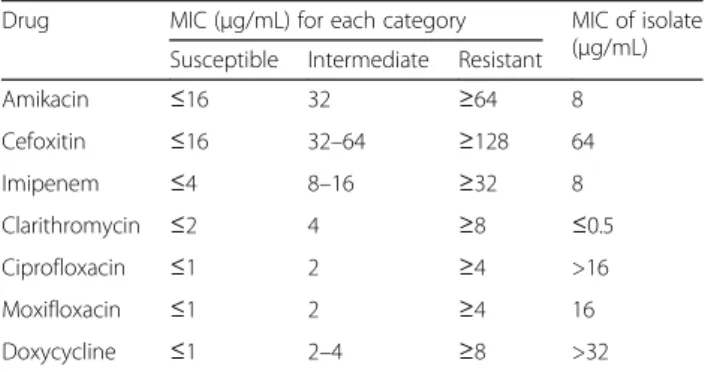
guidelines [25], revealing that the isolate was susceptible
to clarithromycin (minimum inhibitory concentration
[MIC],
≤0.5 μg/mL), even after extended incubation for
14 days (Table 1). The isolate was genotyped for erm(41)
polymorphism and for rrl mutation, which are known as
the main mechanisms of macrolide resistance [26]. The
isolate had a point mutation of C
→ T at position 19
(C19
→ T) in the erm(41) gene, instead of the expected
C28 sequevar of erm(41). It also had no rrl mutation. To
the best of our knowledge, the C19
→ T mutation of
erm(41) in M. abscessus subsp. abscessus is the first
description.
The patient received oral clarithromycin (1,000 mg/d)
with an initial 4-week hospitalization for intravenous
amikacin and cefoxitin [27, 28]. At day 20 of treatment,
clarithromycin was switched to azithromycin (250 mg/d)
due to gastrointestinal disturbance. After discharge, the
patient received oral azithromycin for a total duration of
15 months. Her sputum cultures converted to and
remained negative after 2 months of antibiotic
treat-ment. Chest CT at 12 months of treatment revealed
im-provement in consolidations and bronchiolitis (Fig. 1b).
Discussion
It is important to distinguish the three subspecies of
MABC because of their differences in susceptibility to
clarithromycin [29–32]. M. abscessus subsp. abscessus,
M. abscessus subsp. massiliense, and M. abscessus subsp.
bolletii are commonly inducible resistant, susceptible,
and resistant to clarithromycin, respectively [15].
This is the first case of pulmonary disease caused by a
strain of M. abscessus subsp. abscessus showing a
clari-thromycin susceptible phenotype due to the T19
seque-var of erm(41) gene. According to a previously reported
paper by Nash et al., M. abscessus subsp. abscessus
strains with T28
→ C had no inducible resistance to
clar-ithromycin and had low MIC. In the present study, the
M. abscessus subsp. abscessus clinical isolate had a
C-to-T mutation at position 19 (C19
→ T) leading to an
Arg
→ Stop codon change at codon 7 of the erm(41)
gene. This strain was named SMC-Mabs-T19. The
SMC-Mabs-T19 strain revealed low MIC, similar to the
M. abscessus subsp. abscessus strain with a C28
seque-var. Therefore, maintenance of low clarithromycin MIC
against the SMC-Mabs-T19 strain might have been a
result of the production of non-functional Erm(41). The
entire erm(41) sequence of the susceptible isolate
SMC-Mabs-C19 was unique and differed from that of M.
abscessus subsp. abscessus type strain (GenBank
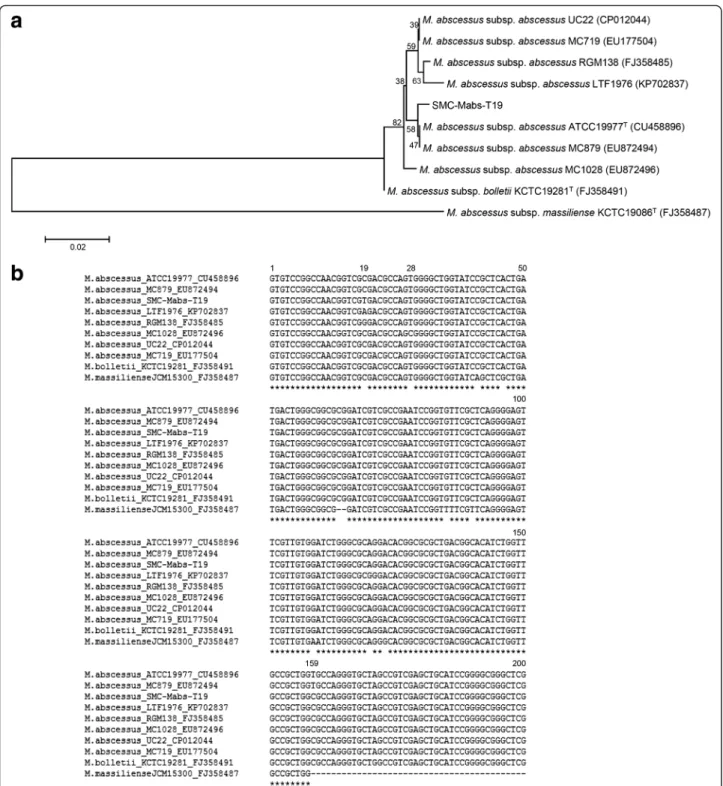
acces-sion no. CU458896) by only two bases: a C-to-T
muta-tion at posimuta-tion 19 (C19
→ T), and a T-to-C mutation at
position 159 (T159
→ C) (Fig. 2a and b). Of these
differ-ences, T159
→ C was also present in the inducible
resistant strains MC719 and UC22 (GenBank accession
nos. EU177504 and CP012044, respectively). Therefore,
the T19 sequevar was the most likely explanation for
the lack of function of erm(41) alleles from the
SMC-Mabs-T19 strain. Until now, erm(41) with a T19
seque-var has not been reported in GenBank. However, we
found only two M. abscessus subsp. abscessus clinical
isolates harboring erm(41) with C19
→ G or A point
mutations, and more information regarding drug
sus-ceptibility was not available (GenBank accession nos.
FJ358485 and KP702837, respectively; Fig. 2b).
Conclusions
The erm(41) gene is clinically important, and
non-functional erm alleles may be an important issue for
management of MABC lung disease. The presence of
a non-functional erm(41) allele in M. abscessus
subsp. abscessus isolates may be associated with
bet-ter outcomes.
Ethics and consent to participate
This study protocol was approved by the institutional
review board of the Samsung Medical Center (IRB
ap-proval 2008-09-016).
Fig. 1 A 62-year-old female with bronchiectasis and nontuberculous mycobacterial lung disease caused byMycobacterium abscessus subsp. abscessus. a Transverse chest computed tomography scan (2.5-mm-section thickness) at the start treatment revealed bilateral bronchiectasis and consolidations (white arrows) in the right middle lobe and lingular division of the left upper lobe as well as multiple tree-in-bud appearances (black arrow), suggesting bronchiolitis. b Transverse chest computed tomography scan (2.5-mm-section thickness) at 12 months of antibiotic treatment revealed decreased consolidation around the bronchiectasis (white arrows) and decreased bronchiolitis (black arrow)
Table 1 Drug susceptibility testing results for antimicrobial
agents against the isolate
Drug MIC (μg/mL) for each category MIC of isolate (μg/mL) Susceptible Intermediate Resistant
Amikacin ≤16 32 ≥64 8 Cefoxitin ≤16 32–64 ≥128 64 Imipenem ≤4 8–16 ≥32 8 Clarithromycin ≤2 4 ≥8 ≤0.5 Ciprofloxacin ≤1 2 ≥4 >16 Moxifloxacin ≤1 2 ≥4 16 Doxycycline ≤1 2–4 ≥8 >32
Fig. 2 Analysis of DNA sequences in theerm(41) of Mycobacterium abscessus subsp. abscessus clinical isolate SMC-Mabs-T19. a Phylogenetic position of isolate SMC-Mabs-T19 and other strains belonging toM. abscessus complex based on entire erm(41) gene sequences. This tree was constructed using the neighbor-joining method. Percentages indicated at nodes represent the bootstrap levels supported by 1,000 re-sampled datasets. Scale bars indicate evolutionary distance in base substitutions per site. b Sequence alignment oferm(41) from SMC-Mabs-T19 and other strains belonging to the M. abscessus complex. Base numbering is from the first base oferm(41). Identical nucleotides are indicated by an asterisk below sequences. Two deletion sites of M. abscessus subsp. massiliense are indicated by dashes
Consent to publish
Written informed consent was obtained from the patient
for publication of this Case report and any
accompany-ing images. A copy of the written consent is available for
review by the Editor of this journal.
Availability of data and materials
All the data supporting the findings is contained within
the manuscript.
Abbreviations
CT:computed tomography;erm(41): erythromycin ribosomal methylase gene; MABC:Mycobacterium abscessus complex; NTM: nontuberculous mycobacteria. Competing interests
The authors declare that they have no competing interests. Authors’ contributions
WJK designed the study. SYK and BHJ drafted the manuscript. WJK contributed to the diagnosis and treatment. SYK carried out microbiological analysis. SJS reviewed and edited the manuscript. WJK reviewed and supervised the manuscript. All the authors approved the final version of the manuscript. Funding
This research was supported by the Basic Science Research Program through the National Research Foundation of Korea (NRF) funded by the Ministry of Science, ICT and future Planning (NRF-2015R1A2A1A01003959) and by a grant of the Korea Health technology R&D Project through the Korea Health Industry Development Institute (KHIDI), funded by the Ministry of Health & Welfare, Republic of Korea (HI15C2778). The funders had no role in the design of the study, the collection and analysis of the data, or the preparation of the manuscript.
Author details
1Division of Pulmonary and Critical Care Medicine, Department of Medicine,
Samsung Medical Center, Sungkyunkwan University School of Medicine, Irwon-ro 81, Gangnam-gu, Seoul 06351, South Korea.2Department of
Microbiology, Yonsei University College of Medicine, Seoul, South Korea.
Received: 20 October 2015 Accepted: 10 May 2016 References
1. Kendall BA, Winthrop KL. Update on the epidemiology of pulmonary nontuberculous mycobacterial infections. Semin Respir Crit Care Med. 2013;34:87–94.
2. Prevots DR, Marras TK. Epidemiology of human pulmonary infection with nontuberculous mycobacteria: a review. Clin Chest Med. 2015;36:13–34. 3. Prevots DR, Shaw PA, Strickland D, Jackson LA, Raebel MA, Blosky MA, et al.
Nontuberculous mycobacterial lung disease prevalence at four integrated health care delivery systems. Am J Respir Crit Care Med. 2010;182:970–6. 4. Hoefsloot W, van Ingen J, Andrejak C, Angeby K, Bauriaud R, Bemer P, et al. The
geographic diversity of nontuberculous mycobacteria isolated from pulmonary samples: an NTM-NET collaborative study. Eur Respir J. 2013;42:1604–13. 5. Koh WJ, Chang B, Jeong BH, Jeon K, Kim SY, Lee NY, et al. Increasing
recovery of nontuberculous mycobacteria from respiratory specimens over a 10-year period in a tertiary referral hospital in South Korea. Tuberc Respir Dis (Seoul). 2013;75:199–204.
6. Leung JM, Olivier KN. Nontuberculous mycobacteria in patients with cystic fibrosis. Semin Respir Crit Care Med. 2013;34:124–34.
7. Leung JM, Olivier KN. Nontuberculous mycobacteria: the changing epidemiology and treatment challenges in cystic fibrosis. Curr Opin Pulm Med. 2013;19:662–9. 8. Martiniano SL, Sontag MK, Daley CL, Nick JA, Sagel SD. Clinical significance of a first positive nontuberculous mycobacteria culture in cystic fibrosis. Ann Am Thorac Soc. 2014;11:36–44.
9. Adjemian J, Olivier KN, Prevots DR. Nontuberculous mycobacteria among patients with cystic fibrosis in the United States: screening practices and environmental risk. Am J Respir Crit Care Med. 2014;190:581–6.
10. Koh WJ, Stout JE, Yew WW. Advances in the management of pulmonary disease due toMycobacterium abscessus complex. Int J Tuberc Lung Dis. 2014;18:1141–8.
11. Kasperbauer SH, De Groote MA. The treatment of rapidly growing mycobacterial infections. Clin Chest Med. 2015;36:67–78.
12. Kang YA, Koh WJ. Antibiotic treatment for nontuberculous mycobacterial lung disease. Expert Rev Respir Med. 2016;10:557–68.
13. Stout JE, Koh WJ, Yew WW. Update on pulmonary disease due to non-tuberculous mycobacteria. Int J Infect Dis. 2016;45:123–34.
14. Ryu YJ, Koh WJ, Daley CL. Diagnosis and treatment of nontuberculous mycobacterial lung disease: clinicians’ perspectives. Tuberc Respir Dis (Seoul). 2016;79:74–84.
15. Griffith DE, Brown-Elliott BA, Benwill JL, Wallace Jr RJ.Mycobacterium abscessus. “pleased to meet you, hope you guess my name…”. Ann Am Thorac Soc. 2015;12:436–9.
16. Lee MR, Sheng WH, Hung CC, Yu CJ, Lee LN, Hsueh PR.Mycobacterium abscessus complex infections in humans. Emerg Infect Dis. 2015;21: 1638–46.
17. Nash KA, Brown-Elliott BA, Wallace Jr RJ. A novel gene,erm(41), confers inducible macrolide resistance to clinical isolates ofMycobacterium abscessus but is absent from Mycobacterium chelonae. Antimicrob Agents Chemother. 2009;53:1367–76.
18. Bastian S, Veziris N, Roux AL, Brossier F, Gaillard JL, Jarlier V, et al. Assessment of clarithromycin susceptibility in strains belonging to theMycobacterium abscessus group by erm(41) and rrl sequencing. Antimicrob Agents Chemother. 2011;55:775–81.
19. Choi GE, Shin SJ, Won CJ, Min KN, Oh T, Hahn MY, et al. Macrolide treatment forMycobacterium abscessus and Mycobacterium massiliense infection and inducible resistance. Am J Respir Crit Care Med. 2012;186:917–25. 20. Brown-Elliott BA, Vasireddy S, Vasireddy R, Iakhiaeva E, Howard ST, Nash K,
et al. Utility of sequencing theerm(41) gene in isolates of Mycobacterium abscessus subsp. abscessus with low and intermediate clarithromycin MICs. J Clin Microbiol. 2015;53:1211–5.
21. Wang HY, Bang H, Kim S, Koh WJ, Lee H. Identification ofMycobacterium species in direct respiratory specimens using reverse blot hybridisation assay. Int J Tuberc Lung Dis. 2014;18:1114–20.
22. Adekambi T, Colson P, Drancourt M.rpoB-based identification of nonpigmented and late-pigmenting rapidly growing mycobacteria. J Clin Microbiol. 2003;41:5699–708.
23. Kim H, Kim SH, Shim TS, Kim MN, Bai GH, Park YG, et al. Differentiation of Mycobacterium species by analysis of the heat-shock protein 65 gene (hsp65). Int J Syst Evol Microbiol. 2005;55:1649–56.
24. Turenne CY, Tschetter L, Wolfe J, Kabani A. Necessity of quality-controlled 16S rRNA gene sequence databases: identifying nontuberculousMycobacterium species. J Clin Microbiol. 2001;39:3637–48.
25. CLSI. Susceptibility testing of mycobacteria, nocardiae, and other aerobic actinomycetes; approved standard-second edition, Document no. M24-A2. Wayne: CLSI; 2011.
26. van Ingen J, Boeree MJ, van Soolingen D, Mouton JW. Resistance mechanisms and drug susceptibility testing of nontuberculous mycobacteria. Drug Resist Updat. 2012;15:149–61.
27. Jeon K, Kwon OJ, Lee NY, Kim BJ, Kook YH, Lee SH, et al. Antibiotic treatment ofMycobacterium abscessus lung disease: a retrospective analysis of 65 patients. Am J Respir Crit Care Med. 2009;180:896–902.
28. Koh WJ, Jeon K, Lee NY, Kim BJ, Kook YH, Lee SH, et al. Clinical significance of differentiation ofMycobacterium massiliense from Mycobacterium abscessus. Am J Respir Crit Care Med. 2011;183:405–10.
29. Kim HY, Kook Y, Yun YJ, Park CG, Lee NY, Shim TS, et al. Proportions of Mycobacterium massiliense and Mycobacterium bolletii strains among Korean Mycobacterium chelonae-Mycobacterium abscessus group isolates. J Clin Microbiol. 2008;46:3384–90.
30. Lee SH, Yoo HK, Kim SH, Koh WJ, Kim CK, Park YK, et al. The drug resistance profile ofMycobacterium abscessus group strains from Korea. Ann Lab Med. 2014;34:31–7.
31. Nie W, Duan H, Huang H, Lu Y, Bi D, Chu N. Species identification of Mycobacterium abscessus subsp. abscessus and Mycobacterium abscessus subsp.bolletii using rpoB and hsp65, and susceptibility testing to eight antibiotics. Int J Infect Dis. 2014;25:170–4.
32. Kim SY, Kim CK, Bae IK, Jeong SH, Yim JJ, Jung JY, et al. The drug susceptibility profile and inducible resistance to macrolides ofMycobacterium abscessus and Mycobacterium massiliense in Korea. Diagn Microbiol Infect Dis. 2015;81:107–11.