High-dose Resveratrol Inhibits Insulin Signaling Pathway in
3T3-L1 Adipocytes
Haemi Lee1,3 and Jae-woo Kim1,2,3,4,* 1
Department of Biochemistry and Molecular Biology, Institute of Genetic Science, 2Integrated Genome Research Center for Metabolic Regulation, Yonsei University College of Medicine, 3Brain Korea 21 Project for Medical Science, 4Department of Biomedical Science, WCU Program of Graduate School, Yonsei University, Seoul, Korea
Background: Insulin resistance is a major factor in the development of metabolic syndrome and is associated with central obesity and glucose intolerance. Resveratrol, a polyphenol found in fruits, has been shown to improve metabolic conditions. Although it has been widely studied how resveratrol affects metabolism, little is known about how resveratrol regulates lipogenesis with insulin signaling in 3T3-L1 adipocytes.
Methods: We treated differentiated 3T3-L1 adipocytes with resveratrol to observe whether resveratrol is effective at reducing lipid accumulation.
Results: Resveratrol treatment after mitotic clonal expansion resulted in decreased lipid accumulation accompanied by reduced fatty acid synthase expression. Decreased glucose uptake was observed with inhibited GLUT4 translocation in cells treated with 100 μM resveratrol, suggesting that high doses of resveratrol block insulin signaling in adipocytes. Insulin-stimulated Akt phosphorylation is also dose-dependently reduced with resveratrol treatment. Interestingly, Akt phosphorylation is upregulated when cells are treated with long-term low doses of resveratrol, suggesting that only low doses of resveratrol improve metabolic conditions.
Conclusion: High doses of resveratrol block the insulin signaling pathway, thereby reducing glucose uptake and lipid accumulation in vitro. The results also provide information about in vivo administration dosages and may explain the discrepancy between in vitro and in vivo effects of resveratrol.
Key Words: Resveratrol, Adipocyte, Insulin signaling pathway, Glucose uptake, Lipid accumulation
Received: January 4, 2013, Accepted: February 11, 2013 *Corresponding author: Jae-woo Kim
Department of Biochemistry and Molecular Biology, Yonsei University College of Medicine, 50 Yonsei-ro, Seodaemun-gu, Seoul 120-752, Republic of Korea
Tel: 82-2-2228-1685, Fax: 82-2-312-5041 E-mail: [email protected]
Original Article
Vol. 3, No. 1, 41-47INTRODUCTION
Obesity is a serious health problem associated with in-creasing risk of various diseases including type 2 diabetes, hypertension, and coronary heart disease [1]. The imbalance between energy intake and expenditure results in increased size and number of adipocytes, which is believed to
contrib-ute to various metabolic abnormalities [2]. Thus, it is im-portant to understand the mechanism of adipocyte differ-entiation and lipid accumulation, as well as changes in in-sulin-responsiveness as obesity progresses.
The murine 3T3-L1 cell line is an established insulin- responsive adipocyte model for studying adipogenesis [2,3]. When 3T3-L1 preadipocytes are treated with hormonal stimuli, they undergo differentiation to acquire the mature phenotype of adipocytes [4]. During adipocyte differentiation, transcriptional factors such as CCAAT/enhancer-binding proteins (C/EBPs) and peroxisome proliferator-activated re-ceptor γ (PPARγ) are involved in the sequential expression
of adipocyte-specific proteins such as glucose transporter 4 (GLUT4), aP2/422, stearoyl-CoA desaturase-1 (SCD-1) and fatty acid synthase (FAS) [5-7]. The GLUT4 expressed in mature adipocytes enables a dramatic increase of insulin- stimulated glucose uptake [8]. Adipogenic insulin signaling in adipocytes depends on several signaling molecules, in-cluding insulin receptor substrate (IRS)-1 and -2, phosphoi-nositide 3-kinase (PI3K), and Akt (or PKB) [9-12]. The theory that the insulin signal cascade is critical to mediate adipogenesis has been supported by the fact that several knockout mice models including insulin receptor or Akt ex-hibited defective fat cell formation [13,14]. This suggests that the insulin signaling pathway is important both for adi-pocyte differentiation and insulin sensitivity of mature adipocytes.
Resveratrol, a polyphenol found in fruits, is a phytoalexin found in Polygonum capsidatum. The richest sources of this compound are peanuts, grapes, and red wine [15]. Previous studies have shown that resveratrol has beneficial effects in-cluding anti-cancer, antioxidant, and cardioprotective prop-erties, as well as the ability to protect cells from lipid accu-mulation [16]. However, little is known about how resvera-trol regulates lipogenesis with insulin signaling in 3T3-L1 adipocytes. This study found that high-dose resveratrol in-hibits the insulin signaling pathway with concomitant sup-pression of glucose uptake, which resulted in reduced lipid accumulation in 3T3-L1 cells.
MATERIALS AND METHODS
1. Cell culture3T3-L1 preadipocytes were propagated and maintained in DMEM containing 10% calf serum. To induce differ-entiation, 2-day postconfluent 3T3-L1 preadipocytes (designated day 0) were fed DMEM containing 10% FBS, 1 μg/ml insulin (I), 1 μM dexamethasone (D), and 0.5 mM 3-isobutyl-methylxanthine (M) until day 2. Cells were then fed DMEM supplemented with 10% FBS and 1 μg/ml in-sulin for two days, after which they were fed every other day with DMEM containing 10% FBS.
2. Glucose uptake assay
On day 8 of differentiation, resveratrol (Sigma) was
add-ed to the cells. After 3 h, adipocytes were incubatadd-ed with 100 nM insulin at 37oC for 20 min. Cells were then washed twice with warm KRP buffer, pH 7.4 (128 mM NaCl, 4.7 mM KCl, 1.25 mM MgSO4, 1.25 mM CaCl2, 20 mM
NaH2PO4). A mixture of KRP buffer containing 1 mM
2-deoxyglucose and 0.2 μCi/l 2-deoxy- D-[14C] glucose was made and added to the cells for 10 min at room temperature. Then, the medium was aspirated and the plates were washed with ice-cold PBS to terminate the induced glucose uptake. The cells were lysed and radioactivity taken up by the cells was determined using a scintillation counter. 3. Western blotting
At the indicated time points, cell monolayers (6-cm dishes) were washed once with cold phosphate-buffered sal-ine (PBS) (pH 7.4) and then scraped into lysis buffer con-taining 1% SDS and 60 mM Tris-HCl (pH 6.8). Lysates were heated at 100oC for 10 min and clarified by centrifugation. Equal amounts of protein were subjected to SDS-PAGE and transferred to a nitrocellulose membrane. The membrane was probed with the following primary anti-bodies: polyclonal rabbit anti-IRS-1 (upstate), polyclonal mouse anti-Akt (upstate), polyclonal anti-phospho Akt (Cell signaling), polyclonal anti-rabbit phosphor rabbit m-TOR (Cell signaling), polyclonal anti-mouse PPARγ, poly-clonal anti-rabbit SIRT1 (Santacruz CA, USA), ACCα and FAS (gift from Dr. Kyung-Sup Kim, Yonsei University College of Medicine). The blots were incubated in the ap-propriate peroxidase-conjugated secondary antibody, and immunoreactivity was visualized by enhanced chem-iluminescence.
4. Oil red-O staining
3T3-L1 preadipocytes were induced to differentiation as described above. At day 8 differentiated adipocytes were washed three times with PBS and then fixed for 2 min with 3.7% formaldehyde. Oil red-O (0.5% in isopropanol) was di-luted with water (3:2), filtered through a 0.45 μm filter, and incubated with the fixed cells for 1 h at room temperature. Cells were washed with water, and the stained fat droplets in the adipocytes were visualized by light microscopy.
Fig. 1. Resveratrol inhibits lipogenesis in 3T3-L1 adipocytes. (A)
Confluent 3T3-L1 preadipocytes were induced to differentiate as described in Materials and Methods. After 2 days of differen-tiation, 3T3-L1 cells were treated with various amounts of resveratrol (a, 0.1% DMSO; b, 50 μM; c, 100 μM) for 3 days. After 8 days, cells were fixed in formaldehyde, and stained with oil Red-O to determine the degree of adipocyte differentiation. (B) Resveratrol represses the expression of adipogenic gene in 3T3-L1 adipocytes. Confluent 3T3-L1 preadipocytes were induced to differentiate as described. After 2 days of differentiation, 3T3-L1 cells were treated with various amount of resveratrol for 2 or 3 days and total cell extracts were prepared at the indicated time for Western blot analyses.
5. Confocal microscopy
3T3-L1 cells were grown on glass coverslips (18-mm di-ameter) placed in 12-well plates. Cells were cultured with or without 50 μM or 100 μM resveratrol for 3 h. Cells were treated with 100 nM insulin for 20 min at 37oC, fixed with 3.7% formaldehyde for 20 min, and permeabilized with 0.1% Triton X-100 for 20 min. The cells were blocked with 1% BSA in PBS with 0.1% Tween-20 for 1 h. The blocking solution was removed and the primary antibody against GLUT4 (Santacruz) was incubated for 1 h, and then in-cubated with Cy3-conjugated goat antimouse secondary an-tibodies for 1 h. Samples were washed with PBS and mount-ed onto glass slides, and image was taken with a Carl Zeiss LSM510 confocal microscope.
RESULTS
1. Resveratrol inhibited lipid accumulation in 3T3-L1 adipocytes
Upon hormonal stimuli, growth-arrested 3T3-L1 pre-adipocytes rapidly reenter the cell cycle and undergo two or more rounds of mitotic clonal expansion in 2 days of dif-ferentiation induction [5]. In this period, cells begin to ex-press C/EBPβ, C/EBPδ, and other transcription factors to activate the gene expression of two pleotropic transcription factors, C/EBPα and PPARγ, which are responsible for the acquisition of mature phenotype of adipocytes [17]. We previously reported that resveratrol inhibits adipogenesis by modulating the amount of reactive oxygen species, which blocks the C/EBPβ activation process [18]. In order to in-vestigate the effect of resveratrol in lipid accumulation of adipocytes, the differentiating 3T3-L1 cells were treated with resveratrol after two days of differentiation induction, which may exclude the effect of resveratrol on mitotic clo-nal expansion (Fig. 1A). As a result, treatment of 50 μM or 100 μM resveratrol markedly reduced lipid accumu-lation in cells in a dose-dependent manner as shown by oil-red O staining (Fig. 1B). Consistent with these morpho-logical changes, the expression of adipogenic genes includ-ing acetyl CoA carboxylase (ACC) α, fatty acid synthase (FAS), and PPARγ was significantly decreased with high doses (100 μM) of resveratrol over the course of 2-3 days
(Fig. 1C). Because the expression of C/EBPα and PPARγ begins after approximately 36 h of differentiation induction, it is assumed that the resveratrol treatment protocol in this study does not affect differentiation per se, but instead it appears that the treatment may reduce the accumulation of lipid after differentiation. Moreover, reduced expression of lipogenic genes such as ACCα and FAS indicates that re-sveratrol inhibits lipid accumulation by inhibiting of genes involved in the lipogenesis process.
Fig. 2. The effect of resveratrol on glucose transport in 3T3-L1 adipocytes. (A) Resveratrol inhibits glucose uptake in 3T3-L1 adipocytes. 3T3-L1 cells were differentiated into adipocytes as described in Materials and Methods. After 8 days of differentiation, 3T3-L1 cells were pretreated with or without 50 μM resveratrol (RSV 50) or 100 μM resveratrol (RSV 100) for 3 h in the presence or absence of insulin (100 nM). Glucose uptake was measured as described in Materials and Methods. The results represent the means ± SD for two independent assays in triplicate (*p < 0.01; compared with control). (B) After 8 days of differentiation, cells were treated with insulin in the presence or absence of resveratrol (RSV). The treated cells were fixed and immunostained with a GLUT4 antibody and photographed with confocal microscope. Arrows indicate sites of GLUT4 membrane translocation.
2. Resveratrol suppressed glucose transport in 3T3-L1 adipocytes
It was well documented that insulin stimulates glucose up-take by GLUT4 translocation and lipogenesis [19,20]. We measured 2-deoxy[14C] glucose uptake in 3T3-L1 adipocytes to test whether the effects on mature 3T3-L1 adipocytes are dependent on insulin signaling. Differentiated 3T3-L1 adi-pocytes (day 8) were treated with or without 50 μM or 100 μM resveratrol for 3 h (Fig. 2A). Compared to the control cells (2 fold-increase of glucose uptake by insulin), glucose uptake in the cells pretreated with 50 and 100 μM resveratrol for a short time (3 h) was reduced by 32% and 51%, respectively.
The effector of the insulin-induced glucose transport in adipocyte is GLUT4 [21]. Next, an immunofluorescence as-say was performed to determine whether resveratrol influ-ences GLUT4 translocation. The control cells translocated GLUT4 to the plasma membrane in response to insulin (Fig. 2B). In contrast, cells pretreated by resveratrol (100 μM)
did not show definite translocation of GLUT4, indicating that resveratrol can reduce glucose uptake and inhibit GLUT4 translocation, which may result in reduced lipid ac-cumulation in 3T3-L1 adipocytes. These data suggest that high doses of resveratrol do not improve insulin sensitivity, but instead block insulin signaling and glucose uptake in 3T3-L1 adipocytes.
3. Resveratrol inhibits Akt and Akt downstream tar-gets in 3T3-L1 adipocytes
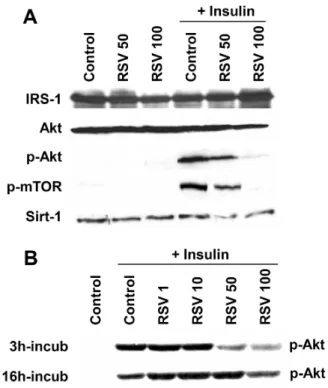
It has been previously demonstrated that Akt signaling is linked to the translocation of GLUT4 to the plasma mem-brane, resulting in the stimulation of glucose uptake by in-sulin [22], and leading to activation of mammalian target of rapamycin (mTOR). To determine the effect of resvera-trol on insulin signaling, 3T3-L1 adipocytes were pre-treat-ed with or without resveratrol in the short-term (3 h) or long-term (16 h) before insulin stimulation. As a result, a short-term treatment of resveratrol repressed insulin signal-ing by decreassignal-ing Akt phosphorylation and inhibitsignal-ing the
Fig. 3. Resveratrol inhibits insulin signaling pathway in 3T3-L1 adipocytes. 3T3-L1 cells were differentiated into adipocytes as described in Materials and Methods. (A) After 8 days of differen-tiation, 3T3-L1 cells were pretreated with or without 50 μM resveratrol (RSV 50) or 100 μM resveratrol (RSV 100) for 3 h and then exposed to 100 nM insulin for 20 min. Total cell extracts were prepared at the indicated times for Western blot analyses. (B) Confluent cells were pretreated with or without 50 μM resveratrol (RSV 50) or 100 μM resveratrol (RSV 100) for 3 h or 16 h and then exposed to 100 nM insulin for 20 min. Total cell extracts were prepared at the indicated times for Western blot analyses.
kinase activity of mTOR (Fig. 3A). Long-term resveratrol treatment had a different effect on the phosphorylation of Akt (Fig. 3B). Akt phosphorylation was gradually increased in a dose-dependent manner (1-50 μM), but then de-creased at high doses (100 μM). The protein of SirT1 was not affected by resveratrol (Fig. 3A). These results suggest that short-term high doses of resveratrol cause down-regu-lation of Akt and mTOR on insulin signaling and will not improve insulin sensitivity. The results also show that long- term treatment with low doses of resveratrol may help con-trol metabolic syndrome.
DISCUSSION
Many reports have implicated the role of the insulin sig-naling pathway; including insulin receptors, IRS-1 and -2, PI3K and Akt; in insulinduced adipogenesis and in-sulin-stimulated glucose uptake [9-12]. Binding of insulin to its receptor triggers the phosphorylation of insulin receptor substrate (IRS) proteins. Tyrosine phosphorylated IRS pro-teins recruit and sequentially activate phosphoinositide 3 kinase (PI3K) and protein kinase B (PKB, also known as AKT) [23,24]. Several knockout mice models including in-sulin receptor, Akt, and PI3K exhibit defective fat cell for-mation [13,25], probably by inhibiting insulin-like growth factor (IGF) signaling. Thus, it is important to carefully consider whether a certain chemical affects fat cell for-mation or lipid accumulation. There are a number of studies about the beneficial effects of resveratrol on metabolism, but it has also been previously reported that resveratrol in-hibits insulin signaling, including MAPK and Akt activation [16,26] and PI3K [27]. Although mild inhibition of insulin signaling is associated with increased life span [26], it re-mains unclear why resveratrol has beneficial effects on met-abolic diseases.
We previously reported that reactive oxygen species facil-itate adipocyte differentiation by accelerating mitotic clonal expansion [18]. Resveratrol acted as an anti-oxidant, in-hibiting the gradual increase of reactive oxygen species which is essential for the C/EBPβ activation. This was shown to be a SIRT1-independent pathway, and was also observed with other anti-oxidants such as genistein, epi-gallocatechin 3-gallate, and N-acetyl cysteine. Thus, as an anti-oxidant, resveratrol affects mitotic clonal expansion and adipocyte differentiation. This study focused on the ef-fect of resveratrol on the insulin signaling pathway and lipid accumulation, so treatment with resveratrol was carried out after mitotic clonal expansion. Particularly, the glucose up-take assay was performed with fully differentiated adipo-cytes (Fig. 2). Because white adipose tissue is thought to be one of the major sites of metabolic derangements, the effect of resveratrol on glucose uptake in adipocytes was analyzed for evidence of insulin resistance. Results from the present study demonstrated that resveratrol inhibits glucose uptake and GLUT4 translocation via down-regulation of
Akt on insulin signaling in 3T3-L1 adipocytes. The reduced glucose uptake might result in decreased formation of fatty acids, which is a major source of fat accumulation in 3T3-L1 adipocytes. Accumulation of fat depends on the bal-ance between fat synthesis (lipogenesis) and breakdown (fatty acid oxidation). Fatty acid synthase (FAS) and ace-tyl-CoA carboxylase (ACC) are the major enzymes regulat-ing fat synthesis [28,29]. For example, inhibition of ACC, which catalyzes the conversion of acetyl-CoA to ma-lonyl-CoA. This is the rate-limiting step of fatty acid biosynthesis. FAS is a multifunctional enzyme that catalyzes the synthesis of long-chain fatty acids. In the present study, resveratrol suppressed lipid droplet accumulation as well as FAS and ACC expression. It is not clear whether resveratrol directly regulated FAS expression. Reduced glucose uptake might have contributed to decreased lipid accumulation, but it is also possible that resveratrol affected adipocyte differ-entiation, which is not associated with insulin signaling. Nevertheless, high doses of resveratrol are clearly associated with GLUT4 translocation issues in mature adipocytes.
Resveratrol treatment leads to activation of SIRT1 both
in vivo and in vitro [16,30]. There is some evidence that SIRT1 is involved in energy metabolism control and has a lipid-lowering effect through AMPK stimulation [25,31,32]. The present study demonstrated that inhibition of Akt acti-vation in parallel with a reduction in the translocation of GLUT4 with resveratrol suppresses lipogenesis in SIRT-in-dependent pathway. Previous and current data demonstrated that in vitro high doses of resveratrol inhibited adipogenesis, glucose uptake, and insulin signaling. These results suggest that resveratrol has different features according to dose and time period, and additional research is necessary to de-termine whether or not resveratrol is beneficial to human health.
ACKNOWLEDGEMENTS
This study was supported by a faculty research grant of Yonsei University College of Medicine (6-2007-0167).
REFERENCES
1. Kopelman PG. Obesity as a medical problem. Nature
2000;404:635-43.
2. MacDougald OA, Lane MD. Transcriptional regulation of gene expression during adipocyte differentiation.
Annu Rev Biochem 1995;64:345-73.
3. Chaika OV, Chaika N, Volle DJ, Wilden PA, Pirrucello SJ, Lewis RE. CSF-1 receptor/insulin receptor chimera permits CSF-1-dependent differentiation of 3T3-L1 preadipocytes. J Biol Chem 1997;272:11968-74. 4. Rosen ED, Spiegelman BM. Molecular regulation of
adipogenesis. Annu Rev Cell Dev Biol 2000;16:145-71. 5. Gregoire FM, Smas CM, Sul HS. Understanding
adipo-cyte differentiation. Physiol Rev 1998;78:783-809. 6. Tontonoz P, Hu E, Spiegelman BM. Stimulation of
adi-pogenesis in fibroblasts by PPAR gamma 2, a lip-id-activated transcription factor. Cell 1994;79:1147-56. 7. Weissman C. Nutrition in the intensive care unit. Crit
Care 1999;3:R67-75.
8. Garcia de Herreros A, Birnbaum MJ. The acquisition of increased insulin-responsive hexose transport in 3T3-L1 adipocytes correlates with expression of a novel transporter gene. J Biol Chem 1989;264:19994-9. 9. Kohn AD, Summers SA, Birnbaum MJ, Roth RA.
Expression of a constitutively active Akt Ser/Thr kinase in 3T3-L1 adipocytes stimulates glucose uptake and glucose transporter 4 translocation. J Biol Chem 1996; 271:31372-8.
10. Magun R, Burgering BM, Coffer PJ, Pardasani D, Lin Y, Chabot J, Sorisky A. Expression of a constitutively activated form of protein kinase B (c-Akt) in 3T3-L1 preadipose cells causes spontaneous differentiation.
Endocrinology 1996;137:3590-3.
11. Miki H, Yamauchi T, Suzuki R, Komeda K, Tsuchida A, Kubota N, Terauchi Y, Kamon J, Kaburagi Y, Matsui J, Akanuma Y, Nagai R, Kimura S, Tobe K, Kadowaki T. Essential role of insulin receptor substrate 1 (IRS-1) and IRS-2 in adipocyte differentiation. Mol Cell Biol 2001;21:2521-32.
12. Sakaue H, Ogawa W, Matsumoto M, Kuroda S, Takata M, Sugimoto T, Spiegelman BM, Kasuga M. Posttrans-criptional control of adipocyte differentiation through activation of phosphoinositide 3-kinase. J Biol Chem 1998;273:28945-52.
13. Bluher M, Michael MD, Peroni OD, Ueki K, Carter N, Kahn BB, Kahn CR. Adipose tissue selective insulin receptor knockout protects against obesity and obe-sity-related glucose intolerance. Dev Cell 2002;3:25-38. 14. Garofalo RS, Orena SJ, Rafidi K, Torchia AJ, Stock
JL, Hildebrandt AL, Coskran T, Black SC, Brees DJ, Wicks JR, McNeish JD, Coleman KG. Severe diabetes, age-dependent loss of adipose tissue, and mild growth deficiency in mice lacking Akt2/PKB beta. J Clin Invest 2003;112:197-208.
resvera-trol: the in vivo evidence. Nat Rev Drug Discov 2006;5: 493-506.
16. Pervaiz S. Resveratrol: from grapevines to mammalian biology. FASEB J 2003;17:1975-85.
17. Farmer SR. Transcriptional control of adipocyte forma-tion. Cell Metab 2006;4:263-73.
18. Lee H, Lee YJ, Choi H, Ko EH, Kim JW. Reactive oxygen species facilitate adipocyte differentiation by accelerat-ing mitotic clonal expansion. J Biol Chem 2009;284: 10601-9.
19. Cong LN, Chen H, Li Y, Zhou L, McGibbon MA, Taylor SI, Quon MJ. Physiological role of Akt in insulin-stimulated translocation of GLUT4 in transfected rat adipose cells. Mol Endocrinol 1997;11:1881-90. 20. Ueki K, Yamamoto-Honda R, Kaburagi Y, Yamauchi
T, Tobe K, Burgering BM, Coffer PJ, Komuro I, Akanuma Y, Yazaki Y, Kadowaki T. Potential role of protein kinase B in insulin-induced glucose transport, glycogen synthesis, and protein synthesis. J Biol Chem 1998;273:5315-22.
21. Saltiel AR, Kahn CR. Insulin signalling and the regu-lation of glucose and lipid metabolism. Nature 2001; 414:799-806.
22. Wang Q, Somwar R, Bilan PJ, Liu Z, Jin J, Woodgett JR, Klip A. Protein kinase B/Akt participates in GLUT4 translocation by insulin in L6 myoblasts. Mol Cell Biol 1999;19:4008-18.
23. Cheatham B, Kahn CR. Insulin action and the insulin signaling network. Endocr Rev 1995;16:117-42. 24. Czech MP. Fat targets for insulin signaling. Mol Cell
2002;9:695-6.
25. Blander G, Guarente L. The Sir2 family of protein deacetylases. Annu Rev Biochem 2004;73:417-35. 26. Zhang J. Resveratrol inhibits insulin responses in a
SirT1-independent pathway. Biochem J 2006;397:519-27. 27. Frojdo S, Cozzone D, Vidal H, Pirola L. Resveratrol
is a class IA phosphoinositide 3-kinase inhibitor.
Biochem J 2007;406:511-8.
28. Gavrilova O, Haluzik M, Matsusue K, Cutson JJ, Johnson L, Dietz KR, Nicol CJ, Vinson C, Gonzalez FJ, Reitman ML. Liver peroxisome proliferator-activated receptor gamma contributes to hepatic steatosis, trigly-ceride clearance, and regulation of body fat mass. J
Biol Chem 2003;278:34268-76.
29. Tontonoz P, Nagy L, Alvarez JG, Thomazy VA, Evans RM. PPARgamma promotes monocyte/macrophage dif-ferentiation and uptake of oxidized LDL. Cell 1998;93: 241-52.
30. Wood JG, Rogina B, Lavu S, Howitz K, Helfand SL, Tatar M, Sinclair D. Sirtuin activators mimic caloric restriction and delay ageing in metazoans. Nature 2004;430:686-9.
31. Hou X, Xu S, Maitland-Toolan KA, Sato K, Jiang B, Ido Y, Lan F, Walsh K, Wierzbicki M, Verbeuren TJ, Cohen RA, Zang M. SIRT1 regulates hepatocyte lipid metabolism through activating AMP-activated protein kinase. J Biol Chem 2008;283:20015-26.
32. Rodgers JT, Lerin C, Haas W, Gygi SP, Spiegelman BM, Puigserver P. Nutrient control of glucose homeo-stasis through a complex of PGC-1alpha and SIRT1.