1. INTRODUCTION
Soft-Remote-Control System
based on EMG Signals for the Intelligent Sweet Home
Jae-Hoon Song
1, Jeong-Su Han
2, Jiwoo Pak
3,
Dae-Jin Kim
4, Jin-Woo Jung
5, Z. Zenn Bien
6, Heyoung Lee
7{memorich1, pyodori2, djkim4, jinwoo5}@ctrsys.kaist.ac.kr
[email protected], [email protected], [email protected]
Department of Electrical Engineering and Computer Science, KAIST,
373-1, Guseong-dong, Yuseong-gu, Daejeon 305-701, Republic of Korea1,2,3,6
(Tel : +82-42-869-5419, Fax : +82-42-869-8750)
Human-friendly Welfare Robot System Engineering Research Center, KAIST,
373-1, Guseong-dong, Yuseong-gu, Daejeon 305-701, Republic of Korea4,5,6,7
(Tel : +82-42-869-8415, Fax : +82-42-869-8410) Department of Control and Instrumentation Engineering, SNUT,
172, Gongreung 2-dong, Nowon-gu, Seoul 139-743, Republic of Korea 7
(Tel : +82-2-970-6545, Fax : +82-2-949-2654)
Abstract: This paper proposes a soft-remote-control (soft-remocon) system based on EMG signals for the Intelligent Sweet Home.
The proposed system is applied to Intelligent Sweet Home which was developed to help the independence living of the elderly and physically handicapped individuals. The goal of proposed system is to control home-installed electronic devices such as TV, air-conditioner, curtain and lamp in Intelligent Sweet Home using EMG signals. Features such as VAR and DAMV having good separability performance are selected for pattern classification. FMMNN is adopted as a pattern classifier. Classification results are allowed to a developed remote control module and then corresponding infrared pulses can operate home-installed electronic devices. We concluded that EMG as an input interface for home-installed electronic devices in Intelligent Sweet Home.
Keywords: EMG, FMMNN, Soft-Remote-Control (Soft-Remocon) System, Intelligent Environment
As the number of the elderly is rapidly increasing along with the number of the handicapped caused by a variety of accidents, the social demand for welfare and support of state-of-the-art technology are also increasing to lead more safe and comfortable lives. In particular, the elderly or the handicapped has serious problems in doing a certain work with their own effort in daily life so that some assistive devices or systems will be very helpful to assist such people or to do the work instead of human beings endowing as much independence as possible so as to improve their quality of life.
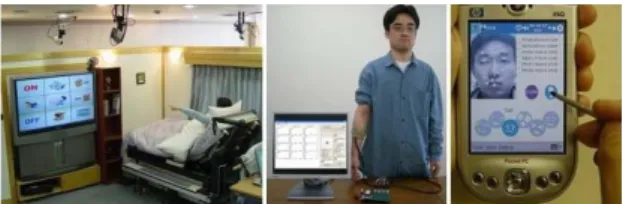
Fig. 1. A variety of interfaces based on bio-signals. This paper proposes soft-remote-control (soft-remocon) system based on EMG signals for Intelligent Sweet Home. EMG signals are bio-electric signals generated by the activation of groups of muscle fibers with impulses sent down to motor nerves from the spinal cord. EMG signals as a human-machine interface provide easy controllability for both assistive devices and digital appliances.
An intelligent environment is a space where both ordinary human activities and technical supports of computation are possible [1]. An intelligent environment can support daily activities of non-handicapped people and can enhance the quality of life for the elderly and the handicapped. It was founded that the elderly and the handicapped had many problems when they used some devices in daily lives. For instance, the elderly had difficulty in using electronic household appliances with smaller input buttons and display characters. The handicapped also suffered from using assistant devices due to their disability or limitation of mobility. Therefore, it is required to develop an input interface for those people. There are a variety of input interfaces in previous studies such as facial expressions, hand gestures (See Fig. 1). As an input interface of the system, bio-signals are also extensively used [2].
The organization of this paper is as follows: In section 2, a configuration of the proposed system is shown. Overall procedure of pattern classification algorithm is also presented. Section 3 specifies the methodologies for EMG signal processing. As a pattern recognition problem, feature extraction is described in section 4 and pattern classification is executed in section 5, respectively. In section 6, the performance of the proposed system in Intelligent Sweet Home is evaluated with experimental results. Finally, conclusion and further work are given in section 7.
2. SYSTEM CONFIGURATION
A main goal of the proposed system is to control assistive devices and digital appliances in Intelligent Sweet Home using EMG signals for the elderly and the handicapped. The inputs for the system are EMG signals measured from users with surface electrodes. The measured signals are amplified to have proper amplitude and the effects of noise are reduced through designed filters. The pattern classification algorithm is applied
to the signals for acquiring desired results. The following Fig.
2 shows general procedure of pattern classification algorithm.
3. EMG SIGNAL PROCESSING
3.1 Definition of basic motions
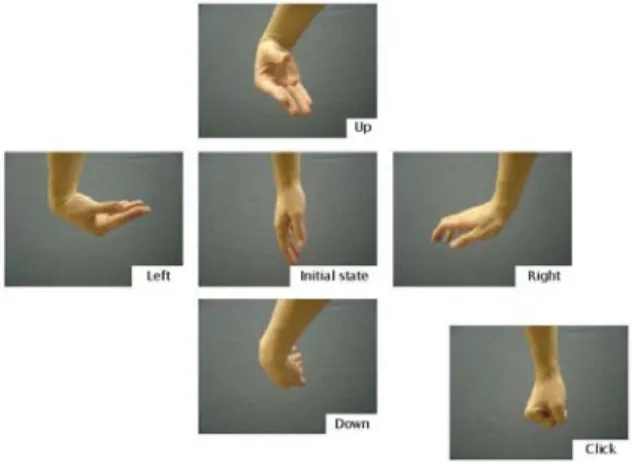
It is required to define basic motions corresponding to patterns to be classified in pattern recognition process. Even though a variety of definitions are possible related to motions of user’s muscles, basic motions should include both indication commands for each direction and selection command, respectively. Basic motions are defined to be accepted naturally to users who operate the system. The following Fig. 5 shows defined basic motions.
Fig. 2. General procedure of pattern classification algorithm[3] The system can be divided by three parts. The first is data acquisition module for EMG signals as mentioned above. The second is pattern classification module which is implemented in personal computer. Features are extracted from EMG signals for pattern classification. It is required to design a pattern classifier which is proper for characteristics of EMG signals. The third is remote control module with Bluetooth chip and micro-controller (PIC18LF4320). Command signals from pattern classification results are converted into pulses for operating electronic devices in Intelligent Sweet Home. Overall system configuration is shown in Fig. 3.
Fig. 5. Basic motions for acquiring EMG signals. Above all, we defined ‘initial state’ as a reference motion. Users can take reference motion as letting their arm straight down naturally without any force. Users also can accept the commands of basic motions naturally with one-to-one corresponding movements into up, down, left and right direction to up, down, left and right movements of their arm, respectively. A click motion for selection command is defined as grasping user’s fist.
Fig. 3. Block diagram of the proposed system. The proposed system is applied to Intelligent Sweet Home [4] which was developed to help the independence living of the elderly and physically handicapped individuals. Intelligent Sweet Home is equipped with an intelligent bed, intelligent wheelchair and transferring system between bed and wheelchair. It provides human-friendly technical solutions such as motion/mobility assistance, health monitoring,
convenient control of digital appliances (See Fig. 4). 3.2 Selection of positions for measuring EMG (Channel)
The muscle in a human body are not a single mass but connected mutually systematically with numerous motor units. A variety of muscles in human body are responded simultaneously when human being takes a specific action by his/her intentions. In case of predefined basic motions in Fig. 5, therefore, the muscles related to wrist movements can be candidates for the position of acquiring EMG signals. We made a selection of the positions for measuring EMG signals such like Fig. 6 since EMG signals are largely affected by the activities of surface muscles.
Fig. 4. Block diagram of Intelligent Sweet Home [4]. Home-installed electronic devices in Intelligent Sweet Home such as TV, air-conditioner, curtain and lamp can be controlled by intensions of users using EMG signals. The following sections described procedures and methodologies of the proposed system in detail.
3) Variance (VAR)
4. FEATURE EXTRACTION
VAR represents signal power and computed as Eq. (3) After measuring raw EMG signals, it is required to extract
features for classifying user’s patterns. EMG signals, therefore, are mapped onto a feature space with a lower dimension than raw data space. Feature sets which are to be extracted for pattern classification should be maximally separable for each class. Namely, the distances among feature vectors for different classes should be separated as far as possible. The distances among feature vectors for the same classes should be near as much as possible.
2 1 1 ( { } 1 N i i VAR x E x N = = − −
∑
) + (3)4) Difference Absolute Mean Value (DAMV)
DAMV is the mean absolute value of the difference
between the adjacent samples, k and k as defined by
Eq. (4) 1 1 1 1 1 | | 1 N i i i DAMV x x N − + = = − −
∑
(4) 4.1 Feature EvaluationExtracted features can be highly qualified as satisfying the following properties [5].
Feature distributions are shown as Fig. 7 for considering class separability and robustness. IAV, VAR and DAMV show the good qualities as a feature compared to ZC. Regarding distributions of each feature, both VAR and DAMV are selected as features for pattern classification. 1) Maximum Class Separability: As mentioned above, this
ensures that the recognition rate will be as high as possible 2) Robustness: The extracted features should be maintained the cluster separability in a noisy environment as much as possible.
5. PATTERN CLASSIFICATION
3) Complexity: This can be obtained from easiness of implementation in a reasonable hardware configuration.
In this paper, pattern classification algorithm which is appropriate for the characteristics of EMG signals was used to classify basic motions.
4.2 Features Candidate
There are a variety of features which can be extracted from EMG signals. Some of them are appreciated naturally, some are obtained through rigorous signal processing techniques such as wavelet transform, cepstrum. Some features are derived or estimated from techniques related to signal representation and modeling, i.e. time-series coefficients [5].
5.1 Fuzzy Min-Max Neural Networks (FMMNN)
We adopted Fuzzy min-max neural networks (FMMNN) as a pattern recognizer. FMMNN is a supervised learning neural network classifier that utilizes hyperbox fuzzy sets as pattern classes. A hyperbox defines a region of the n-dimensional pattern space that has pattern with full class membership. A hyperbox is completely defined by its min point and max point, and a membership function is defined with respect to these hyper min-max points. The min-max (hyperbox) membership function combination defines a fuzzy set class, and the resulting structure fits naturally into a neural network framework. Learning in the FMMNN is performed by properly placing and adjusting hyperboxes in the pattern space [6].
Following four features are extracted from raw EMG signals. In the mathematical expressions, N is the time-window for computing the features.
1) Integral Absolute Value (IAV)
IAV is mean absolute value of the signal and calculated as an Eq. (1) 1 1 | | (1) N i i IAV x N = =
∑
FMMNN has several properties which is proper for characteristics of EMG signals. FMMNN can overlap classes to minimize the amount of misclassification for all of the classes. FMMNN is also able to learn new class and refine existing classes quickly and without destroying old class information. This on-line adaptation property can complement variation of EMG signals. It is, therefore, possible to consider the time-varying characteristics and inter-individual differences of EMG signals.
2) Zero Crossing (ZC)
ZC is the number of times that the signal goes across the zero amplitude axis and expressed by Eq. (2)
1 1 sgn( ) N i i i ZC x + = =
∑
− x ⎫ ⎬ 1 0 sgn( ) 0 if x x otherwise > ⎧ = ⎨ ⎩ ⎭ (2) 0 50 100 150 200 250 0 0.1 0.2 0.3 0.4 0.5 0.6 0.7 0.8 0.9 1 day0sub1damv128ch4 number of sample m a gni tu d e class feature 0 50 100 150 200 250 0 0.1 0.2 0.3 0.4 0.5 0.6 0.7 0.8 0.9 1 day0sub1var128ch4 number of sample m agn it u d e class feature 0 50 100 150 200 250 0.1 0.2 0.3 0.4 0.5 0.6 0.7 0.8 0.9 1 day0sub1zc128ch4 number of sample m agn it u d e class feature 0 50 100 150 200 250 0 0.1 0.2 0.3 0.4 0.5 0.6 0.7 0.8 0.9 1 day0sub1iav128ch4 number of sample m agn it u d e class feature(a) IAV (b) ZC (c) VAR (d) DAMV Fig. 7. Feature distributions of EMG signals at channel #4.
5.2. Applying FMMNN to the Proposed System
The inputs of FMMNN are extracted features as mentioned in section 4, i.e., VAR and DAMV. Corresponding outputs are classified results through FMMNN. This pattern classification algorithm is implemented in a personal computer. Above all, supervised learning process is executed in off-line configuration using extracted two features. Then, corresponding fuzzy min-max hyperboxes along the boundary are defined. Since we extracted two features such as VAR and DAMV, two-dimensional plot can be shown as Fig. 8 according to feature distributions. With these learned structures, FMMNN classifies input patterns when EMG signals are applied to the system by on-line configuration from users. 0 2 4 6 8 10 12 14 16 18 20 -0.5 0 0.5 1 1.5 2 2.5 3 3.5 4 4.5 5 day0sub0vardamv128 var dam v init left right up down click
(a) A distribution of extracted features (VAR, DAMV)
0 2 4 6 8 10 12 14 16 18 20 -0.5 0 0.5 1 1.5 2 2.5 3 3.5 4 4.5 5 day0sub0vardamv128+box var dam v init left right up down click
(b) Corresponding fuzzy min-max hyperboxes Fig. 8. Two-dimensional plots of feature distribution.
6. PERFORMANCE EVALUATION
6.1 Experimental Environment
Inputs for the proposed system are EMG signals from four pairs of surface electrodes. In order to acquire EMG signals, both an electrode-band with four electrodes and a reference electrode are placed on predefined muscles which are described in section 3.2. To measure EMG signals, we used a developed EMG measurement system to amplify the amplitude of raw EMG signals and to reduce the effect of noise in the environment. The amplified EMG signals are converted to digital signals by A/D converter function in PIC16F877 with 1-kHz sampling frequency and 8-bits resolution.
Fig. 9. A developed EMG measurement system. The proposed system is applied in Intelligent Sweet Home. Target devices to be controlled are limited to TV, air-conditioner, curtain and lamp. To evaluate performance of the proposed system as a new user-interface, three users are involved in experiments. Three persons are non-handicapped and have no prior knowledge about experiment. EMG signals are measured from each user and converted to appropriate amplitude for digital signal processing. After learning FMMNN with extracted features for each subject, pre-defined motions are classified.
In order to implement remote control function for each device, proper signals should be generated by pattern classification results. The commands from users for operating each device are programmed in micro-controller (PIC18LF4320). We also used infrared LEDs to make infrared ray to be used for control signals of the devices. An infrared LED has several advantages. There is no restriction of bandwidth and it is proper for wireless communication with regard to cost, portability and so on. Remote control using an infrared LED is, therefore, suits for small area such as Intelligent Sweet Home.
We developed a 50mm×50mm printed-circuit board (PCB) to integrate these functions into a small device and the configuration is shown in Fig. 10. Eight IR-LEDs are placed to complement narrow angle of an IR-LED in the PCB. A Bluetooth-RS-232C wireless micro data transceiver module makes it possible to transmit signals over short distances between computers and other devices in Intelligent Sweet Home and thereby simplify communication and synchronization between devices. Since it eliminates wires and cables between the PCB with eight IR-LEDs and the user with an EMG signal acquisition module, there are not spatial constraints of users inside Intelligent Sweet Home.
(a) front side with Bluetooth chip (b) rear side with microcontroller
Fig. 10. Remote control module with eight IR-LEDs, a Bluetooth chip and a micro-controller.
6.2 Experimental Results
EMG signals from a user are acquired ahead of on-line test. After FMMNN learned user’s patterns with extracted features, the proposed system operated to control home-installed electronic devices in Intelligent Sweet Home. A user is placed on the bed in Intelligent Sweet Home. A following Fig. 11 shows an operating example. A TV is being controlled by user’s intention using his left arm with electrode band for acquiring EMG signals.
Fig. 11. A scene that a user is controlling a device in Intelligent Sweet Home.
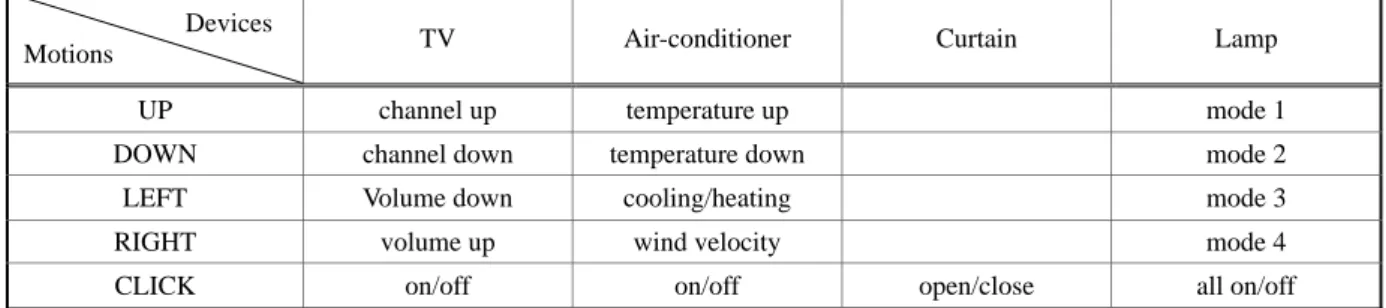
Fundamental functions to operate TV are power on/off, channel change and volume adjustment. Even though there are six basic motions, possible commands are five movements since initial motion is used as a reference. If a user takes a predefined ‘left’ motion, volume of TV is increased. As a same manner, if a user takes a ‘down’ motion, channel of TV is changed to lower number. There are a variety of functions in case of air-conditioner. Possible commands are, however, fixed at five motions, hence rarely used functions are excluded. Power on/off, temperature adjustment, selection of operation mode (cooling or heating) and wind-velocity control are available. Only two operation modes such as open and close are possible in case of curtain. Therefore, one motion is good enough to operate curtain in virtue of toggle function. On/off commands for other devices are applied in the same manner. There are various kinds of illuminators in Intelligent Sweet
Home. They are divided by four modes according to kinds and intensities of lightings. A user can adjust the illumination appropriately to match a certain situation. The relationship between basic motions from users and operation command for home-installed electronic devices is summarized in Table 1.
For other two subjects, same manners are applied without any change or consideration. Successful results of the proposed system are acquired through experiments for all of subjects. Pattern classification results for three subjects are presented in Table 2.
7. CONCLUSION
This paper proposed soft remcon system based on EMG signals for Intelligent Sweet Home. EMG signals are acquired using a developed measurement system and amplified for digital signal processing. As an appropriate pattern classifier, FMMNN is adopted to apprehend user’s intention. Both VAR and DAMV are extracted as features for pattern classification. We developed remote control module with IR-LEDs, Bluetooth chip and micro-controller. Three subjects are involved in experiment. Each user can control home-installed electronic devices such as TV, air-conditioner, curtain and lamp according to own intention. Experimental results showed satisfactory performance of the proposed system.
There are, however, so many other electronic devices which have various operation modes for the elderly and the handicapped. Studies to extend the performance of the system should be performed. Even though the proposed system is satisfactorily operated, an overall structure of the system is complex and bulky. Therefore, the system should be developed to have simple configuration using wireless EMG measurement system, embedded system and so on.
The significance of this paper is the feasibility of EMG as an input interface for home-installed electronic devices in Intelligent Sweet Home. The proposed system can provide natural interface for the non-handicapped people as well as the elderly and the handicapped.
Table 1. The relationship between basic motions from users and operation commands for home-installed devices. Devices
Motions TV Air-conditioner Curtain Lamp
UP channel up temperature up mode 1
DOWN channel down temperature down mode 2
LEFT Volume down cooling/heating mode 3
RIGHT volume up wind velocity mode 4
CLICK on/off on/off open/close all on/off
Table 2. Pattern classification results of basic motions for three subjects.
Initial Left Right Up Down Click Average
Subject #1 100% 94.12% 97.06% 90.63% 80.00% 72.50% 88.50%
Subject #2 90.00% 97.14% 94.87% 82.86% 74.29% 86.11% 87.62%
Subject #3 100% 96.97% 92.31% 100% 91.67% 56.52% 87.61%
ACKNOWLEDGEMENT
This research is partially supported by Human-Friendly Welfare Robot System Engineering Research Center, KAIST and Brain Korea 21 program.
REFERENCES
[1] Le Gal, C.; Martin, J.; Lux, A.; Crowley, J.L., “SmartOffice: design of an intelligent environment”, Intelligent Systems, IEEE, Volume 16, Issue 4, pp. 60-66, Jul-Aug 2001.
[2] Jeong-Su Han; Zenn Bien, Z.; Dae-Jin Kim; Hyong-Euk Lee; Jong-Sung Kim, “Human-machine interface for wheelchair control with EMG and its evaluation,” EMBS, Proceedings of the 25th Annual International Conference of the IEEE, Volume 2, pp. 1602-1605, Sep. 17-21, 2003.
[3] Ying-Horng Tarng; Gwo-Ching Chang; Jin-Shin Lai; Te-Son Kuo, “Design of the human/computer interface for human with disability using myoelectric signal control”, EMBS, Proceedings of the 19th Annual International Conference of the IEEE, Volume 5, pp. 1909-1910, 1997.
[4] Zenn Bien, Z; Dae-Jin Kim; Jin-Woo Jung, “Human-friendly Robotic System in Intelligent Residential Space for the Physically Challenged and/or the Elderly”, Proceedings of the 6th EAJ International Symposium on Living with Robot, Tokyo, Japan, 2004. [5] Zardoshti-Kermani, M.; Wheeler, B.C.; Badie, K.;
Hashemi, R.M., “EMG feature evaluation for movement control of upper extremity prostheses”, IEEE Transactions on Rehabilitation Engineering, Volume: 3, Issue: 4, pp. 324-333, Dec. 1995.
[6] P. Simpson, “Fuzzy min-max neural networks - Part 1: Classification”, IEEE Tranactions on Neural Networks, Volume 3, pp. 776-786, Sep. 1992.