Su Jung Baik, Tae Hun Kim, Kwon Yoo, Il Hwan Moon, Min-Sun Cho
Ischemic colitis during interferon-ribavirin therapy for
chronic hepatitis C: A case report
Su Jung Baik, Department of Gastroenterology, Health Promo-tion Center, Yonsei University Gangnam Severance Hospital, Seoul 158-050, South Korea
Tae Hun Kim, Kwon Yoo, Il Hwan Moon, Department of Inter-nal Medicine, Ewha Medical Research Institute, Ewha University Mokdong Hospital, Ewha Womans University School of Medi-cine, Seoul 158-710, South Korea
Min-Sun Cho, Department of Pathology, Ewha University Mok-dong Hospital, Ewha Womans University School of Medicine, Seoul 158-710, South Korea
Author contributions: Baik SJ drafted and edited the manu-script; Kim TH treated the patient and contributed both to manuscript revision and final approval; Yoo K and Moon IH contributed to the literature review; Cho MS contributed to the pathological analysis.
Correspondence to: Tae Hun Kim, MD, Professor, Department of Internal Medicine, Ewha Medical Research Institute, Ewha University Mokdong Hospital, Ewha Womans University School of Medicine,911-1 Mokdong, Yangcheon-gu, Seoul 158-710, South Korea. [email protected]
Telephone: +82-2-26502724 Fax: +82-2-26552076 Received: December 8, 2011 Revised: February 10, 2012 Accepted: May 6, 2012
Published online: August 21, 2012
Abstract
Ischemic colitis is a rare complication of interferon administration. Only 9 cases in 6 reports have been described to-date. This report describes a case of isch-emic colitis during pegylated interferon and ribavirin treatment for chronic hepatitis C, and includes a review of the relevant literature. A 48-year-old woman was treated with pegylated interferon α-2a and ribavirin for chronic hepatitis C, genotype Ib. After 19 wk of treatment, the patient complained of severe afebrile abdominal pain with hematochezia. Vital signs were stable and serum white blood cell count was within the normal range. Abdominal computed tomography showed diffuse colonic wall thickening from the splenic flexure to the proximal sigmoid colon, which is the most vulnerable area for the development of ischemic
colitis. Colonoscopy revealed an acute mucosal hyper-emic change, with edema and ulcerations extending from the proximal descending colon to the sigmoid colon. Colonic mucosal biopsy revealed acute exuda-tive colitis. Polymerase chain reaction and culture for
Mycobacterium tuberculosis were negative and the cul-tures for cytomegalovirus, Salmonella and Shigella spe-cies were negative. After discontinuation of interferon and ribavirin therapy, abdominal pain and hematochezia subsided and, following colonoscopy showed improve-ment of the mucosal ulcerations. Ischemic colitis cases during interferon therapy in patients with chronic hepa-titis C reported so far have all involved the descending colon. Ischemic colitis is a rarely encountered complica-tion of interferon administracomplica-tion in patients with chronic hepatitis C and should be considered when a patient complains of abdominal pain and hematochezia.
© 2012 Baishideng. All rights reserved.
Key words: Ischemia; Hepatitis C; Interferon
Peer reviewers: Ole Haagen Nielsen, Professor, Department of Gastroenterology, Herlev Hospital, University of Copenhagen, Herlev Ringvej 75, DK-2730 Herlev, Denmark; Dr. Giuseppe Chiarioni, Division of Gastrointestinal Rehabilitation, Azienda Ospedaliera di Verona, Ospedale di Valeggio s/M, 37067 Valeg-gio, Italy
Baik SJ, Kim TH, Yoo K, Moon IH, Cho MS. Ischemic colitis during interferon-ribavirin therapy for chronic hepatitis C: A case report. World J Gastroenterol 2012; 18(31): 4233-4236 Available from: URL: http://www.wjgnet.com/1007-9327/full/v18/i31/ 4233.htm DOI: http://dx.doi.org/10.3748/wjg.v18.i31.4233
INTRODUCTION
Pegylated interferon (IFN) combined with ribavirin is currently the standard treatment for chronic hepatitis C (CHC) and can achieve sustained virological response
CASE REPORT
Online Submissions: http://www.wjgnet.com/esps/ [email protected]
doi:10.3748/wjg.v18.i31.4233
4233 August 21, 2012|Volume 18|Issue 31|
WJG|www.wjgnet.com
World J Gastroenterol 2012 August 21; 18(31): 4233-4236 ISSN 1007-9327 (print) ISSN 2219-2840 (online) © 2012 Baishideng. All rights reserved.
in approximately 55% of genotype-I hepatitis C virus (HCV) infections[1]. The side effects of this
combina-tion treatment result in premature treatment terminacombina-tion in 10%-15% and dose adjustment in 32%-42% of pa-tients[1]. Therefore, physicians need to be well aware of
both the common and uncommon side effects of treat-ment. Ischemic colitis is a rare complication of interferon administration[2]. Only 9 cases in 6 reports (one in
Japa-nese[3] and 5 in English[2,4-7]) have been described to date.
This report describes a case of ischemic colitis during pegylated interferon and ribavirin treatment for CHC and includes a review of the relevant literatures.
CASE REPORT
A 48-year-old woman was admitted for the evaluation of acute abdominal pain and hematochezia. The patient had been treated with combination therapy of pegylated IFN-α 2a (180 μg/wk) (Pegasys; Roche, Basel, Switzer-land) and ribavirin (1000 mg/d) (LG Ribavirin; LG Life Sciences, Seoul, Korea) for CHC, genotype Ib. A qualita-tive HCV test was initially obtained using reverse tran-scription-polymerase chain reaction (RT-PCR) (Abbott Laboratories, Abbott Park, IL, United States), and the serum HCV viral load was 1.67 × 10⁶ viral copies/mL.
The serum HCV RNA level decreased to undetectable levels after 12 wk of treatment. The treatment process was uneventful until 16 wk of therapy. At week 16, the patient complained of mild epigastric discomfort and nausea, which resolved spontaneously a few days later. Three weeks later, at week 19 of therapy, the patient complained of severe abdominal pain with hematochezia, but she remained afebrile. Small amounts of bloody stool were passed 2-3 times per day. The patient denied recent travel or additional medications such as antibiotics or non-steroidal anti-inflammatory drugs. The patient had no history of diabetes mellitus, hypertension, inflamma-tory bowel disease, atrial fibrillation, valvular heart dis-ease, coronary artery disdis-ease, or hypercoagulable condi-tions. She was a non-smoker, and her family history was unremarkable.
Physical examination revealed direct tenderness on the left lower quadrant of the abdomen. Blood pressure was 114/76 mmHg, pulse 80 beats/min, respiration rate 20/min, and body temperature 37.9 ℃. Complete blood
count revealed a hematocrit of 26.9%, hemoglobin 8.7 gm/dL, platelets 115 000/μL, and white blood cell count 4700/μL with differential counts within the normal range. C-reactive protein was slightly elevated at 0.7 mg/ dL (normal < 0.4 mg/dL). Serum electrolytes, liver pro-file, renal function tests, amylase, and lipase were within normal limits. The coagulation profile was within the normal range, with a prothrombin time of 11.2 s and an activated partial thromboplastin time of 23.9 s. Upper en-doscopy was performed 6 mo prior to admission, which documented a healing stage small gastric ulceration at the antrum. Helicobacter pylori infection was documented by
histological examination and was successfully eradicated
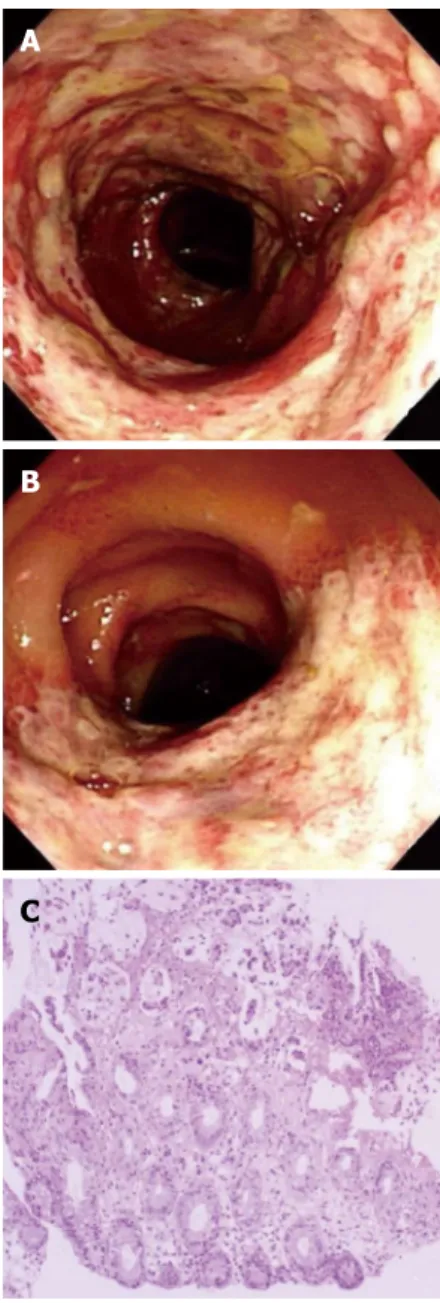
with antibiotic therapy at that time. At admission, upper endoscopy was negative for an active bleeding source, and colonoscopic examination revealed acute hyperemic mucosal changes with edema, erosion, and ulcerations. Acute inflamed, friable mucosal changes extended from the sigmoid colon (Figure 1A) to the proximal descend-ing colon (Figure 1B). The rectum showed relatively normal mucosa. Colonic mucosal biopsy revealed acute exudative colitis compatible with a diagnosis of ischemic colitis (Figure 1C). On the biopsy specimen, staining for cytomegalovirus showed no positive cells, and staining for acid-fast bacilli was negative. Tuberculous nucleic acid was undetectable by polymerase chain reaction. A serum anti-Streptolysin O test was negative. Bacteriologic culture studies of stool and colonic fluid were negative
4234 August 21, 2012|Volume 18|Issue 31|
WJG|www.wjgnet.com
Baik SJ et al. Interferon-induced ischemic colitis
C
B A
Figure 1 Colonoscopy images and pathology. A: Mucosal hyperemic
change with edema, erosion, and ulcerations and hemorrhagic friable mucosa on the sigmoid colon; B: Segmental ulceration was seen on the proximal de-scending colon; C: Pathological examination of the dede-scending colon showed acute exudative colitis. Epithelial detachment was observed (hematoxylin and eosin stain, × 40).
for Mycobacterium, Salmonella, and Shigella species.
Abdomi-nal computed tomography showed circumferential wall thickening and pericolic fat infiltration from the descend-ing colon to the proximal sigmoid colon, a well-known predisposing area for the development of ischemic colitis (Figure 2). The findings from colonoscopy, computed tomography, and pathology were all compatible with the diagnosis of ischemic colitis.
After IFN and ribavirin treatment were discontinued, the patient’s abdominal pain decreased and hematochezia resolved. One week later, subsequent colonoscopy showed marked improvement in ulceration and mucosal edema. Serum HCV RNA remained undetectable for up to 3 mo after cessation of treatment, but reappeared 1 year later. The reappearance of serum HCV RNA suggests that the antiviral treatment for CHC was not successful.
DISCUSSION
In current standard combination therapy of pegylated IFN and ribavirin in CHC patients, more than 50% of sustained virological response is expected. However, a large proportion of the patients are not eligible for the treatment or drop out early during the treatment due to side effects.
The side effects of IFN and ribavirin combination therapy are mostly associated with IFN administration, while hemolytic anemia is attributable to ribavirin[1]. Side
effects associated with IFN treatment have been de-scribed not only in CHC, but also in chronic hepatitis B[8],
chronic myeloid leukemia[9], metastatic renal cell
carcino-ma[10], and multiple myeloma[11]. Flu-like symptoms such
as general malaise, fever, arthralgia, headache, and hema-tologic abnormalities such as leukopenia and thrombocy-topenia are frequently observed early adverse effects of IFN-α administration[2]. Although the severity of these
symptoms is directly related to the dose and frequency of IFN administration, remarkable individual variation has been observed[2]. Among the various gastrointestinal side
effects of IFN-α, ischemic colitis is rarely reported dur-ing treatment of CHC, occurrdur-ing in less than 1% of pa-tients[12]. Other than ischemic colitis, microscopic colitis[7]
and ulcerative colitis[13] have also been reported.
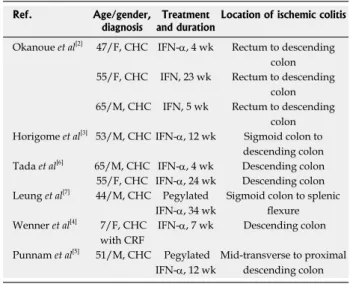
Nine cases of ischemic colitis related to IFN therapy in CHC have been reported in 6 studies, and the most common symptoms were abdominal pain and lower gastrointestinal bleeding such as melena and hemato-chezia[2-7]. The descending colon was most frequently
involved in all ischemic colitis cases associated with CHC (Table 1). In reported cases, hematochezia and melena appeared between week 4 and 34 of IFN treatment, and the mean duration of IFN treatment before the occur-rence of ischemic colitis was 14 wk. The characteristics of this case correspond well with those of previously re-ported cases in terms of symptoms, location, and period of duration.
The etiology of ischemic colitis is not yet clearly eluci-dated. The mechanism of IFN-induced ischemic colitis is thought to be associated with immune modulation of cy-tokine networks. Sparano et al[10] documented the role of
interleukin-2 (IL-2) and IFN-α in the development of co-lonic ischemia. They suggested that a disordered coagula-tion cascade played a role in the pathogenesis of colonic ischemia, assuming that derangement of coagulation is
4235 August 21, 2012|Volume 18|Issue 31|
WJG|www.wjgnet.com
14 cm
14 cm
Figure 2 Abdominal computed tomography. A: Circumferentially layered
wall thickening and pericolic fat infiltration at the descending colon (arrow); B: Circumferential wall thickening and pericolic fat infiltration at the proximal sig-moid colon (arrows).
Table 1 Characteristics of ischemic colitis associated with interferon treatment in chronic hepatitis C patients
Ref. Age/gender,
diagnosis and durationTreatment Location of ischemic colitis
Okanoue et al[2] 47/F, CHC IFN-α, 4 wk Rectum to descending
colon
55/F, CHC IFN, 23 wk Rectum to descending
colon
65/M, CHC IFN, 5 wk Rectum to descending
colon
Horigome et al[3] 53/M, CHC IFN-α, 12 wk Sigmoid colon to
descending colon
Tada et al[6] 65/M, CHC IFN-α, 4 wk Descending colon
55/F, CHC IFN-α, 24 wk Descending colon
Leung et al[7] 44/M, CHC Pegylated
IFN-α, 34 wk
Sigmoid colon to splenic flexure
Wenner et al[4] 7/F, CHC
with CRF
IFN-α, 7 wk Descending colon
Punnam et al[5] 51/M, CHC Pegylated
IFN-α, 12 wk
Mid-transverse to proximal descending colon CHC: Chronic hepatitis C; CRF: Chronic renal failure; IFN-α: Interferon-α; F: Female; M: Male.
4236 August 21, 2012|Volume 18|Issue 31|
WJG|www.wjgnet.com
4 Wenner WJ, Piccoli DA. Colitis associated with alpha
inter-feron? J Clin Gastroenterol 1997; 25: 398-399
5 Punnam SR, Pothula VR, Gourineni N, Punnam A,
Ranga-nathan V. Interferon-ribavirin-associated ischemic colitis. J Clin Gastroenterol 2008; 42: 323-325
6 Tada H, Saitoh S, Nakagawa Y, Hirana H, Morimoto M,
Shima T, Shimamoto K, Okanoue T, Kashima K. Ischemic colitis during interferon-alpha treatment for chronic active hepatitis C. J Gastroenterol 1996; 31: 582-584
7 Leung Y, Urbanski SJ, Schindel L, Myers RP. Ischemic
coli-tis during pegylated interferon-alpha and ribavirin therapy for chronic hepatitis C. Can J Gastroenterol 2006; 20: 661-663 8 Gish RG, Lau DT, Schmid P, Perrillo R. A pilot study of
extended duration peginterferon alfa-2a for patients with hepatitis B e antigen-negative chronic hepatitis B. Am J Gas-troenterol 2007; 102: 2718-2723
9 Hehlmann R, Hochhaus A, Baccarani M. Chronic myeloid
leukaemia. Lancet 2007; 370: 342-350
10 Sparano JA, Dutcher JP, Kaleya R, Caliendo G, Fiorito J, Mitsudo S, Shechner R, Boley SJ, Gucalp R, Ciobanu N. Co-lonic ischemia complicating immunotherapy with interleu-kin-2 and interferon-alpha. Cancer 1991; 68: 1538-1544 11 Ludwig H, Fritz E. Interferon in multiple
myeloma--summary of treatment results and clinical implications. Acta Oncol 2000; 39: 815-821
12 Fried MW. Side effects of therapy of hepatitis C and their management. Hepatology 2002; 36: S237-S244
13 Sprenger R, Sagmeister M, Offner F. Acute ulcerative colitis during successful interferon/ribavirin treatment for chronic hepatitis. Gut 2005; 54: 438-439; author reply 439
14 Guyer DR, Tiedeman J, Yannuzzi LA, Slakter JS, Parke D, Kelley J, Tang RA, Marmor M, Abrams G, Miller JW. In-terferon-associated retinopathy. Arch Ophthalmol 1993; 111: 350-356
15 Nadir A, Amin A, Chalisa N, van Thiel DH. Retinal vein thrombosis associated with chronic hepatitis C: a case series and review of the literature. J Viral Hepat 2000; 7: 466-470
S- Editor Gou SX L- Editor Rutherford A E- Editor Zhang DN mediated by tumor necrosis factor or its interactions with
other cytokines[10]. IFN therapy also induces an increase
in plasma-activated complement C5a, a potent intravascu-lar aggregator of granulocytes, favoring the development of microthrombi in small vessels. IFN-induced vasculitic reactions, mediated by the deposition of immune com-plexes in the vasculature, may also play a pathogenic role in ischemia of various organs[14,15]. Thrombogenic effects
of activated cytokines and immune complex-mediated vasculitic reactions may play a role in the pathogenesis of IFN-induced ischemic colitis[14]. The potential role of
cytokines for the development of IFN induced ischemic colitis needs to be investigated further.
In conclusion, physicians should be vigilant of the various common and uncommon complications of both pegylated IFN and ribavirin. Ischemic colitis is a rarely encountered complication of pegylated IFN administra-tion but it should be considered when a patient com-plains of abdominal pain and hematochezia.
REFERENCES
1 Sung H, Chang M, Saab S. Management of Hepatitis C
Antiviral Therapy Adverse Effects. Curr Hepat Rep 2011; 10: 33-40
2 Okanoue T, Sakamoto S, Itoh Y, Minami M, Yasui K,
Saka-moto M, Nishioji K, Katagishi T, Nakagawa Y, Tada H, Sawa Y, Mizuno M, Kagawa K, Kashima K. Side effects of high-dose interferon therapy for chronic hepatitis C. J Hepa-tol 1996; 25: 283-291
3 Horigome H, Takezono Y, Fujino N, Uchida A, Murasaki G.
[A case of ischemic colitis associated with interferon treat-ment]. Nihon Shokakibyo Gakkai Zasshi 1996; 93: 181-184 Baik SJ et al. Interferon-induced ischemic colitis