P1-84 / J.-H. Jou
IMID 2009 DIGEST •
Abstract
A highly efficient blue organic light-emitting diode (OLED) was fabricated by using a novel polymer host, poly[3-(carbazol-9-ylmethyl)-3-methyloxetane] . The resultant solution-processed device showed a markedly high efficiency of 29.7 lm/W at 100 cd/m2 by doping 24 wt% blue dye bis(3,5-difluoro-2-(2-pyridyl)-phenyl-(2-carboxy pyridyl) iridium (III).
1. Introduction
Organic light-emitting diodes (OLEDs) have been being studied for its potential application in large-area displays and solid-state illumination.[1] The turning point for OLEDs to achieve 100% internal quantum efficiency is the finding of electrophosphorescence, and consequently, the power efficiency of OLED devices have been greatly enhanced.[2]
The efficiency of the OLEDs is one of the primary research concerns. However, blue light efficiency is commonly lower than those of other emissions.[3] Currently, the best reported power efficiency of solution-processed blue OLEDs is 14 lm/W at 100 cd/m2.[4] The lack of host materials for high-energy
blue emission is one major cause of the low efficiency.[5] Effective host materials for blue emission must, firstly, possess wide band gaps, either of singlet or triplet.[6,7] Secondly, the hosts must possess high-mobility character.[8,9] Thirdly, the hosts must be bipolar.[10] Polymers carrying pendent electro-active fragments such as carbazolyl and triphenyldiamino groups are widely studied. These materials are used for hole transporting layer and host materials for phosphorescent OLEDs.[11-13]
In this report, a highly efficient solution-processed
blue phosphorescent OLED with a novel host material poly[3-(carbazol-9-ylmethyl)-3-methyloxet-ane] (RS-12) is presented. The power efficiency of the resultant device is 25.8 lm/W at 100 cd/m2, 17.8 lm/W at 1,000
cd/m2, which is the highest among all
solution-processed blue phosphorescent OLEDs ever presented.
2. Experimental
The device consisted of a 125 nm indium tin oxide (ITO) layer, a 46 nm poly(3,4-ethylene-dioxythio phene): poly (styrene sulfonic acid) (PEDOT: PSS) hole transporting layer, a 25 nm of polymer blue emissive layer (EML), a 32 nm 2,2’-2”-(1,3,5-benzene - triyl)tris(1-phenyl-1-H-benzimidazole) (TPBi) electron transporting layer, a 0.7 nm lithium fluoride layer and a 150 nm aluminum layer. Various polymeric blue emissive layers that contain 24 wt% bis(3,5-difluoro-2-(2-pyridyl)-phenyl-(2-carboxy pyridyl) iridium (III) (FIrpic) guest doped in poly[3-(carbazol-9-ylmethyl)-3-methyloxetane] (RS-12), and poly(9-vinyl-carbazole) (PVK). The well-mixed EML solutions were kept at 60 and spin℃ -coating on hole transporting layer at 5,000 rpm under nitrogen atmosphere.
A Novel Polymer Host for Highly Efficient
Solution-Processed Blue Organic Light-Emitting Diode
Jwo-Huei Jou
1, Cheng-Wei Lin
1, I-Ming Lai
1, Wei-Ben Wang
1,
Chuan-Huan Chiu
1, Saulius Grigalevicius
2, Chung-Chih Wu
31Department of Materials Science and Engineering, National Tsing Hua University,
Hsin-Chu, Taiwan 30013, Republic of China
2Department of Organic Technology, Kaunas University of Technology, Radvilenu
plentas 19, LT-50254, Kaunas, Lithuania
3Department of Electrical Engineering, National Taiwan University, Taipei, Taiwan 10617,
Republic of China
P1-84 / J.-H. Jou
• IMID 2009 DIGEST
Fig. 1. Schematic energy diagram of the blue devices with the two different polymer hosts, PVK and RS-12. Also shown are the molecular structures of the two polymer hosts.
3. Results and discussion
As shown in Figure 1, the blue EML comprised a novel polymer host, RS-12, and a guest bis(3,5-difluoro-2-(2-pyridyl)-phenyl-(2-carboxypyridyl) iridium (III) (FIrpic). Meanwhile, a typical polymer host, poly(N-vinyl-carbazole) (PVK), was also studied for comparison. The physical properties of the polymer hosts were summarized in Table I. As seen, the new host, RS-12, as well as PVK, exhibited a singlet-band-gap of 3.7 eV, much higher than that of the blue guest, FIrpic, which was 2.7 eV. This should enable the occurrence of energy transfer from the host to guest. Importantly, RS-12 shows a triplet-band-gap of 3.7 eV, much higher than that of FIrpic, which was 2.6 eV. This should confine the triplet energy on FIrpic molecules.
TABLE I. Some physical properties of the two polymer hosts used for the blue devices.
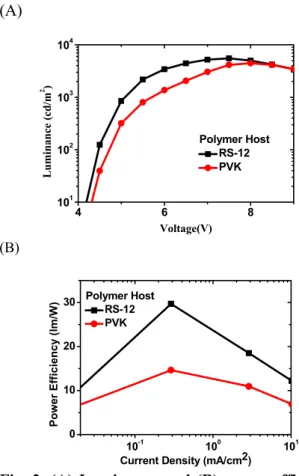
Figure 2 shows the device luminance and power efficiency of the blue OLEDs. As seen in Figure 2A, the RS-12-composing device shows higher luminance than that of the PVK-composing counterpart. In Figure 2B, the RS-12-composing device shows a power efficiency of 25.8 lm/W at 100 cd/m2, much
higher than that of the PVK-composing one, which was 15.4 lm/W. At higher luminance, such as 1,000 cd/m2 for example, the RS-12-composing counterpart
exhibits 17.8 lm/W at 1,000 cd/m2, while only 6.3 lm/W for the PVK-composing one. The markedly higher efficiency obtained by the RS-12-composing device may be attributed to its wide singlet- and triplet-band-gap, leading to a good energy transfer from the host to guest and an excellent confinement of the triplet energy on FIrpic molecules.
(A) 4 6 8 101 102 103 104 Polymer Host RS-12 PVK Lum ina n ce (c d/m 2 ) Voltage(V) (B) 10-1 100 101 0 10 20 30 Polymer Host RS-12 PVK Po wer Eff iciency ( lm/W)
Current Density (mA/cm2)
Fig. 2. (A) Luminance and (B) power efficiency of the RS-12-composing device, comparing with those of the PVK-composing counterpart.
P1-84 / J.-H. Jou
IMID 2009 DIGEST •
4. Summary
Markedly-high power efficiency of 29.7 lm/W, corresponding to a maximum external quantum efficiency 19.2% was obtained for a solution-processed blue phosphorescent OLED by using RS-12. The markedly-high efficiency may be attributed to its wide singlet- and triplet-band-gap, leading to a good energy transfer from the host to guest and an excellent confinement of the triplet energy on FIrpic molecules.
5. References
1. J. H. Burroughes, D. D. C. Bradley, A. R. Brown, R . N. Marks, K. Mackay, R. H. Friend, P. L. Burns, A. B. Holmes, Nature. 1990, 347, 539.
2. M. A. Baldo, S. Lamansky, P. E. Burrows, M. E. Thompson, and S. R. Forrest, Appl. Phys. Lett. 1999, 75, 4.
3. B. W. D’Andrade, J-Y. Tsai, C. Lin, M. S. Weaver, P. B. Mackenzie, J. J. Brown, Proc. of IDW 2006, 469. 4. S.C. Lo, R.N. Bera, R.E. Harding, P.L. Burn, I.D.W.
Samuel, Adv. Funct. Mater. 2008, 18, 3080.
5. M. F. Wu, S. J. Yeh, C. T. Chen, H. Murayama, T. Tsuboi, W. S. Li, I. Chao, S. W. Liu, J. K. Wang, Adv. Funct. Mater. 2007, 17, 1887.
6. R. J. Holmes, S. R. Forrest, Y. J. Tung, R. C. Kwong, J. J. Brown, S. Garon, M. E. Thompson, Appl. Phys. Lett. 2003, 82, 15.
7. P. I. Shih, C. L. Chiang, A. K. Dixit, C. K. Chen, M. C. Yuan, R. Y. Lee, C. T. Chen, E. W. G. Diau, C. F. Shu, Org. Lett. 2006, 8, 13.
8. M. H. Tsai, H. W. Lin, H. C. Su, T. H. Ke, C. C. Wu, F. C. Fang, Y. L. Liao, K. T. Wong, C. I. Wu, Adv. Mater. 2006, 18, 1216.
9. S. Tokito, T. Iijima, Y. Suzuri, H. Kita, T. Tsuzuki, F. Sato, Appl. Phys. Lett. 2003, 83, 3.
10. A. B. Padmaperuma, L. S. Sapochak, P. E. Burrows, Chem. Mater. 2006, 18, 2389.
11. P. E. Burrows, A. B. Padmaperuma, L. S. Sapochak, P. Djurovich, M. E. Thompson, Appl. Phys. Lett. 2006, 88, 183503.
12. C. Adachi, R. Kwong, S. R. Forrest, Org. Elec. 2001, 2, 37.
13. M. Stolka, D. M. Pai, D. S. Renfer, J. F. Yanus, J. Polym. Sci. B: Polym. Phys. 2000, 38, 362.
14. D. Tanaka, Y. Agata, T. Taekeda, S. Watanabe, J. Kido, J. Appl. Phys. 2007, Vol. 46, No. 5.