Korean Sentiment Analysis Using Natural Network:
Based on IKEA Review Data
YuJeong Sim*, Dai Yeol Yun**, Chi-gon Hwang***, Seok-Jae Moon****
* Graduate School of Smart Convergence Kwangwoon University, Korea
** Professor, Department of information and communication Engineering, Institute of Information
Technology, Kwangwoon University, Seoul, 01897, Korea
*** Visiting Professor, Department of Computer Engineering, Institute of Information Technology,
Kwangwoon University, Seoul, 01897, Korea
**** Professor, Department of Artificial Intelligence, Institute of Information Technology,
KwangWoon University, Korea
E-mail : {tladbwjd, hibig10, duck1052, msj8086}@kw.ac.kr
Abstract
In this paper, we find a suitable methodology for Korean Sentiment Analysis through a comparative experiment in which methods of embedding and natural network models are learned at the highest accuracy and fastest speed. The embedding method compares word embeddeding and Word2Vec. The model compares and experiments representative neural network models CNN, RNN, LSTM, GRU, Bi-LSTM and Bi-GRU with IKEA review data. Experiments show that Word2Vec and BiGRU had the highest accuracy and second fastest speed with 94.23% accuracy and 42.30 seconds speed. Word2Vec and GRU were found to have the third highest accuracy and fastest speed with 92.53% accuracy and 26.75 seconds speed.
Keywords: NLP, Word2Vec, CNN, RNN, LSTM, GRU, BiLSTM, BiGRU
1. Introduction
Deep learning, which has recently gained much attention in the field of artificial intelligence, refers to learning techniques for artificial neural networks with deep structures. Deep learning has overcome the Vanishing Gradient, Slow Learning, and Overfitting problems that arise when artificial neural networks have deep structures. By partially eliminating these existing constraints, it has achieved outstanding results in areas such as image, voice, natural language processing[1]. In this paper, we study Sentiment Analysis one of the fields of natural language processing. Sentiment Analysis is a field of document classification that classifies subjective impressions, sensibilities, attitudes of textual documents, individual opinions, on a topic, unlike text mining, which extracts information from text[2]. The Sentiment Analysis methodology using a natural network can be divided into a process of obtaining a document vector through embedding after tokenizing a document and a process of classifying a vectorized document[3]. The core technology of natural networks is to quickly build a model with maximum accuracy from given training data. Thus, in this paper, we analyze using natural network techniques to find the best performance for Korean language Sentiment Analysis and conduct research
IJIBC 21-2-22
Manuscript Received: March. 21, 2021 / Revised: March. 26, 2021 / Accepted: March. 28, 2021 Corresponding Author: Seok-Jae Moon
Tel: +82-01-7753-8086, Fax: +82-2-916-4751
by comparing predictive accuracy and speed among models.
2. Related research
2.1 CNN
CNN is an artificial natural network structure mainly used for computer vision problems. CNN is one of the most commonly used machine learning for visual image analysis, and is also applied to natural language processing. Because CNN uses a small sized convolution mask, it has far fewer parameters than MLP (Multi-Layer Perceptron), which is a fully connected structure. In addition, it uses a weight sharing technique in which all nodes share the same mask.
Figure 1. CNN structure
2.2 RNN
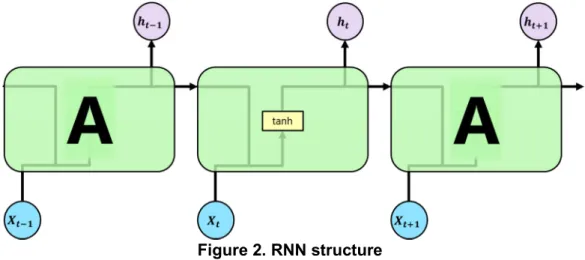
RNN's learning uses stochastic instructor descent to update weights with Real-Time Recurrent Learning (RTRL) or BackPropagation Through Time (BPIT)[5]. RNN can store information about the previous state in memory form. Thus, it is a natural network optimized to handle time series data whose information is associated with the next obtained data.
2.3 LSTM
RNN is unable to learn properly due to the Vanishing Gradient problem as the number of steps going back increases. Due to this, RNNs do not have long-term memory, and LSTM improves this problem[6]. A characteristic of LSTM is that it has two vectors (short-term state / long-term state) and three gates. LSTM solved the problem of RNN by containing long-term memory in long-term states.
Figure 3. LSTM structure
2.4 GRU
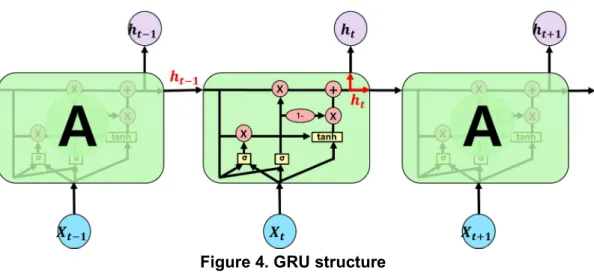
GRU is a simplified version of LSTM, reducing three LSTM gates to two[7]. It cannot be concluded that either GRU or LSTM is better in terms of the performance of the model. However, GRUs with fewer parameters perform better when the amount of data is small.
Figure 4. GRU structure
2.5 BiLSTM
BiLSTM is a model that uses LSTM, a model that overcomes the limitations of RNN through gate techniques, together with the consequences of reverse as well as forward. It is widely used in various NLP problems considering speed because it is advantageous for context-based association analysis.
Figure 5. BiLSTM structure
2.6 BiGRU
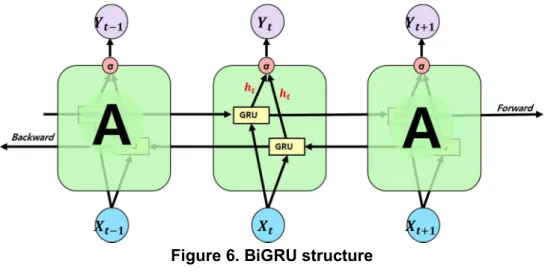
BiGRU is a model that uses both forward and reverse results together. The characteristic of BiGRU is that end-to-end learning is possible in which all parameters are simultaneously learned in the process of minimizing the loss to the output value. Improving performance by internalizing the similarity between words and phrases in the input vector. Also, even if the data length is long, the performance does not deteriorate.
Figure 6. BiGRU structure
3. Experiment
After collecting IKEA review data, separate the training data from the test data at a 3:1 ratio. Then, the data is purified using the data regular expression to remove all but Korean. We perform tokenization tasks using Mecab, one of the morpheme analysers. In this process, stop words are specified to remove unnecessary tokens. Examples include ‘듯’, ‘때’, ‘와’, ‘의’. Now perform integer encoding on training data and test data so that the machine can process text numerically. Afterwards, the padding work is carried out to match the lengths of samples of different lengths equally. Finally, the data Sentiment Analysis with natural network models and then performance comparisons are made.
Figure 1. Sentiment analysis process
As shown in Figure 1, the analysis was conducted in the order of Data Collection – Refine – Tokenization – Integer encoding – Padding– Sentiment Analysis.
4. Experiment result
The performance comparison of natural network models, divided by Embedding Layer and Word2Vec, is shown in Table1. and Table2.
Table1.Performance Comparison of Neural Network Models Using Embedding Layers Natural Network
Train Test Training
Time (초)
Accuracy (%) loss Accuracy (%) loss
Embedding Layer + CNN 87.03 0.1373 87.27 0.1323 173.89
Embedding Layer + RNN 87.25 0.3462 87.62 0.3398 94.33
Embedding Layer + LSTM 89.17 0.2788 89.53 0.2849 198.45
Embedding Layer + GRU 90.97 0.2287 91.10 0.2153 29.19
Embedding Layer + BiLSTM 91.14 0.1986 91.43 0.1955 51.42
Embedding Layer + BiGRU 92.89 0.1589 93.02 0.1639 49.15
Table2. Performance Comparison of Neural Network Models Using Word2Vec Natural Network
Train Test Training
Time (초)
Accuracy (%) loss Accuracy (%) loss
Word2Vec + CNN 89.71 0.1183 89.85 0.1184 108.89 Word2Vec + RNN 88.08 0.3064 88.05 0.3010 76.91 Word2Vec + LSTM 90.07 0.2895 90.14 0.2849 212.79 Word2Vec + GRU 92.39 0.2016 92.53 0.2033 26.75 Word2Vec + BiLSTM 92.45 0.1871 92.79 0.1868 51.52 Word2Vec + BiGRU 94.02 0.1535 94.23 0.1531 42.30 Data
Collection Refine Tokenization
Integer
4. Conclusion
In this paper, in order to find a model that performs best in Korean sentiment analysis, we analyzed using a neural network model and conducted a study by comparing the accuracy and speed between the models. In the learning stage, CNN, RNN, LSTM, GRU, BiLSTM, and BiGRU were trained using a total of 6 algorithms. In the experimental stage, the accuracy and speed of each model were compared. Experiments show that models with Word2Vec perform better than models with Embedded Layer. Among models using Wor2Vec, BiGRU has the highest accuracy and second fastest speed with 94.23% accuracy and 42.30 seconds speed. GRU is the third highest and fastest with 92.53% accuracy and 26.75 seconds speed. These results show that BiGRU with Wor2Vec has the highest performance among natural network models.
Performance improvements require greater amounts of data to be obtained and in-depth research on machine learning applications should be conducted. In order to increase the accuracy of the system, additional service development and research will be required. In the future, research on a new machine learning model that can detect more diverse emotions with high accuracy is being planned.
References
[1] Liu, Bing. "Sentiment analysis and subjectivity." Handbook of natural language processing 2.2010 (2010): 627-666. [2] Maas, Andrew, et al. "Learning word vectors for sentiment analysis." Proceedings of the 49th annual meeting of the
association for computational linguistics: Human language technologies. 2011.
[3] Feldman, Ronen. "Techniques and applications for sentiment analysis." Communications of the ACM 56.4 (2013): 82-89.
[4] Gu, Jiuxiang, et al. "Recent advances in convolutional neural networks." Pattern Recognition 77 (2018): 354-377. [5] Choi, Edward, et al. "Using recurrent neural network models for early detection of heart failure onset." Journal of
the American Medical Informatics Association 24.2 (2017): 361-370.
[6] Hochreiter, Sepp, and Jürgen Schmidhuber. "Long short-term memory." Neural computation 9.8 (1997): 1735-1780. [7] Cho, Kyunghyun, et al. "Learning phrase representations using RNN encoder-decoder for statistical machine