INTRODUCTION
Suicide ranks third in the list of the top 10 causes of death among adolescents worldwide [1] and first among the top 10 causes of death among adolescents in South Korea since 2009 [2]. The consequences of suicide to the community, including the family and relatives of the individual who died, further underscores the need to curtail the frequency of suicide.
Adolescent suicide is the result of complex interactions be-tween individuals, families, and their communities, and many studies have identified mental disorder as a major risk factor for adolescent suicide [3]. Findings implicating the dissolu-tion of a family due to the separadissolu-tion of or divorce of the par-ents in suicide have been consistent [4-6]. Further, suicide at-tempts [7], depression and anxiety [8], and behavioral problems [9] have been identified as other risk factors for adolescent suicide as well. However, as not every adolescent who com-mits suicide follows the same behavioral pattern, the various
trajectories that induce the suicide of adolescents with these risk factors must be explored in depth. Psychological autopsy has been introduced as an important part of this effort. Psy-chological autopsy is the process of reviewing the state of the deceased for a certain time period before his or her suicide by assessing the records left by and the statements of people around the deceased individuals to speculate the cause of sui-cide; it has become an essential research tool by which to un-derstand the complex causes of suicide [10].
Schools are places where most adolescents spend most of their time. According to research, signs indicating a height-ened risk of suicide more frequently present at school than at home, and students are more likely to gain protective factors against suicide at school: e.g., by bonding with someone at school who can help with the suicide problem [11]. This find-ing suggests that schools can play a critical role in suicide pre-vention and interpre-vention. Nevertheless, studies have rarely conducted an in-depth analysis of suicide within the school system [12].
Beginning in 2015, the Ministry of Education has obligated all elementary, middle and high schools to submit a detailed This is an Open Access article distributed under the terms of the Creative Commons
Attribution Non-Commercial License (https://creativecommons.org/licenses/by-nc/4.0) which permits unrestricted non-commercial use, distribution, and reproduction in any medium, provided the original work is properly cited.
Classification of Adolescent Suicide Based
on Student Suicide Reports
Hoin Kwon1, Hyun Ju Hong2,3, and Yong-Sil Kweon2,4
1Department of Counseling Psychology, Jeonju University, Jeonju, Korea 2Suicide and School Mental Health Institute, Hallym University, Chuncheon, Korea
3Department of Psychiatry, Hallym University Sacred Hospital, Hallym University, Anyang, Korea 4Department of Psychiatry, The Catholic University of Korea College of Medicine, Seoul, Korea
Exploring the risk factors of adolescent suicide is important for effective suicide prevention. This study explored the clustering of ado-lescent suicides based on six risk factors: mental disorder, broken family, depression, anxiety, previous suicide attempts, and deviant be-haviors. Using 173 student suicide reports obtained from the Ministry of Education, we evaluated the associations between suicide and variables related to mental disorders; dysfunctional family life; depression and anxiety; previous suicide attempts; deviant behaviors such as drinking and smoking; and school life characteristics, including attendance and discipline, problems within the past year, and incidents prior to suicide. In addition, reports of warning signs just before suicide were included in the analysis. The two-stage cluster analysis classified the students into three clusters: the silent type (cluster 1; 48.55%), in which no risk factors were observed; environmen-tal-risk type (cluster 2: 24.28%), which featured a high frequency of broken households, deviant behaviors such as smoking/drinking and running away from home; and depressive type (cluster 3: 27.17%), which featured a high frequency of mental health problems such as depression, anxiety, and suicide attempts. Identifying the sub-types of adolescent suicide may help to inform tailored suicide preven-tion and intervenpreven-tion strategies in school.
Key Words: Adolescent; Suicide; Risk factors; Cluster analysis.
Received: August 3, 2020 / Revision: September 1, 2020 / Accepted: September 3, 2020
Address for correspondence: Yong-Sil Kweon, Department of Psychiatry, The Catholic University of Korea College of Medicine, 222 Banpo-daero, Seo-cho-gu, Seoul 06591, Korea
and comprehensive annual “Student Suicide Report” to the Office of Education and Ministry of Education. The content provided in these reports has populated the student suicide database [13].
This study aims to analyze the features of suicide among Korean students based on the 2018 and 2019 data reported in the student suicide reports. In particular, we aim to exam-ine how student suicide can be classified via cluster analysis based on the six previously identified risk factors for adoles-cent suicide: mental disorder, previous suicide attempts, de-pression, anxiety, family breakup, and deviant behaviors. Fur-ther, by exploring the differences in the changes or stressful situations immediately before suicide, as well as verbal and behavioral signs before suicide, between the clustered groups, we attempt to speculate the process that leads to suicide among adolescents and gain conclusions that may help schools to de-velop suicide prevention and intervention strategies
METHODS
ParticipantsThis study used data from student suicide reports submit-ted to the Suicide and School Mental Health Institute in 2018 and 2019 [14,15]. Two teachers, including the homeroom teacher, wrote the suicide report. A total of 258 cases of stu-dent suicides were reported from January 2017 to December 2018. After excluding 75 cases due to their missing data re-quired for cluster analysis (i.e., namely status of mental dis-order, family breakup, suicide attempts, deviant behaviors, depression, and anxiety), the data from the remaining 173 cases were included in the analysis.
Instruments Demographic factors
The base questionnaire included the students’ demograph-ic factors, including sex, age, and school level. Further, the student’s family’s socioeconomic status, as reported by the teachers, was assessed as high/middle/low. Families in which both parents did not reside together due to divorce, bereave-ment, or separation were defined as disorganized families. Finally, intimacy with parents was rated on a 6-point scale from very weak to very strong. A higher score indicated great-er intimacy.
Strengths and Difficulties Questionnaire
In this study, the children’s and adolescents’ mental health problems were screened using the Strengths and Difficulties Questionnaire developed by Goodman and standardized into Korean by Ahn et al. [16]. The strengths are assessed by the
questionnaire through five items for social orientation, and difficulties through 25 items: five for each of the subscales of hyperactivity, emotional symptoms, behavioral problems, and peer-relationship problems. The internal consistency (Cron-bach’s α) computed in this study was 0.81 for strengths and 0.80 for difficulties.
Deviant behaviors
In this study, a single item that asked about various deviant behaviors in the Student Suicide Report was used: specifically, about smoking, drinking, running away from home, theft, school violence perpetration, and others. The presence of any one of these items was analyzed.
Self-destructive behaviors and psychiatric problems In the Student Suicide Report, two items asking about non-suicidal self-injury and suicide attempts in the past year and the presence of mental disorder and its diagnosis were includ-ed. Further, in terms of students’ emotional and behavioral states in the past two months, the presence of depression or anxiety was analyzed.
School life
Students’ grades were classified as good, moderate, or poor. Whether the student had good attendance without unauthor-ized absences or tardiness was also considered. School belong-ingness was assessed on a 4-point scale from 1 to 4, where higher scores indicates a greater sense of belonging. Relation-ships with teachers were also rated on a 4-point scale from 1 to 4, where higher scores indicate better relationships. Fur-ther, whether the school-based mental health screening test was performed and whether the students were classified as normal or in need of management were analyzed.
Problems in the past year and events immediately before suicide
Problems within the past year were categorized into five types of problems: personal, addiction, family, friends, and school study. Personal problems include dissatisfaction with looks, physical health problems, and mental health problems. Addiction problems include addictions to gaming, the inter-net, smartphone, pornography, and drugs. Family problems include domestic violence, financial difficulties, physical and mental health problems of family members, parent-child con-flict, and conflict between parents. Friend problems include extortion, violence victimization and perpetration, bullying/ cyberbullying victimization and perpetration, joining of school gang, dating, and intimate relationship problems. School study problems include pessimism about poor grades and dropping grades, burden with high competition in school and learning
workload, burden of study and prospective career focus, fear of academic failure, and parental pressure concerning grades. Having at least one problem in each of the five subscales was included in the analysis.
Events immediately preceding suicide include conflict with parents, conflict with friends, dating and relationship problems, conflict with siblings, career- and grade-related events, punish-ment, and others. The presence of each event was included. Warning signs before death
Students’ warning signs before death consist of three types: verbal, behavioral, and emotional. Eight verbal signs, includ-ing “talkinclud-ing about suicide” and “ask about how to commit sui-cide,” were considered. Behavioral signs contained 12 items, including “changes in sleep” and “handle personal matters.” Three emotional signs, such as “changes in emotional state” and “avoid social contact,” were included. After rating these three types independently, the frequency of the items within each cluster type was computed, and the total scores for the three types of signs (verbal, behavioral, and emotional) were summed.
Study procedure
This study was approved by the Institutional Review Board of the Hallym University School of Medicine (2016-I044). First, the participants’ demographic and clinical features were an-alyzed using descriptive statistics. To examine how the adoles-cents’ risk factors could be classified, a two-step cluster anal-ysis was performed that considered psychiatric disorders, family breakup, past suicide attempts, depression, and anxi-ety. The differences in demographic features, clinical and sui-cide-related features, and school and behaviors between the groups were analyzed with a cross tabulation analysis and one-way analysis of variance (ANOVA) followed by the Scheffe post-hoc test. All statistical analyses were performed using SPSS 25.0 (IBM Corp., Armonk, NY, USA).
RESULTS
Participants’ demographic featuresOur analysis included the data provided by 173 student sui-cide reports. The mean age of the students was 16.05 (standard deviation=1.79), and 56.1% of the sample was comprised of male students. A majority of the students were attending high school (64.7%), followed by middle school (32.4%) and elemen-tary school (2.9%). The most common method of suicide was jumping (71.1%), followed by hanging (24.9%), and gas poi-soning (2.3%). Family breakups, past suicide attempts, psy-chiatric diagnosis, depression, anxiety, and deviant behaviors were analyzed using frequency analysis. Of the participants,
19.1% were diagnosed with a psychiatric disorder, 23.7% were in a broken family, 12.7% had deviant behaviors, 5.8% had engaged in previous suicide attempts, 26.6% had depression, and 11.6% had anxiety. The most common psychiatric diag-nosis among the 33 students with a psychiatric condition was depression (57.6%), followed by unknown or unclear diagno-sis (24.2%); schizophrenia (6.1%); and finally attention-defi-cit/hyperactivity disorder, panic disorder, obsessive-compul-sive disorder, and conversion disorder (3.0% each).
Clustering results
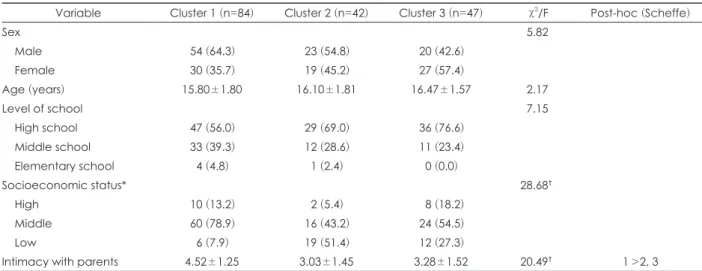
A two-step cluster analysis was performed to analyze the types of suicide among adolescents. Based on previous stud-ies, the six risk factors of adolescent suicide, namely family breakup, past suicide attempts, mental disorders, depression, anxiety, and deviant behaviors were included in the cluster analysis. First, the most appropriate number of clusters with-out hurting cluster quality was determined by considering the Akaike information criterion (AIC), Bayesian information criterion (BIC), and distance measures. This calculation helped to inform the hierarchical cluster analysis based on this was performed. With respect to AIC, BIC, and distance measures, three clusters were determined to be the most appropriate, and cluster quality was good at a silhouette measure of cohesion and separation of 0.7 [17]. The variable importance was the highest for depression, followed by family breakup, mental dis-order, anxiety, deviant behaviors, and past suicide attempts. Cluster 1 included students with no clear presentation of any risk factors (depression 0.0%, family breakup 0.0%, men-tal disorder 0.0%, anxiety 0.0%, deviant behaviors 0.0%, pre-vious suicide attempts 0.0%); this group was named the silent type. Cluster 2 had higher frequencies of family breakup and deviant behaviors than did the other groups; this group was named the environmental-risk type (depression, 16.7%; fam-ily breakup, 81.0%; mental disorder, 2.4%; anxiety, 0.0%; de-viant behaviors, 38.1%; previous suicide attempt, 0.0%). Clus-ter 3 had higher prevalences of depression, mental disorders, and previous suicide attempts relative to the other groups (de-pression, 83.0%; family breakup, 14.9%; mental disorder, 68.1%; anxiety, 42.6%; deviant behaviors, 12.8%; previous suicide at-tempts, 21.3%); this group was named the depressive type. Demographics of three clusters
The differences in the demographic data between the three clusters were analyzed using one-way ANOVA and Pearson’s chi-squared test. There were no significant differences in age between the three clusters. Regarding sex ratio, clusters 1 and 2 had a higher percentage of males, while cluster 3 had a high-er phigh-ercentage of females; none of the diffhigh-erences whigh-ere statis-tically significant. The analysis of residual structures using
Pearson residuals revealed that the three clusters were signifi-cantly different in terms of socioeconomic status: cluster 1 had a significantly lower percentage of students with a “low” socioeconomic status than did the other groups, while clus-ter 2 had a significantly higher percentage of students rated to have a “low” socioeconomic status. Table 1 shows the de-mographic characteristics of these groups.
Strengths and difficulties of three clusters
The differences in strengths and difficulties among the three clusters were analyzed using one-way ANOVA. There were no significant differences in the social orientation (strength), hyperactivity, or behavioral problems subscales (difficulties) between the three clusters. On the other hand, there were sig-nificant differences in the emotional problems and peer re-lationship problems subscales between the three clusters. The Scheffe test confirmed that cluster 3 had a significantly high-er frequency of pehigh-er relationship and emotional problems than did clusters 1 and 2. Table 2 shows the strengths and dif-ficulties of the three clusters.
School life of the three clusters
The differences in school life between the three clusters were analyzed. The three clusters differed in school
atten-dance and punishments received from school. The analysis of residual structures using Pearson residuals for a post-hoc test revealed that cluster 1 had a significantly lower percent-age of students reported to have had poor attendance due to early leave and absences relative to the other groups, while cluster 3 had a significantly higher percentage of students reported to have poor attendance due to early leave and ab-sences compared to the other groups. Regarding school pun-ishments, the percentage of students who received punishment in school was significantly lower in cluster 1 and significant-ly higher in cluster 2 than in the other groups. There were no significant differences in the percentage of students deemed to be in need of management after school-based mental health screening test: 10.4% in cluster 1, 12.5% in cluster 2, and 24.4% in cluster 3. The three clusters differed significantly in school belongingness and relationships with teachers. Scheffe’s test confirmed that clusters 1 and 2 had a higher sense of school belongingness than did cluster 3, with no significant differ-ence between clusters 1 and 2. Cluster 1 had better relation-ships with teachers than did cluster 3, with no significant dif-ferences between clusters 1 and 2 and between clusters 2 and 3. There were no significant differences between the clusters in terms of the distribution of school grades. Table 3 shows the school life-related characteristics of the three clusters.
Table 1. The demographic characteristics of cluster types
Variable Cluster 1 (n=84) Cluster 2 (n=42) Cluster 3 (n=47) χ2/F Post-hoc (Scheffe)
Sex 5.82 Male 54 (64.3) 23 (54.8) 20 (42.6) Female 30 (35.7) 19 (45.2) 27 (57.4) Age (years) 15.80±1.80 16.10±1.81 16.47±1.57 2.17 Level of school 7.15 High school 47 (56.0) 29 (69.0) 36 (76.6) Middle school 33 (39.3) 12 (28.6) 11 (23.4) Elementary school 4 (4.8) 1 (2.4) 0 (0.0) Socioeconomic status* 28.68† High 10 (13.2) 2 (5.4) 8 (18.2) Middle 60 (78.9) 16 (43.2) 24 (54.5) Low 6 (7.9) 19 (51.4) 12 (27.3)
Intimacy with parents 4.52±1.25 3.03±1.45 3.28±1.52 20.49† 1>2, 3
Data are presented as n (%) or mean±standard deviation. *the ratio of missing value is 9.20%, †p<0.001
Table 2. Strengths and difficulties among cluster types
Variables Cluster 1 (n=84) Cluster 2 (n=42) Cluster 3 (n=47) F Post-hoc (Scheffe) SDQ_prosocial behaviour 6.62 (2.12) 6.05 (2.49) 5.60 (2.46) 3.04
SDQ_hyperactivity 2.21 (2.11) 2.70 (2.14) 2.50 (1.81) 0.89
SDQ_peer problems 1.56 (1.43) 1.42 (1.10) 3.31 (2.11) 22.27* 3>1, 2 SDQ_emotioanl symptoms 1.20 (1.40) 1.79 (1.52) 4.15 (2.28) 46.01* 3>1, 2 SDQ_conduct problems 0.97 (0.10) 1.49 (1.38) 1.24 (1.25) 2.90*
Data are presented as mean (standard deviation). The ratio of missing values is 1.16%. *p<0.05. SDQ: Strengths and Difficulties Questionnaire
Circumstances preceding the time of death of the three clusters
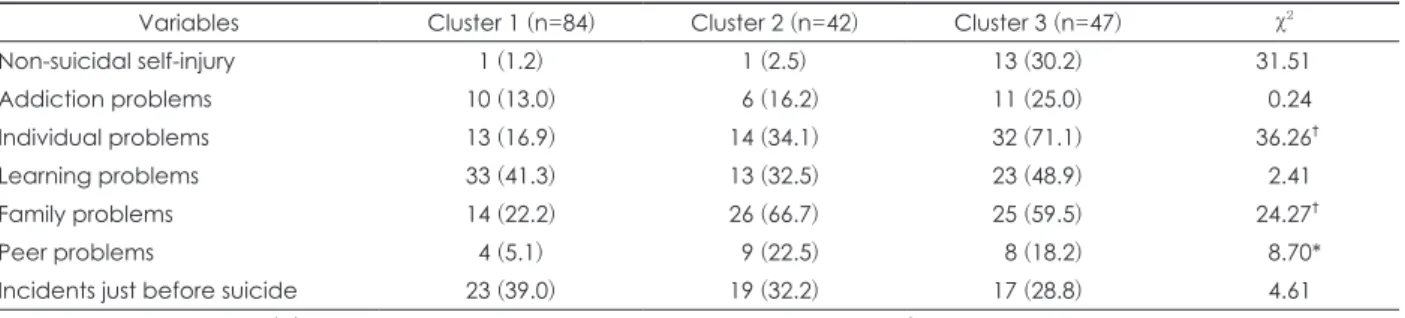
We performed Pearson’s chi-squared test to assess the pre-sentation of problems in the following five areas in the year preceding suicide: personal, addiction, family, friend, and school studies. The results showed that the three clusters dif-fered significantly in personal, family, and friend problems but not in problems related to addiction or studies. The anal-ysis of residual structures using Pearson residuals revealed that cluster 2 and cluster 3 had significantly higher rate of personal and friend problems than cluster 1, while cluster 2 had a higher rate of family problems than did the other clus-ters. Further, the results of the cluster analysis of the presence of non-suicidal self-injuries were significant. More specifi-cally, cluster 3 had a significantly higher frequency of self-injury (30.2%) than did clusters 1 and 2.
The results of the cluster analysis of the presence of evident stressful situations immediately before suicide were not sig-nificant. More specifically, 39.0% of cluster 1, 32.2% of cluster 2, and 28.8% of cluster 3 had experienced an evident stressful situation in the year preceding the suicide. The most common
stressful event in the entire sample was conflict with parents (19.2%), followed by others (5.8%), problem behaviors (3.6%), and career- and grade-related problems (3.0%). For a more detailed analysis, we performed a cluster analysis for each of the stressful events (conflict with parents, conflict with friends, dating and relationship problems, conflict with siblings, ca-reer- and grade-related events, and problem behaviors). The results confirmed that there were significant differences be-tween the three clusters in dating, relationship problems, and school punishments. Although the rate itself was low, clus-ter 2 had a significantly higher frequency of dating and rela-tionship problems and problem behaviors than did the oth-er clustoth-ers. These results are shown in Table 4.
Regarding pre-suicide warning signs, the total scores for the verbal, behavioral, and emotional sign subscales were computed and compared between the three clusters. Table 5 shows the results. The most evident warning sign in the en-tire student pool was changes in emotional state, changes in sleep, and self-depreciative words (5.2% of the sample). The three clusters differed significantly in all three signs. Scheffe’s post-hoc test confirmed that cluster 3 showed higher verbal,
Table 3. School factors among cluster types
Variables Cluster 1 (n=84) Cluster 2 (n=42) Cluster 3 (n=47) χ2/F Post-hoc (Scheffe)
Truancyn 8 (9.5) 15 (35.7) 27 (58.7) 36.04 Disciplinary 2 (2.4) 10 (23.8) 4 (8.5) 15.19 High-risk group* 8 (10.4) 5 (12.5) 10 (24.4) 4.40
Belongingness to school 3.38±0.67 3.20±0.72 2.66±0.87 14.19‡ 1, 2>3
Relationship with teacher 3.59±0.61 3.35±0.53 3.19±0.71 6.29† 1>3
Data are presented as n (%) or mean±standard deviation. Missing values are within the 0.6-8.7% range. *students who were classified as high-risk group who have mental health problems requiring intervention in nationwide school-based mental health screening test, †p<0.01, ‡p<0.001
Table 4. Differences in clinical characteristics among cluster types
Variables Cluster 1 (n=84) Cluster 2 (n=42) Cluster 3 (n=47) χ2
Non-suicidal self-injury 1 (1.2) 1 (2.5) 13 (30.2) 31.51 Addiction problems 10 (13.0) 6 (16.2) 11 (25.0) 0.24 Individual problems 13 (16.9) 14 (34.1) 32 (71.1) 36.26† Learning problems 33 (41.3) 13 (32.5) 23 (48.9) 2.41 Family problems 14 (22.2) 26 (66.7) 25 (59.5) 24.27† Peer problems 4 (5.1) 9 (22.5) 8 (18.2) 8.70* Incidents just before suicide 23 (39.0) 19 (32.2) 17 (28.8) 4.61 Data are presented as n (%). Missing values are within the 3.5-6.0% range. *p<0.05, †p<0.001
Table 5. Warning signs among cluster types
Variables Cluster 1 (n=80) Cluster 2 (n=39) Cluster 3 (n=46) F Post-hoc (scheffe) Verbal signs 0.01 (0.11) 0.05 (0.22) 0.41 (0.68) 16.95* 3>1, 2 Behavioral signs 0.03 (0.16) 0.15 (0.43) 0.60 (1.02) 14.70* 3>1, 2 Emotional signs 0.03 (0.16) 0.08 (0.27) 0.36 (0.60) 13.72* 3>1, 2 Total scores 0.06 (0.29) 0.28 (0.69) 1.39 (2.04) 20.55* 3>1, 2 Data are presented as mean (standard deviation). The ratio of missing values is 4.6%. *p<0.001
behavioral, and emotional signals than did clusters 1 and 2. There were no significant differences between clusters 1 and 2.
DISCUSSION
This study explored how student suicides can be clustered into the following three types based on six known risk factors for suicide: the silent type, which does not present any of the risk factors; the environmental-risk type, in which broken families and deviant behaviors such as smoking/drinking and running away from home are more common; and the depressive type, which is characterized by depression and the diagnosis of a mental disorder.
The first type of students lacked all of the risk factors of suicide as viewed by their teachers, and they were thus named the silent type. There were twice as many male students than female students in this group, and they had relatively good socioeconomic statuses, strong sense of high school belong-ingness, good relationships with their teachers, and had adapt-ed to school life well. Furthermore, they had no prior history of mental disorders, suicide attempts, or non-suicidal self-in-jury, and they were not involved in any stressful events during the period preceding the suicide. Unfortunately, this type of student accounted for 48.6% of the entire sample. Previous studies have also mentioned a subtype of adolescents who were not predicted to commit suicide [12,18-20]. A British study on the suicides of adolescents reported that adoles-cents who were relatively well functioning and lacked a clear history of mental disorder or previous suicide attempts com-prised 19% of their sample [19]. They mentioned that students in this group were characterized by unstable personalities, high expectations for themselves, aspirations towards perfec-tion, and tendencies to become overwhelmed by perceived failures. An Israeli school-based psychological autopsy study on adolescents who committed suicide described these ado-lescents as the “tragic narrative” type, and reported that they accounted for about 20% of suicide cases [12]. This group of adolescents was reported to experience extreme stress, have difficulties in adaptation, refrain from seeking outside help, and consider seeking help as a personal failure [12]. The per-centage of the silent type in our sample was two-fold higher than those reported by the aforementioned studies [12,19]. This finding underscores the difficulty of detecting mental health problems in schools and performing timely interven-tions to prevent suicide in this population. According to a pre-vious study, the vast majority of adolescents at risk of suicide do not seek help due to concerns about confidentiality and potential stigmatization [21]. Considering the high number of students categorized into the silent type, as well as the traits exhibited by this type, school-based supportive interventions
need to be provided to seemingly normal students without clear risk factors, and school-based suicide prevention pro-grams should include stress and emotional management, awareness of mental health problems, and reduction of stig-matization for seeking help. On one hand, it is possible that important life events that these students experienced or risk factors, such as previous suicide attempts, may not have been evident to their teachers [22]. Therefore, gatekeeper training should be provided to school staff and faculty to equip them to detect minor changes in students.
The second type accounted for 24.28% of the entire sample. These students were of a relatively low socioeconomic status compared to other types, more than 80% of the students were members of broken families, and about one-third of the stu-dents demonstrated deviant behaviors. This group was named the environmental-risk type. About 23% of these students had received punishment at school, and a substantial number of the students experienced family conflicts. Further, some stu-dents experienced problems due to their behaviors having been exposed or had dating and relationship problems around the time of their suicide. On the other hand, these students were not conspicuously depressed or anxious as observed by their teachers, had not received diagnoses for any mental dis-orders, and had no prior self-injury or suicide attempts. Past studies have reported that family breakup caused by divorce, bereavement, or separation are clear risk factors for suicide [4,5]. A Korean study also reported family breakup to be a sig-nificant risk factor for suicidal behaviors among adolescents [23]. Our study results suggest that the loss of a family mem-ber is likely to exacerbate deviant behaviors and thus expose the children to an elevated risk of suicide. Deviant behaviors are associated with aggression and impulsivity [24], and are key risk factors for suicide [25]. Considering that the depres-sive symptoms of the children in this group passed unob-served by teachers, it is possible that these students would not be identified by the screening of suicide risk based on depres-sive symptoms. In the future, closer attention should be paid to suicidal behaviors and deviant behaviors in adolescents who lost a family member, and interventions that induce psy-chological stress caused by family environments should be comprehensively considered in suicide prevention interven-tions for these students.
The third cluster accounted for 27.17% of the entire sample. Named the depressive type, this group of students was mostly comprised of adolescents who were diagnosed with a men-tal disorder, complained of depression, and had previously at-tempted suicide or committed non-suicidal self-injury prior to their suicides. These students not only frequently showed attendance problems, such as unauthorized school absences, but also had a low sense of school belonging and had poor
relationships with their teachers, thereby exhibiting markedly reduced functioning in school than did the other types of students. Furthermore, they were more likely to show clear risk signs, such as mentioning suicide or showing behavioral changes, immediately before suicide than were the other types of students. While their prior suicide attempts and non-sui-cidal self-injury were likely a means of expressing their pain, these behaviors seem to have strengthened their suicidal po-tential [26], and their failure to receive help afterwards seems to have led to suicide. The fact that they had already been diagnosed with a psychiatric disorder and that they clearly showed risk behaviors such as self-injury and suicide attempts suggests that they were the type of students whose suicidal risk would have been most likely detectable. However, the rate at which the risk signs were observed by the teachers was found to be very low in this study. This contrasts with the re-sults of a Korean psychological autopsy study, which found that 92.3% of the individuals who died from suicide exhibited warning signs within three months of their death [27]. This difference may be attributable to the person reporting the warning signs: i.e., whether the teachers or family members submitted the report. Psychological autopsy reports on fam-ily members are the result of a close analysis of lives of de-ceased and other records, but the teacher’s school suicide re-ports have practical limitations in identifying the status of suicide students in more detail. Despite the high rate of risk factors among the third type of students, our study found that warning signs were not effectively detected around the time of death, indicating the need for increased awareness of the warning signals exhibited by adolescents at high risk of suicide by the school staff and faculty, as well as families. In addition, treatment targeting suicidal risk and intensive crisis interventions are also needed.
The results of this study suggest that family breakup and mental disorders, which have been identified in association with suicide by past studies [3,4], can independently increase the risk of suicide as reflected by deviant behaviors and self-mutilation/suicide attempts, respectively. Furthermore, we observed a silent type of students who committed suicide; students in this group did not express known risk factors for suicide, and any changes in their behavior were not detected by their teachers. However, considering that the rate of men-tal disorder was relatively low in the entire sample, we also speculate that the family-risk type and silent-type students had mental disorders that had not been diagnosed or treated at the times of their death. Further, considering that many people in Korea with mental disorders do not seek aggressive treatment because they either fear stigmatization or down-play the gravity of mental health problems, there is a need for continuous effort to improve the prioritization of mental
health and reduce the stigma associated with mental disease. This study is subject to a few limitations. First, data from 75 adolescents were excluded from the analysis due to miss-ing values for major variables used in cluster analysis. The consequently reduced sample size limits the generalizability of our findings. This limitation further indicates the possi-bility that our study data, which were reported by teachers, may not have appropriately reflected the subjects’ situations and traits. Subsequent studies should integrate data from var-ious sources, including family reports, and conduct in-depth interviews. Second, the subjects were clustered based only on six risk factors–despite a variety of other candidate risk factors such as exposure to childhood trauma or a family his-tory of suicide. Nevertheless, this study is significant in that it detected various risk factors and pre-suicide signs among adolescents who committed suicide based on teachers’ reports and clustered them into different types. Another limitation of this study was that we performed the cluster analysis of the risk factors at the same time point, although the temporal dis-tance from these risk factors to suicide death might have dif-fered. Nevertheless, we presented the process through which adolescents progress to suicide and suggest that different warn-ing signs may be considered in establishwarn-ing suicide prevention interventions strategies tailored to specific possible trajectories.
CONCLUSION
This study explored how student suicides can be clustered based on the six known risk factors for suicide. Cluster anal-ysis identified three categories: the silent type, which does not present any risk factors; the environmental-risk type, in bro-ken families and deviant behaviors such as smoking/drink-ing, and running away from home are more frequent; and the depressive type, which is characterized by depression and a history of mental disorder. In the future, continuous and long-term studies are needed to identify further risk factors of suicide among adolescents.
Acknowledgments
This work was supported by the Ministry of Education of the Re-public of Korea and the National Research Foundation of Korea (NRF-2018S1A5B8A02081988).
Conflicts of Interest
The authors have no potential conflicts of interest to disclose.
Author Contributions
Resources: Hyun Ju Hong. Supervision: Yong-Sil Kweon. Writiting— original draft: Hoin Kwon. Writing—review & editing: Yong-Sil Kweon, Hyun Ju Hong.
ORCID iDs
Hyun Ju Hong https://orcid.org/0000-0002-6348-9996 Yong-Sil Kweon https://orcid.org/0000-0001-5638-6350
REFERENCES
1) World Health Organization. Suicide [cited 2020 Sep 2]. Available from URL: https://www.who.int/news-room/fact-sheets/detail/sui-cide.
2) Statistics Korea. Annual report on the cause of death statistics 2019 [cited 2020 Jul 2]. Available from URL: http://kostat.go.kr/ portal/korea/kor_nw/1/6/2/index.board?bmode=read&bSeq=&aS eq=385219&pageNo=1&rowNum=10&navCount=10&currPg=&s earchInfo=&sTarget=title&sTxt=.
3) Mann JJ, Apter A, Bertolote J, Beautrais A, Currier D, Haas A, et al. Suicide prevention strategies: a systematic review. JAMA 2005; 294:2064-2074.
4) Brent DA, Perper JA, Moritz G, Allman C, Friend A, Roth C, et al. Psychiatric risk factors for adolescent suicide: a case-control study. J Am Acad Child Adolesc Psychiatry 1993;32:521-529.
5) Gould MS, Fisher P, Parides M, Flory M, Shaffer D. Psychosocial risk factors of child and adolescent completed suicide. Arch Gen Psychiatry 1996;53:1155-1162.
6) Brent DA, Johnson BA, Perper J, Connolly J, Bridge J, Bartle S, et al. Personality disorder, personality traits, impulsive violence, and completed suicide in adolescents. J Am Acad Child Adolesc Psy-chiatry 1994;33:1080-1086.
7) Nock MK, Green JG, Hwang I, McLaughlin KA, Sampson NA, Zaslavsky AM, et al. Prevalence, correlates, and treatment of life-time suicidal behavior among adolescents: results from the Na-tional Comorbidity Survey Replication Adolescent Supplement. JAMA Psychiatry 2013;70:300-310.
8) Bentley KH, Franklin JC, Ribeiro JD, Kleiman EM, Fox KR, Nock MK. Anxiety and its disorders as risk factors for suicidal thoughts and behaviors: a meta-analytic review. Clin Psychol Rev 2016;43: 30-46.
9) Allebeck P, Allgulander C. Suicide among young men: psychiatric illness, deviant behaviour and substance abuse. Acta Psychiatr Scand 1990;81:565-570.
10) Jae YM. Suicide and psychiatric disorder. J Korean Soc Biol Ther Psychiatry 2004;10:3-10.
11) Lazear K, Roggenbaum S, Blase K. Youth suicide prevention school-based guide. Tampa, FL: Department of Child and Family Stud-ies, Division of State and Local Support, Louis de la Parte Florida Mental Health Institute, University of South Florida;2003. 12) Zalsman G, Siman Tov Y, Tzuriel D, Shoval G, Barzilay R, Tiech
Fire N, et al. Psychological autopsy of seventy high school sui-cides: combined qualitative/quantitative approach. Eur Psychiatry
2016;38:8-14.
13) Suicide and School Mental Health Institutes. 2015 School based psy-chological autopsy. Chuncheon: Suicide and School Mental Health In-stitutes;2016.
14) Suicide and School Mental Health Institutes. 2018 Student suicide death and attempt issue reports. Chuncheon: Suicide and School Men-tal Health Institutes;2019.
15) Suicide and School Mental Health Institutes. 2019 Student suicide death Report. Chuncheon: Suicide and School Mental Health Insti-tutes;2020.
16) Ahn JS, Jun SK, Han JK, Noh KS, Goodman R. The development of a Korean version of the strengths and difficulties questionnaires. J Korean Neuropsychiatr Assoc 2003;42:141-147.
17) Kaufman L, Rousseeuw PJ. Finding groups in data: an introduc-tion to cluster analysis. Hoboken, NJ: John Wiley & Sons, Inc.; 1990.
18) Beautrais AL. Suicides and serious suicide attempts: two popula-tions or one? Psychol Med 2001;31:837-845.
19) Fortune S, Stewart A, Yadav V, Hawton K. Suicide in adolescents: using life charts to understand the suicidal process. J Affect Dis-ord 2007;100:199-210.
20) Portzky G, Audenaert K, van Heeringen K. Suicide among ado-lescents. A psychological autopsy study of psychiatric, psychoso-cial and personality-related risk factors. Soc Psychiatry Psychiatr Epidemiol 2005;40:922-930.
21) Hawton K, Rodham K, Evans E, Weatherall R. Deliberate self harm in adolescents: self report survey in schools in England. BMJ 2002;325:1207-1211.
22) Hawton K, Saunders KE, O’Connor RC. Self-harm and suicide in adolescents. Lancet 2012;379:2373-2382.
23) Kwon H, Lee JS, Kim AR, Hong HJ, Kweon YS. Risk factors for suicidal ideation and attempts in adolescents. J Korean Acad Child Adolesc Psychiatry 2018;29:114-121.
24) Bukstein OG, Brent DA, Perper JA, Moritz G, Baugher M, Schweers J, et al. Risk factors for completed suicide among adolescents with a lifetime history of substance abuse: a case-control study. Acta Psychiatr Scand 1993;88:403-408.
25) Renaud J, Berlim MT, McGirr A, Tousignant M, Turecki G. Cur-rent psychiatric morbidity, aggression/impulsivity, and personality dimensions in child and adolescent suicide: a case-control study. J Affect Disord 2008;105:221-228.
26) Joiner TE, Van Orden KA. The interpersonal psychological theory of suicidal behavior indicates specific and crucial psychothera-peutic targets. Int J Cogn Ther 2008;1:80-89.
27) Korea psychological autopsy center. Psychological interview report [cited 2020 Jul 2]. Available from URL: http://www.psyauto.or.kr/ sub/data_02.asp.