1. INTRODUCTION
Face detection plays an important role in face recognition, video surveillance, and human computer interface. Today, a study for the effective block up an outward flow of information is topic of conversation. Biological recognition recognizes each person by distinct characteristic such as fingerprint, iris, retina, voice or face. Face recognition doesn’t need to contact with recognition machine and also doesn’t need to pose a special action. By the reasons face recognition shows the least rejection symptoms in all of the biological recognitions [1].The typical three applicable parts are security in the face recognition, manless observation system, and HCI (human computer interface). Security system is used in a safe, gate, and member management. Manless observation system is applied to apartment, airport, and crimeridden area. HCI is applied to gauge board control, electric home appliances, and internet decision. It is big problem that the accuracy of face recognition is very sensitive to face’s angle, intensity, and pose, but its demand is growing now because of convenience and effectiveness. Most of researches that are operating now are focused on solving those kinds of problems, and various researches are still needed. When face recognition was tried first, face detection was considered just as preprocessing part of recognition, but now detection is separated from face recognition, because it is very important and complicate problem. Many researches are using similar sized front facial images for face recognition recently, but practically the front facial image will not be satisfied due to the change of facial shape and environment condition by nature [2]. The image which is demanded to be recognized can have complex background and also faces located at different position. The face recognition efficiency depends upon accuracy of face detection, so detection is very important part of face recognition. Face detection is defined as finding the minimized area that includes the face. The goal of researches of face detection is to find the method which is independent from the change of face such as race, sex, age, and motion of face and that of circumstance for example background, illumination, and accessories. The method [3], [4] which is transforms color information into HSV(hue saturation velocity) space and then using skin color information and the priori knowledge [5], [6], [7] based method which is using eye location are famous face detection methods. Above and beyond these methods, the method [8] using skin color for input of neural network and the method [9] using second order
Gaussian density function are also used for face detection. This research intends to realize real time face recognition system for analyzing the efficiency of face detection and recognition. We explain eye detection algorithm with progressive thresholding in section 2. We explain face detection algorithm using skin color segmentation in section 3. The section 4 is the result of experiment and the last section is conclusion.
2. PROGRASSIVE THRESHOLDING
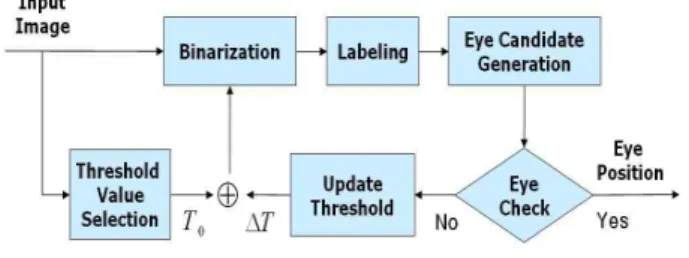
The brightness of the pupil of eyes is usually lower in the grayscale image than those of the skin and those of the white region of the eye. So, if we can find an appropriate threshold value the eyes can be separated from other facial features in the face. Fig. 1 is the block diagram of eye detection using progressive thresholding.Fig. 1 Block diagram of eye detection. 2.1 Threshold value selection
Because the pupil is generally appeared in the low intensity of the face, it is important that selecting the optimal threshold value. The eye detection is first performed by using binarization with the optimal threshold value. We define the range of the optimal threshold value. The optimal minimum value T0 is 5% of the low accumulated histogram and the optimal maximum threshold value Tmax is 50%.
If locating eyes is failed after performing binarization with the optimal minimum threshold value and generating the eye candidates, the above process will be iteratively operated with the progressive increase of the threshold value until detecting eyes. In this paper, an interval of its increase is∆T =5. The
Face Detection by Eye Detection with Progressive Thresholding
Ji-Moon Jung
*, Tae-Chul Kim
*, Eun-Young Wie
*and Ki-Gon Nam
** * Department of Electrical Engineering, Pusan University, Pusan, Korea(Tel : +82-51-323-2301; E-mail: [email protected])
** Department of Electrical Engineering, Pusan University, Pusan, Korea (Tel : +81-51-510-2433; E-mail: [email protected])
Abstract: Face detection plays an important role in face recognition, video surveillance, and human computer interface. In this paper, we present a face detection system using eye detection with progressive thresholding from a digital camera. The face candidate is detected by using skin color segmentation in the YCbCr color space. The face candidates are verified by detecting the eyes that is located by iterative thresholding and correlation coefficients. Preprocessing includes histogram equalization, log transformation, and gray-scale morphology for the emphasized eyes image. The distance of the eye candidate points generated by the progressive increasing threshold value is employed to extract the facial region. The process of the face detection is repeated by using the increasing threshold value. Experimental results show that more enhanced face detection in real time.
progressive increasing threshold value can be denoted by Eq. (1) T i T Ti = 0+ ×∆
(1)
where T0 ≤Ti ≤TmaxFig. 2 shows an arbitrary image histogram and the selection of threshold value range.
Fig. 2 Selection of threshold value range.
After selecting the threshold value of Eq. (1), the eyes can be separated from other facial features producing the binary image with following equation.
≤ = otherwise T y x I if y x I In i B 0 ) , ( 1 ) , ( (2) Where,
I
In( y
x
,
)
is the pixel value of input image and Tiis the progressive increasing threshold value in the range from 0
T
toT
max.2.2 Generation of eye candidate blocks
In order to generate the blocks of eye candidate, the connected component labeling is applied to the binary image and then morphological operation is applied to the labeling image [10]. Each connected component is the eye candidate block and the centroid point of it is the eye point of the eye candidate. The centroid point is calculated by the total number of pixels in the connected component and the summation of the position values in it. The centroid point is denoted by
× = × = =
∑
∑
L L L L L y N y x N x y x P 1 1 ) , ( (3)Where, PL( yx, ) is the centroid point of each eye candidate block, N is the total number of pixels and L
both
∑
L
x and
∑
yLare the summation of the coordinatesvalue(x, y) in the pixels. The number and the position of each block are used to extract eye position in the step of eye position decision. Fig. 3 shows the process of generating eye candidate blocks.
Fig. 3 Process of generating eye candidate blocks. 2.3 Decision of eye position
In order to decide eye position, we use the priori knowledge of geometrical facial features and normalized cross-correlation coefficient (for short NCC). All blocks and the centroid points of those are checked to satisfy the priori knowledge. With the association satisfying the priori knowledge, correlation coefficient is calculated by NCC [11]. If we find the eye candidates corresponding to maximum correlation coefficient, they will be taken as true eyes. The priori knowledge is used to find eye candidates. Table 1 shows a priori knowledge for eye detection.
Table 1 Priori knowledge.
A The pixel number in each eye block is limited in a certain range
B There is no other block between the two eye blocks C The shape of each eye block is similar to a circular D Any block connected with or very close to the four
edges of facial images is not an eye block
E There is no other block in a certain area under each eye
F The vertical distance difference between the geometrical centers of the two eye blocks is not more than a certain number of pixels
G The distance between the geometrical centers of the two eye blocks should be within a certain range of pixel number such as from 20 pixels to 60 pixels Because of the symmetrical construction of face, the both sides of face are similar. The correlation coefficient is used as a similarity measure to identify eyes. Two arbitrary blocksB ,n Bm are sub-images for the left eye and the right eye, and they are compared for the correlation coefficient.
[
][
]
[
]
[
]
∑∑
∑∑
∑∑
− = − = − = − = − = − = − − − − = 1 0 1 0 1 0 1 0 2 2 1 0 1 0 ) , ( ) , ( ) , ( ) , ( M m N n M m N n R R L L M m N n R R L L B n m B A n m A B n m B A n m A r (4)Where,
A
L andA
R are sub-image of left eye and right eye,R
B
is a sub-image flipped byA
R into left direction.A
L andB
R are the mean values ofA
LandB
R.Fig. 4 shows the association of two eye candidates satisfying the priori knowledge. The block
B
5 is excepted from the eye candidates due to not satisfying a priori knowledge. The others are satisfying the priori knowledge and are compared. The correlation coefficients of them are calculated using normalized cross-correlation coefficient and then eye candidates have the connected component coefficient. After sorting correlation coefficients in descending order, the maximum correlation coefficient decides true eyes of all eye candidates. The connected component coefficient)
,
,
,
(
n m nm nm nmP
P
r
W
θ
consists of the centroid pointsPn,Pm, the degreeθ
nm between the horizontal line and the line of two centroid points and correlation coefficientr
nm. It is used to normalize detected face. Table 2 displays eye candidate and their connected component coefficient.Fig. 4 Association of each block.
Table 2 Eye candidate point by correlation coefficient.
3. FACE DETECTION
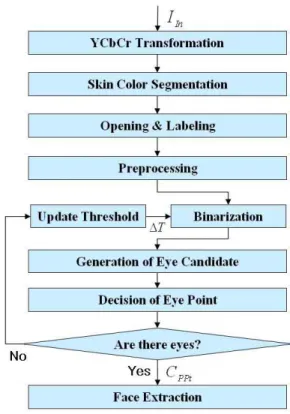
Face detection consists of skin color analysis for face candidate and eye detection for face extraction. Fig. 5 shows the flow chart of proposed face detection system. For face detection, we use feature based method (using skin color) and priori knowledge method (eyes detection). The concept that find face candidates by using skin color focus on the fact that most of skin color have specific area in color images. This method transforms RGB color space into YCbCr color space and detect skin color region of CbCr. Skin color method have good efficiency even if size and direction of face are changed, but the existence of an object which have skin color make the accuracy of detection worse. The skin color method can just help to find the candidates of face. It shows outstanding processing speed. YCbCr color space is used for skin color segmentation because of a little influence of illumination. In order to reduce face candidates, we use information of
geometric facial features and we can only segment optimal face candidate at the complex background.
Fig. 5 The flow chart of proposed face detection system. 3.1 Skin color analysis
In YCbCr color space, skin color region is displayed in the red region of fig. 6. The ellipse in the fig. 6(b) is used to segment face candidates for skin color filter [12].
Fig. 6 Skin color region of the YCbCr color space. (a) YCbCr color space, (b) CbCr color space The skin color region which was detected by color filtering has to separate to 1 and 0 by using the Eq. (4).
≤ − + − = otherwise b y y a x x if j i S 0 1 ) ( ) ( 1 ) , ( 2 2 0 2 2 0 (4)
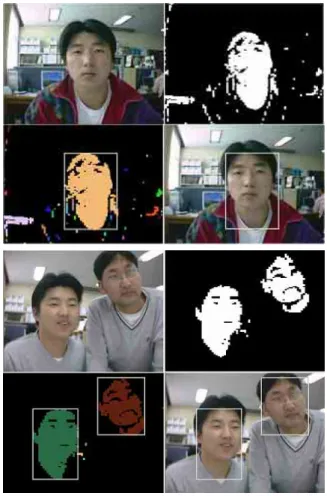
The binary image includes so many noise factor that it need to reject the noise by opening operation. After that, we operate connected component labeling [13] for classifying the face candidate region. The face candidate region is classified by edge contacted square and be reduced by priori knowledge for the size of candidate and number of inside pixels. Fig. 7
4 P 1 B 2 P 2 B 3 P B3 4 B 12 W 23 W 34 W 14 W W13 24 W 1 P θ12 5 P B5
represents image of each step for finding face candidate region.
Fig. 7 Face candidate detection.
Input image, skin color segmented and opening image, labeling image and face candidate images 3.2 Eye detection
Eye detection is used for verifying that the detected face candidate is real face or not. The eye detection method follows next sequence. First of all, define general priori knowledge for the feature of eyes. Put the Y components of image as input. Operate preprocessing of input image for robust face detection. Preprocessing includes histogram equalization, log transformation, and gray-scale morphology emphasize eyes image. Fig 8 represents result images and histogram of preprocessing sequences.
We find optimized minimum and maximum threshold value from the histogram of image. As increasing the threshold from minimum to maximum value, we acquire different binary image. Fig. 5 shows each binary image of different threshold value
This area is been grouping by labeling and becomes eye candidate block for eye detection. We find the center of mass of eyes candidate which come from different threshold. We confirm each of them satisfy the priori knowledge and combine all centroid of eyes candidate block. We calculate normalized cross-correlation coefficient for the combination which satisfy the priori knowledge. We sort correlation coefficient r in descending order and send the eyes with maximum correlation coefficient r to face detection step.
3
(a) (b) (c) Fig. 8 Example of Preprocessing results and histogram.
(a) Input image and histogram,
(b) Histogram equalization image and histogram, (c) Log transformation image and histogram
Fig. 5 Binary image about increasing threshold value. 3.3 Face extraction
In face extraction step, we normalize preprocessed face image for the input image of face recognition step.
Fig.9 Process of image normalization.
Fig. 9 shows image normalization steps. First, we rotate preprocessing image by rotation matrix and make a match of eyes. For adjustion the size of input image to database image,
nm θ n P m P 2 L L 2 3L 2 L 2 L
we cut suitable size of up, down, left, and right of the image using the length between eyes.
Each person have the different length between eyes, so that it is possible to think losing personal feature by normalize the image size using length between eyes, but if we normalize the image size according to the length between eyes, face area and the length between each feature point are different. We can still get personal feature by normalized images.
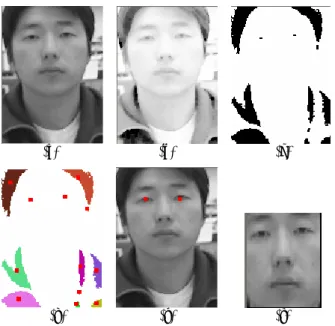
Fig. 10 shows the steps from face candidate to face detection.
(a) (b) (c)
(d) (e) (f) Fig. 10 Results of Eye detection.
(a) Face candidate (b) Preprocessing image (c)Binary image (d) Labeling image (e) Eye detected image (f) Normalized face
4. EXPERIMENTAL RESULTS
The face detection system is tested with images captured by a web camera in real time. The frame size is 240
×
320 pixels and Fig .11 shows the results of experiment in real time. Fig. 11(a) is tested with image not wearing classes at night and fig. 11(b) is tested with image wearing glasses in a day.(a)
(b)
Fig. 11 Experimental results of face detection. (a) Image wearing classes at night (b) Image not wearing classes in a day
5. CONCLUSIONS
In this paper, we proposed the face detection for the real time application. We use YCbCr color space for finding face candidate without illumination influence. We add histogram equalization, log transformation, and grayscale morphology to general eyes detection algorithm. Using the iterative threshold we detect eyes. By the proposed preprocessing steps, we can acquire more accurate face area from images.
As a result of experiment, proposed face detection method can detect more accurate than general one. For the future we will concentrate on solving the problems such as interception of eyes, face angle variation, and pose changes. Development of local feature extraction algorithm is also need for good recognition system. If local feature and geometric information are added we can realize more powerful recognition system using less information.
ACKNOWLEDGMENTS
This work was supported by "Research Center for Logistics Information Technology (LIT)" hosted by the Ministry of Education & Human Resources Development in Korea.
REFERENCES
[1] T. Fromherz, P. Stucki and M. Bichsel, “A survey of Face Recognition of faces: A Survey”, MML Technical Report, No. 99.01, Dept. of Computer Science, University of Zurich, 1997.
[2] E. Hjelmas and B. K. Low, "Face Detection: A survey,"
Computer Vision and Image Understanding, vol. 83, no.
3, pp. 236-274, Sep. 2001.
[3] S. Matsuhashi and O. Nakamura, "Human-face extraction using modified HSV color system and personal identification through facial Image based on isodensity maps," Canadian Conf. on Elec. and Comp.
Eng. '95, vol. 2, pp. 909-912, Sep. 1995.
[4] H. Wu, Q. Chen and M. Yachida, "Face Detection and Rotations Estimating using Color Information," 5th
IEEE Int. Workshop on Robot and Human Communication, pp. 341-346, Nov. 1996.
[5] L. Zhang and P. Lenders, "Knowledge-Based Eye Detection for Human Face Recognition," Fourth Int.
Conf. on Knowledge-based Intelligent Systems and Allied Technologies, vol. 1, pp. 117-120, 2000.
[6] Liang Tao and H. K. Kwan, "Automatic localization of human eyes in complex background," IEEE Int. Symp.
on Circuits and Systems '02, vol. 5, pp. 669-672, 2002.
[7] H. Han, T. Kawaguchi and R. Nagata, "Eye Detection Based on Grayscale Morphology," IEEE Region 10
Conf. on Computer, Communications, Control and Power Eng., vol. 1, pp. 498-502, Oct. 2002.
[8] H. Ishii and M. Fukumi, "Face detection based on skin color information in visual scenes by neural networks,"
IEEE Int. Conf. on Systems, Man, and Cybernetics, vol.
5, pp. 350-355, 1999.
[9] B. Moghaddam and A. Pentland, "Probabilistic Visual Learning for Object Representation," IEEE Trans. on
PAMI, vol. 19, pp. 696-710, Jul. 1997.
[10] L. G. Shapiro, G. C. Stockman, Computer Vision, USA: Prentice Hall, 2001.
[11] Liang Tao and H. K. Kwan, "Automatic localization of human eyes in complex background," IEEE Int. Symp.
on Circuits and Systems '02, vol. 5, pp. 669-672, 2002.
[12] R. L. Hsu, M. Abdel-Mottaleb, and A. K. Jain, "Face detection in color images," IEEE Trans. on PAMI, vol. 24, no. 5, pp.696-706, May 2002..